
Showing posts with label guest post. Show all posts
Showing posts with label guest post. Show all posts
09 December 2010
Two Hot Chicks for Christmas
I can't believe I forgot to post this announcement today! I am guest posting over at Book Journey while Sheila is away for some Christmas joy-spreading.
Click the pick to check out the post, and be sure to browse around the rest of Sheila's site as she is one awesome blogger!


30 September 2010
Guest Post: Ana Means A Lot
One of my favorite bloggers is Ana from things mean a lot. She writes intelligent and interesting reviews, she always adds to my TBR pile/wish list, and she is one of the nicest in the blogosphere. Since Ana is busy with moving, I agreed to write up a guest post for her today. Head on over and check out my post on Reading Creatively aka Yes! That's What I'm Talking About!
21 August 2010
Guest Post: Sheila's Fun with Festivals

I am currently buried under family members, food, festival, and fun, so some kind bloggers have graciously agreed to guest post here on eclectic / eccentric.
Today, the lovely Sheila of Book Journey shares stories of small town festivals with you. We thought this would be a great post since the whole reason I'm MIA is my family reunion which takes place during my hometown's annual Glad Fest, short for Gladiolus Festival.
~~~~~~~~~~~~~~~~~~~~~~~~~~~~~
Hi everyone! I'm back to share with you a little taste of Minnesota and festivals. Minnesota summers and fall are huge festival times. I am not sure if it is like this in every state, but if Minnesota can come up with a way to celebrate - they will do it. I being an adventure type girl love experiencing some of these events so thought I would share a little Minnesota with you today in the event you ever travel to my corner of the world.
Minnesota celebrates the sunny days - and you can find bands and concerts of all sorts any weekend from June - September. Craft fairs, Fisherman's Weekend events, Dragon Boat races.... you can find it in Minnesota.
 One of my favorite Festivals is the Renaissance Festival. If you have one of these in your home state you must take the time to attend. The Renaissance Fair is like stepping back into another time period, as a book lover, I like that a lot! The costumes, the talking, the shows... all a magical event. My girlfriends and I try to get to the festival every other year and this is an on year so you know there will be pictures!
One festival I have always wanted to go to but have yet to make it is the Beanhole Days in Pequot Minnesota. Apparently, as I am told, beans are placed in large kettles on a fire and buried under ground. The festival is the rising of the beans (seriously, I couldn't make this stuff up if I tried!). The beans are served by volunteers to the awaiting crowds.


Driving home from a bridal shower last weekend I saw a sign that said Worm Races. I am not really sure what that is about.
My husband grew up in Finland Minnesota and we now have a cabin in that area where we go as often as we can to just chill out. Every summer I take my friends and we go to the cabin for the weekend and experience Silver Bay/Beaver Bay Days, which is a festival of small town proportion. Street merchants, book sale, big weekend breakfast at the fire station and street dances. It is a tradition that I have attended the past 4 years and we have a blast. If we are feeling super energetic, the same weekend in Ely Minnesota is the annual Blueberry Festival. This is a large arts and crafts fair and bake sale. oddly last year when we attended we did not see one blueberry. Not in a pie, a muffin, or even in a single berry form. LOL
Ok, lets not forget the Pig Races of Leader, Minnesota. I have experienced this once with my friends and it is definitely a small town experience but people come from all over to bet on these pigs every weekend.

I could obviously go on and on about Minnesota festivals but I have highlighted here a few that I really think are awesome. I would love to know what sort of festivals do you have where you live? (You never know- I may need to road trip!)
20 August 2010
Guest Post: Rebecca the Mistress of Trivial Pursuit
I am currently buried under family members, food, festival, and fun, so some kind bloggers have graciously agreed to guest post here on eclectic / eccentric.
Today, the lovely Rebecca of Lost in Books discusses the positives and negatives of being an eclectic reader!
~~~~~~~~~~~~~~~~~~~~~~~~~~~~~
When Trisha asked for guest posts about being an eclectic reader all I could think was- awesome. Because I am definitely an eclectic reader. I read nearly every type of book there is- fiction and nonfiction. I find it way more interesting and plus it keeps my A.D.D. brain stimulated.
I love lists so I thought I would put together a list of what I personally feel are the advantages and disadvantages of being an eclectic reader.
REASON TO LOVE IT:
1. So one reason I love being an eclectic reader is that it never gets boring. You can always switch it up. Not in the mood for a mystery? Grab some chick lit. Not in the mood for chick lit? Grab some literary fiction. Not in the mood for literary fiction? Grab a fantasy book. It’s always something different. It really suits my needs for constant mental stimulation, originality, and learning. Since I have A.D.D., I would never have found a love for reading if I had to stick with only two or three genres. I get bored way too easily, as anyone who knows how many books I read at a time can testify.
FLIP SIDE:
I can read 5 books at a time, especially if they are in different genres. I always get comments about how can I do this. I can’t focus or keep my attention on anything for very long, no matter how interesting it is. Also, I can keep my stories pretty straight because it would be hard to mix up Melissa de la Cruz’s Blue Bloods with David Sedaris’ Naked and Sandra Dallas’ Prayers for Sale. But the problem with reading 5 books at a time is it takes for-ever to finish one. I can’t sit down and finish a book in a day or sometimes even a week or two weeks. In that way, it does seem like it drags on, but I get bored reading the same story for too long just as I do when watching movies that are over 120 minutes.
REASON TO LOVE IT:
2. You never run out of books to read. My TBR list is thousands of books long. There is never a shortage of books I want to pick up or only a handful left like there might be if I was only into crime fiction, for example. Also it is easy to find books for others to borrow. So my best friend, my mother, my sisters, my girlfriends, my guy friends, my boyfriends, and the ladies who clean my mother’s house all can find something they want to borrow and read. (As long as they bring it back, of course.)
FLIP SIDE:
My TBR list is out of control. There are so many books I want to read and there will never be time enough to read them all. How to choose? I have to try to pick the best of the bunch and rely on the reviews and opinions of readers I trust, like Trisha, who often have similar views to mine on books. But there is not as much guilt about putting down a book I am not into because there are just too many fish in the sea to be stuck with the equivalent of sardines. Plus I can always find a new home for it.

REASON TO LOVE IT:
3. I am a well-rounded reader. Like a liberal arts education, I learn a little bit of everything through reading, even through fiction. I have learned about forensics, history, various cultures, religions, police procedures, the arts, politics, you name it. I am not specialized and boxed in, if you will. I can talk about the value of reading classic novels, the best reads on Indian culture, and I can discuss who writes better chick lit- Sarah Dessen, Emily Giffin, or Lauren Weisberger.
FLIP SIDE:
It’s kind of like being a jack of all trades, master of none. I’m sort of like the general, family physician to the neurologists, pediatricians, and dermatologists. They know a lot about one thing, while I know a little about a lot. While historical fiction fans are comparing all of the Austen sequels/remakes, I can only comment on a few and while the paranormal fans are debating the pros and cons of different vampire series, I have only read a couple of books in a couple of series. So while I am not going to be an expert in any genre or have a niche, I could totally kick butt in Trivial Pursuit. :P
REASON TO LOVE IT:
4. Being an eclectic book reviewer means I seek out a variety of book blogs to read, as I want to hear about a variety of books. In doing so I have met a lot of very cool bloggers, some of whom I consider my friends and not just acquaintances, though I haven’t “met” anyone I haven’t liked. I have found so many blogs I like to visit and read, and the cool people that go with them are an added bonus.
FLIP SIDE:
I have found so many blogs I like to visit and read. LOL. My Google Reader is in constant danger of swallowing me alive! I want to read the eclectic blogs, the historical fiction blogs, the urban fantasy/paranormal blogs, the cultural-centric blogs, the nonfiction blogs. And because I have met so many great bloggers and blogs I don’t want to leave anyone out or miss out on anything and that is, quite frankly, overwhelming. Not to mention impossible. It’s not that I don’t want to read everyone’s blog, just that I am only one person and I just can’t get to every blog every day- or even every week. I wish I could cause I would SO be there. And sometimes I am reading, I just don’t always comment, especially if something incredibly profound or witty doesn’t strike me because otherwise I wouldn’t even get to as many posts and blogs as I do now.
So, there are the pluses and minuses of being an eclectic reader, in my opinion. But if you ask me, the pluses totally outweigh the minuses. I really love being an eclectic reader.
Now I want to know what you think:
Are you an eclectic reader? What are the advantages or disadvantages to you? Do you agree or disagree with my personal list? Do you wish you were more or less eclectic, or that you are right where you want to be?
19 August 2010
Guest Post: Sandy and Carlos Sitting in a Tree
I am currently buried under family members, food, festival, and fun, so some kind bloggers have graciously agreed to guest post here on eclectic / eccentric.
Today, Sandy from You've Gotta Read This shares with you her thoughts on The Shadow of the Wind by Carlos Ruiz Zafon.
~~~~~~~~~~~~~~~~~~~~~~~~
Listening to this book has been long in coming. As usual, I felt I was the last to read it, and had heard dozens of bloggers raving about its sultry, atmospheric content. I ordered it on audio from the library, quickly uploaded it, then realized it was short one disc. The library accused me of losing it, I had to accuse them of being Communists, and it got ugly before my honor was restored. Then of course, once the dust settled, I had to order it again, in order to upload the missing disc. Three months later, here I am.
It was not a short audio...17 discs. But what a tale. I find myself almost dreading the task of summarizing my thoughts. I hope I can do it justice, as it has the makings of a true classic. It is a story about book lovers for book lovers, which I believe is why it has touched the hearts of so many of you.
Tween-aged Daniel and his father live in pre-WWII Barcelona where they own and run a bookstore. Daniel's mother has recently died, and to ease Daniel's pain, his father takes him to the Cemetery of Forgotten Books, a library of old, forgotten but preserved texts. Promising never to tell another soul, Daniel is allowed to choose one book, provided he vows to adopt and protect the book for life. Daniel chooses the book "Shadow of the Wind" by Julian Carax. The book captures his imagination, and soon Daniel attempts to find out more about the mysterious author. No one seems to know the fate of Carax, except that all of his books (except Daniel's) have been absconded and burned by a shadowy, disfigured man named Lain Coubert. The name Coubert just happens to be a character from one of Carax's stories; a character that represents the Devil.

Daniel befriends a homeless war veteran, Fermin Romero de Torres, who begins to work in the bookstore. Fermin and Daniel begin to investigate the life of Carax in earnest, and find themselves dragged down a dark path of no return. They come face-to-face with the author's life of sadness, fear, passion, friendships, unrequited love, bitterness and revenge. The lines between Carax's life and Daniel's life seem amazingly parallel and begin to blur, to the point where I even began to get confused whose life we were reading about. Daniel and Fermin's efforts become less a fact-finding mission and more a life-threatening situation when they butt heads with Carax's childhood friend turned mortal enemy, the murderous Francisco Javier Fumero.
There were many visuals that this story conjured in my mind's eye, the very best of them the Cemetery of Forgotten Books. Doesn't your literary heart just long to see something like this? You can almost imagine the unearthly stillness, the smell of old paper, and the thousands of lovingly protected stories kept there. The characters in this tale are larger than life, caricatures almost. I received the most pleasure and entertainment from Fermin Romero de Torres, a slightly off-center, passionate man, haunted by the past but determined to live life to its absolute fullest, with vigor. He reminded me so much of my father-in-law. The tale would also win an award for the most detestable, the most evil antagonist with Fumero. My skin crawled every time he spoke.
I must spend a little time talking about the audio production. The narrator, Jonathan Davis, was perfection. His voice is professionally neutral at one moment, the next moment the Spanish names and places and streets of Barcelona are rolling off his tongue as if it is his native language. He embodies a youthful voice for Daniel, an animated, expressive, Spanish-accented one for Fermin, and a maniacal, spine-chilling one for Fumero. And intermittently throughout the production, we are treated with beautiful, haunting piano music written by the author himself. Have a listen:
So if you haven't read this book yet, have I convinced you? If you have read it, have I done it justice? This is one of those rare books that transport you to a different country, a different time, to the point where you will forget where you are. It is a tale of mystery and passion and misfortune - it could rival a Shakespearean tragedy. Yet, it never loses its charm and beauty.
5 out of 5 stars
18 August 2010
Guest Post: Amy of the Useless and Obscure Facts
I am currently buried under family members, food, festival, and fun, so some kind bloggers have graciously agreed to guest post here on eclectic / eccentric.
Today, Amy from Amy Reads shares with you her thoughts on reading eclectically.
~~~~~~~~~~~~~~~~~~~~~~~~
When Trisha sent out a request for guest posts I immediately felt flattered and excited to have been asked. Wow, I thought, I’ve never done a guest post before! Then I sat down and wondered what I could write about. Thankfully, Trisha also included a list of possible topics to discuss. One of those topics made me think of something really relevant to her and her blog, and also to me and my blog, Amy Reads.
The topic I choose to discuss today is why I read eclectically (and the benefits of doing so).
If you’ve seen my blog you may have noticed that I read an odd mix of books. If you haven’t, no worries, I’ll explain. I read some young adult – mainly urban fantasy / dystopian / paranormal, but also some based more on real life. I read some fiction – translated and international fiction, the occasional classics, some bestsellers, some odd random ones that I find at second hand bookstores. I read some non-fiction – women’s issues, biographies, gender studies, race and cultural studies, human rights textbooks, narrative non-fiction on just about any subject, bestsellers, obscure titles, anything I can get my hands on, really.
That is quite the mix. People often ask me why I read such a wide variety. The thing is, I don’t know how people can possibly always read the same thing. Reading eclectically is the only way I can do it.
Today I might feel like reading a biography, tomorrow I might want to read something about bees, the next day I might want to read that novel I found by that Croatian author I’ve heard so much about. Often times I will read a book and get started on a trend. Currently, for example, I’ve read 2 books by Nigerian authors in a row. I will read a book and if there is a bibliography I will go off on a reading tangent of similar books or just books on the same topic. But then I’ll get sick of that topic and switch to something completely different. Or the latest book I read will mention something else, like a Nigerian book about twins that mentions religious violence that makes me think of a non-fiction book about religious violence on my review pile, and I decide to go off and read it next.
If I try to force myself to read any particular book, I might love it, I might just get more and more frustrated. I’ve learned that it is better to let my mind decide what it wants each day than to force a book on myself. It is hard to guarantee what I will want to read next at any given time. (The obvious solution is to have piles and piles of books to be read that you can sift through whenever the mood hits you for any random obscure topic. Which is, of course, exactly what I have, thank goodness!)

In my mind, the better question is how, exactly, do you always read the same thing? Don’t you get bored? Don’t you ever need a change of pace, of scenery, of topic? I want to know, what is your take on eclectic reading?
17 August 2010
Guest Post: Sandy and James Discuss Blindness (film)
I am currently buried under family members, food, festival, and fun, so some kind bloggers have graciously agreed to guest post here on eclectic / eccentric.
Today, James of Ready When You Are C.B. and Sandy of You've Gotta Read This discuss the film version of Blindness. Check out yesterday's post for the discussion of the book!
~~~~~~~~~~~~~~~~~~~~~~~~~~~~
From Sandy:
A while back, C.B. James of Ready When You Are C.B. and I decided it would be fun to both read Blindness by Jose Saramago, watch the corresponding movie, and review both via a transcontinental "discussion".
 Here is what we had to say about the film:
Sandy: Even though I had just finished the novel and was blown away by it all, I admit I was not all that eager to watch the movie version. I liked the sound of the casting…Julianne Moore, Danny Glover, Mark Ruffalo, and the yummy Gael Garcia Bernal. But the movie was ripped apart and digested by the critics. Before I pressed “Play”, I mused…with the exception of the doctor’s wife, everyone in the story is blind. How on earth are they going to pull it off? How will they accurately portray the horror, the chaos, the deplorable overwhelming filth? I knew I needed to evaluate the film on two levels. First, did the film accurately translate from page to silver screen? Second, does the movie stand on its own if you didn’t read the book?
James: I just finished watching the movie ten minutes ago. After we spent so much time discussing the book, I was eager to see the movie. I liked how the movie depicted being blind - the way the actors and the setting kept coming in and out of focus, in and out of whiteness. It made the viewer one of the blind. Many cheesy horror movies in the 1970's used "killer cam," filming a scene as though the camera was the killer. Blindness used a similar "blind cam" by using visual images that made the camera, and by extension the viewer, blind.
Sandy: I loved the “blind cam”. It made me feel almost claustrophobic, which I think was the point. A movie critic I am not, but I thought the director, Fernando Meirelles, did a respectable job of literally translating a dense, disturbing book to an audio visual experience. Most of the significant scenes in the book weren’t missed. Like you said, we saw what the blind saw (a milky whiteness), tension and filth and naked bodies abound, it was truly horrific to see it come to life. Which is exactly the way it should be.
 James: Just to give everyone an example, there is one scene where a blind boy walks towards the camera along what should be a clear path. We don't see anything in his way. Suddenly there is a loud crash and we see a table materialize, and the boy runs into it. As for portraying how horrible the blind world becomes, the movie did a very good job of this, too. I was worried about the scene where the women in ward #1 are summoned to the thugs’ ward. This was not something I wanted to watch. If I were an actress, I could imagine refusing to do that scene, but it was well-handled. If the movie went to the extremes that the book did, showing the day-to-day horror of life in the hospital, it would have been unwatchable. Reading these images is one thing, but seeing them is another matter. All of this said, the answer to your first question would be “yes”. My only quibble with the book-to-movie translation was that the movie implied that circumstances greatly improved once they left the hospital. But I guess one cannot include an entire book in a single movie.
Sandy: To answer my second question (does the movie stand on its own?), I’m pretty sure the movie would not carry its weight, had I not the insight from the novel. There were plenty of unanswered questions in the novel, but even more so in the film. Film can only communicate so much in a 2 hour time span. The director kept the action moving along, and spent less time on the cerebral intensity and ambiguity. Cerebral ponderings don’t fill seats in the theater, after all.
James: I had no problem answering your first question (did the film accurately translate from film to screen?), but I'm not so sure about your second question. When a woman (I'd lost track of who she was by the time she did it) sets fire to the thugs’ ward, I asked myself where the lighter came from, then recalled the answer from the book. There were a few too many moments like that. Reading the book first helped, which is not a good sign for a movie.
Sandy: No it isn’t. If I hadn’t read the book, I definitely would have been confused. Did you notice that in the book, about half of the pages were dedicated to the hospital quarantine, and the other half dedicated to surviving in the “free” world. The movie, on the other hand, invested all but a half hour to the hospital scenes. I suppose a studio would visualize more Hollywood moments in the hospital, PLUS it is a contained set. I was a little disappointed with this choice of pacing. I think they took the easy way out personally.
James: I agree with you. There was so little of the second half of the book that I wondered “why bother at all?” In the book, the "free" world is just as horrible as the hospital was, parts of it are worse. The movie's free world was like a very bad vacation. My bigger complaint with the movie is that it was not enough of a thriller. The book is not a thriller. I wouldn't argue that. But pretty early on, it was hard to put down. There was tension in reading it - much more than I expected. The movie treats the book too much like a sacred text, afraid to offend it. I was horrified by what happened, but never frightened for the characters survival. If you read and watch P.D. James' The Children of Men, which has a wonderful, thrilling movie adaptation, you'll see what I mean. I recommend both very highly, by the way.
 Sandy: I never read Children of Men, but the movie was one of the better ones released in 2006! I had a couple of other quibbles too, besides the pacing. In the book, the doctor’s wife was the hero, understandably. But the black man with the eye patch was a very strong character, a voice of wisdom, and a spiritual guide. Julianne Moore did an excellent job of carrying the movie, but Danny Glover got the shaft. I’m not sure he would have been the best to portray the voice of wisdom (more of a Morgan Freeman role I think) but he never even got the chance. He was just another blind person in the group. I was also disappointed that the movie created, from scratch, marital discord between the doctor’s wife and the doctor. Now don’t get me wrong, there was plenty of reason for discord, but it simply was not there in the book. I was annoyed at the obvious need to insert more drama.
James: The lack of marital discord in the book is one thing that makes the doctor's wife such an admiral person. Not only did she willingly accompany her blind husband into quarantine, but she also encourages the woman with dark glasses to sleep with him because they both needed a kind of deeper comfort she could not provide. Not many people would do that. The movie reduced that sequence to one of more typical marital discord. I thought it was cliched when it could have been original.
I did watch some of the DVD extras on the making of the film. The actors and the extras did work with an acting coach to learn what it was like to be blind. During many of the scenes they also wore special contact lenses that made them practically blind in reality. But it didn't see any blind people working with them at all, which surprised me. Also, there were 45 minutes of computer generated effects in the movie. They filmed the exterior city scenes in Montevideo, Uruguay and added background building images from Toronto and Sao Paulo to come up with an unidentifiable city. The milky whiteness effects were made with actual milk. They filmed scenes by playing them on a laptop screen and filming the reflection in a tub of milk. This is the only time Saramago has sold film rights to any of his books. The director talked about how afraid he was that Saramago wouldn't like it. When they did screen it for him in Lisbon, he was moved to tears he liked it so much. As for me, because I fully embrace the use of whole numbers, I'm going to give it a 4 out of 5 stars. Be warned that if you haven't read the book first, you're sure to give it a 3 out of 5 stars.
Sandy: I would have loved to have seen the extras, but I watched Blindness on my “Instant Queue” on Netflix! Overall, I was entertained by the movie and didn’t feel it was as bad as all that. No, I don’t think it deserves any awards, but neither did I feel I was robbed of two hours either. My bottom line? Out of five stars, I'll give it a 3.5. I like fractions! I will leave you all with a little taste...the Blindness trailer.
16 August 2010
Guest Post: James and Sandy Discuss Blindness (book)
I am currently buried under family members, food, festival, and fun, so some kind bloggers have graciously agreed to guest post here on eclectic / eccentric.
Today, James of Ready When You Are C.B. and Sandy of You've Gotta Read This discuss the book version of Blindness. Come back tomorrow for their discussion of the movie!
~~~~~~~~~~~~~~~~~~~~~~~~~~~~
From James:
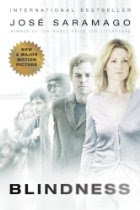
James: Let's start with the source of the blindness. It starts mysteriously and seems to spread like a virus from one person to another. Saramago never tells us where it comes from; the characters in the book don't know either. I guess a religious person might see it as a punishment from God, but I don't remember this line of reasoning discussed in the book. Mass blindness is not an unusual idea, almost everyone on earth goes blind in John Wyndham's The Day of The Triffids for example and I just know this happened on Start Trek at least once.
Saramago is more interested in how universal blindness affects the world than he is in what caused it or in how to cure it. It's very similar to P.D. James's novel The Children of Men which looks at what the world would be like if no one had anymore children. But Blindness is a story of individual survival. How could the individual survive in a world gone blind? He can't. So how will the characters adapt to a situation with no happy ending possible? How long can they remain civil? These are the questions I think Saramago is interested in exploring. He does not appear to have a high opinion of civilized man.
Sandy: I must admit, I like explanations, but wasn’t going to get any with this story. To me, it had a definite feel of Stephen King. Sort of a supernatural, you’re-not-meant-to-understand-so-just-go-with-it kind of plot. Personally, though? To satisfy my need for answers, I am choosing to believe that this is a warning, or lesson from God. Like the flood. A comment is made later in the book (I can’t seem to find the quote), a realization, that when they COULD see, they were still blind - they saw without seeing. It implies that there are lessons to be learned from the sins of the past. The jury is out on whether they will move forward and actually learn from their mistakes or not. What do you think?
This also brings up the question…why did one woman NOT lose her sight? Am I not meant to have an answer for that one either? Is she supposed to bear witness, and use it to lead the masses down a higher path?
You are absolutely right, we see first-hand what Saramago thinks of man, and it isn’t good. What the blindness does is strip away all the layers of decency and dignity and reduce us to animals, fighting to survive. I found myself thoroughly horrified at how quickly everything disintegrated. The infected immediately abandoned hygiene and modesty, and the strong (aka the ones with the weapons) take what they want and dominate the weak. I imagine it wasn’t so different back in the stone age. It causes me to look inward, and ask myself a few questions. Would I maintain my dignity in this scenario? If I were forced to choose between eating and succumbing to the criminals, what would I do? Would I have the courage to fight back?
James: You raise two good points here: what is the moral purpose of the blindess epidemic and how would the reader behave in this situation? The two are closely tied. Once the blindness epidemic is over, the survivors will have to face what they did to survive. There's going to be a lot of survivor guilt.
While reading Blindness, especially the section in the hospital, I kept thinking back to Viktor Frankel's book Man's Search For Meaning. The way the concentration camps were run is reflected in the way the hospital culture developed. In the camps, a select group of prisoners were put in charge of everyone else and ruled through brute force. Frankel describes them as often more vicious than the actual gaurds were. In their defense, the capos did what they thought they had to do in order to survive. The thugs who rule the hospital where the blind are quarentined do the same, they become much more vicious than the capos ever did, but they are trying to survive, too. Reader's can't help but wonder what they would do in this situation. Would they cause others to suffer in order to ensure their own survival?
Frankel described people in the concentration camps who acted selflessly and generously towards other prisoner in his book. In Blindness there is a core group of characters who look out for each other and the doctor's wife who can see but chooses to go with her husband. She has historic parrallels with the concentration camps as well; there were people who chose to follow their loved ones to the camps.
I can see the first part of Blindness as an allegory for the concentration camps. The hospital becomes more like a camp as time passes and more and more people are imprisoned there. Things change in the second half when the hospital burns down. Instead of becoming free like the camp survivors did, the blind patients enter a larger prison/world.
 Sandy: You know, when I spoke of the people in charge with the weapons, I wasn’t even thinking of the guards. You are right, they were just doing their jobs, albeit a little trigger-happy. I am actually hung up on the thugs. I find it interesting, almost like observing an experiment, how in just about any stressful or chaotic situation, the most brutal rise to the top and assert themselves. I’d like to say it is survival of the fittest, but I’m not sure I like that thought. I can’t seem to get past the idea of having sex with vulgar, stinky thugs for food. While my husband would stand by and say that I would probably do anything for food, I’m not sure I would do THAT. Unless my kids were starving.
 I like your parallel to concentration camps, which is basically what we have in the first half of the story. You probably also remember from Man’s Search for Meaning that when camp victims were eventually liberated, they had severe difficulties in adapting to the free world. The victims became angry and lashed out at the injustice of their imprisonment, plus, as you said, they have survivor’s guilt. So I maintain that if we were allowed to expand on a sequel to Blindness, we would see a lot of really serious dysfunction and chaos. If it was God trying to prove a point, I don’t think the point would be well-taken and lessons not learned.
On a different subject, I wanted to bring up the topic of the prose in this novel. Very different, huh? Sort of stream of consciousness, almost like Cormac MacCarthy. I bet Saramago’s middle school literature teacher is rolling over in his or her grave. It was hard to read at first, but I became so engrossed in the horror of the story, I stopped noticing the quirky, run-on sentences and entwined dialogue.
James: It's hard for me to judge the prose since I'm reading the book in translation. I'm just going to assume that it is a faithful translation, but the book is better in the original, and say what I want to say. After a short while I got used to the prose, the way Saramago entertwines the dialogue with the narrative without using standard punctuation and line breaks. But to be honest I don't think it added to my reading experience. I felt he used too many literary devices when just telling the story would have done the job. Why make things harder on your readers; the book's material must send enough people heading for the hills as it is. I didn't like the
 fact that the characters are unnamed either. It just defied logic a little too much for me. In a world full of blind people knowing each others names will probably come in pretty handy. And that so many of the core group is identified by eyes--the eye-doctor, the girl with dark glasses, the man with the eye-patch--struck me as a little precious. This also leaves the only sighted person being identified as "the doctor's wife" which got on my nerves. Why can't the docter be "the seeing woman's husband"? I read the first page of the new sequal, Seeing, in the back of my edition. The dog of tears has a name, but she's still "the doctor's wife."
Sandy: See, while the twisted, intermingled sentences were different and required some brain-tweaks, I thought it DID add to the book. To me, it made me FEEL the chaos. It implied that people were talking over each other, in a rush of panic and confusion, which I imagine would be pretty close to reality. I guess I did not view it as a literary device. What I DID see as a hokey device was the lack of names. I understand the author is trying to emphasize that when you are blind, names aren’t important, but like you said, the references (the boy with the squint, the girl with the dark glasses) required sight to identify. So unless you were the doctor’s wife, it made no sense at all. It didn’t bother me so much, it just didn’t add.
Overall, this was an intense, disturbing but satisfying read for me. I generally don’t like gentle or predictable, and this was far from that. I’m a student of Stephen King, which has prepared me to embrace the cataclysmic collapse of society and dignity of mankind in literature. I like to have my nose rubbed in the fact that we are precariously balancing between civilized and animal behavior. It keeps me humble! Out of five stars, I’d give it a 4.5.
James: You make a very good point about feeling the chaos because of the prose style. And I guess it would be harder to identify who is talking if everyone was blind, the lack of standard punctuation does bring that home. I've read more Stephen King novels than an English Major should probably admit, too, which made reading Blindness easier for me than it probably is for many readers. That raises another set of issues for me: why does a book like this one help give an author a Nobel Prize for literature while a book like The Stand does not. (I would not rank The Stand as among Stephen King's best work, by the way.) If forced to, I would say Blindess is better than The Stand, but I would not give it a five out of five. I'm going to go with four out of five. I used to teach 5th grade math which includes fractions and decimals; I now avoid them whenever possible.
15 August 2010
Guest Post: Ana *hearts* Daniel Wallace
I am currently buried under family members, food, festival, and fun, so some kind bloggers have graciously agreed to guest post here on eclectic / eccentric.
Today, Ana from things mean a lot shares with you her thoughts on The Watermelon King by Daniel Wallace.
~~~~~~~~~~~~~~~~~~~~~~~~
The Watermelon King is quite possibly my favourite of the books I’ve read this year [2007], and it cemented Daniel Wallace’s position among my favourite authors. It’s actually quite hard to write about a book I love this much – it had such a deep and personal impact on me that I don’t even know where to start. But I’ll try to do my best
Daniel Wallace is best known for Big Fish, the book the Tim Burton movie of the same title was based on. The Watermelon King is set in the same fictional Alabama town as Big Fish, Ashland, and they actually deal with some of the same themes as. Daniel Wallace is a writer of stories about stories – stories that deal with the occasionally thin line between a story and a lie, with the instances in which stories save us, and with the hope and meaning they can bring into our lives. But he also deals with the occasions in which that hope falls apart, and you desperately long to reach behind a story and touch the plain facts – the naked truth. There is a character in this book, Edmund Rider, who’s at first very reminiscent of Big Fish’s Edward Bloom: both are men made out of stories, and both immensely frustrate their grandson and son because of this. However, as you read on and get to know these characters you realise that The Watermelon King is a much darker tale than Big Fish.

This narrative structure immediately drew me into the novel, as I love stories in which a community talks about its history and its past. The facts, of course, are necessarily mythologized, but that only adds to the novel’s appeal. And by “mythologized” I certainly don’t mean that everything in the stories the townspeople tell is pretty. There’s racism, there’s small-mindedness, and there’s plenty of hatred. But there is also a moving sense of nostalgia – a nostalgia whose terrible consequences we only fully grasp as the story progresses.
The second section of the book tells the story of Thomas Rider’s upbringing and of his life with his grandfather; while the third tells us what actually happened when he went back to Ashland beyond the stories that people told him about his mother. One of the things we learn is that Thomas Rider was told is the story of the Watermelon King. This story is a perfect example of Wallace’s magic realism and of how he embeds his stories with myths:
Once upon a long time ago, beneath this sun, in these fields, our world was full of watermelons. Everywhere you looked there were watermelons. You couldn’t walk without stepping on them. Not one person thought to grow them; they seemed to grow themselves. It was said you could watch a vine grow, that you could actually see it move, creeping along the ground as though gripping for something to hold on to, that a watermelon would swell before your eyes like a balloon, and that some grew so large, so enormous, that children could stand upright within their hollowed-out shells.
This is, however, only the beginning. Ashland was Watermelon Capital of the World, and to celebrate this abundance, every year there was a Watermelon Festival. In this festival, [possible spoiler, though this is revealed fairly early on] the Watermelon King – the oldest male in the town who was still a virgin – would be crowned, and he’d offer his virginity as a sacrifice for the town.
This sounds like the story of an old Pagan rite, but by stretching it until modern times,
Daniel Wallace explores its emotional impact and its implications when it comes to gender roles. How would the Watermelon King feel as he was crowned? The rite was of course a public humiliation, a mark of failure in one’s “manhood”, and a terribly invasion of what is most personal by the public sphere.
In this novel Daniel Wallace portrays the dark side of small towns in a way that almost reminded me of Shirley Jackson’s “The Lottery”. It’s not a very flattering portrait, but having grown up in one I do know that despite their charms small towns can indeed be cruel. Few things are uglier than a community’s sense of entitlement to anyone’s private affairs.
There are plenty of delicate and difficult things in this novel, but Daniel Wallace handles them with immense grace. His writing is simple, beautiful, and often very moving. The story unfolds perfectly at the exact right pace, and its full darkness only becomes obvious towards the end. There is much more that I wanted to say about this book, about why I found it so powerful and moving, but I really don’t want to spoil the horrifying final revelation for you. So I’ll urge you all to find out for yourselves instead.
I was very excited to discover that Daniel Wallace will have a new book, Mr. Sebastian and the Negro Magician, out next week [Note from present-day Ana: I read it in 2008 and loved it just as much as I hoped]. I definitely plan on picking it up soon, as well as Ray in Reverse.
The other day I read a great interview with Wallace at the Southern Literary Review, in which he named Kurt Vonnegut, Walker Percy and J. D. Salinger as some of his favourite authors. I’d share the link, but unfortunately it contains one badly-disguised major spoiler for The Watermelon King.
Other Blog Reviews:
A Fondness for Reading
Bold.Blue.Adventure.
A Striped Armchair
14 August 2010
Guest Post: Jenny, The Woman of Many Shampoos
I am currently buried under family members, food, festival, and fun, so some kind bloggers have graciously agreed to guest post here on eclectic / eccentric.
Today, Jenny of Take Me Away discusses the joys and sorrows of eclectic reading.
~~~~~~~~~~~~~~~~~~~~~~~~~~~~
Eclectic Reading
Ah, the joys and sorrows of eclectic reading. Sometimes eclectic reading feels essential, but at other times I imagine how much easier life would be if I only read one genre ever.

Or have you ever heard that after using the same shampoo day after day after day after day that mixing it up for a few days with a different shampoo will do your hair wonders?
Well, if you haven’t heard of either of those things try them because they work! And let me tell you, the same is true for me when it comes to reading books. I can’t imagine limiting myself to one genre of book. There’s so much out there to read, and I read for different reasons.
Sometimes I need a true escape, sometimes I need an action packed thriller, sometimes I want to learn something whether it’s about new psychological research or about a time in history. Sometimes I’m in the mood for a good cozy mystery. Well, I could go on, but I’m sure you know what I mean and probably understand. If I read more than 2 books in a row from the same genre I start to feel stuck and need something to mix it up. And the things I love about these genres will quickly become my biggest pet peeve. I might love a good drama but after too many it turns to melodramatic and melancholy for me. I might love a good YA novel that brings me back to being a teen, but eventually the teen angst is too much for me. I even love good mystery/thrillers, but even those turn a little too formulaic for me after a while. And sometimes I’ll read too much brain candy and it rots my brain. And then I need something with a little more depth.
BUT, for those who do have the ability to stick to one genre, well, I admire them. Sticking mainly to one genre probably makes it easier to read more books in that genre than I can for any one genre. Plus it makes them more of an “expert” in their genre because they’ve read so much of it. Those readers probably have a better idea of what elements stay the same across most of the books so they can focus more on the other elements, whereas if I visit a genre I’m consuming those elements that are standard for every book in the genre. And I’ll admit I’m a little envious that some readers are able to maintain a blog about one type of book because the readers always know what to expect. With an eclectic blog, you never know what you’ll find. For some that’s a good thing, but I know some people crave consistency.
So what about you, do you NEED to read eclectically? Or do you prefer to stick to one main genre? And do you prefer the same as your tastes in someone else’s blog (ie. consistency or mixing it up). Btw, do you think I could possibly have said the word genre any more??
13 August 2010
Guest Post: Alexandra Returns to Reading
I am currently buried under family members, food, festival, and fun, so some kind bloggers have graciously agreed to guest post here on eclectic / eccentric.
Today, Alexandra from Good Day, Regular People shares with you her thoughts on the effect blogging has on reading time.
~~~~~~~~~~~~~~~~~~~~~~~~
Has Blogging Affected Your Reading Life?
A few weeks ago, Trisha posted on her ever growing TBR list and the accompanying anxiety that grows along with it. Her post smacked of what has happened to my reading life, since I began blogging. And I don't like it.
I've always been hungry for books. I would go through them like popcorn ever since I taught myself to read at age 4, when my grandmother became too busy to read to me as more brothers and sisters came along. In my childhood room, there would be a minimum of 3 books bookmarked, that I'd be reading simultaneously.
I was the bookworm kid who'd get caught with the flashlight on under the covers, after lights out, just reading "one more chapter." Sleep deprived was how I made my way through grade school and high school. All due to the written word. I couldn't get enough of it. I was always on the look out for what to read next. I would look over people's shoulders on the bus, or in the library, to see what they were reading.
This has been my reading life for the past too many years to count or to say how long it's been. That all changed when I began blogging this past winter. I did not know, nor could've predicted, that no longer reading would be a fallout from my blogging. Aside from blogging being a mass consumer of time, it has also eaten up my before bedtime nightly ritual of curling up with a good book. The thing is, I love blogging. I love meeting people who come to my blog. I love visiting other blogs.
I would enter my room, and see the pile of TBR books, one stacked on top of the other, right next to my bed. Before I began blogging, I'd reach for the book on top, every night, without change, and read. Now, I see this pile of books, and they remind me how I just don't read anymore. I had to move the stack, so I wouldn't have to visually pass it before getting into bed. The sleep of the guilty is not a refreshing one. I kept promising myself that "after this week," I'd get back to it. I'd promise that "after I get back to my commenters," I'd pick up a book. But the time never came. As my pile grew, my displeasure at not cracking a book open in months, also grew.

I was not happy. I did not want to stop blogging, I did not want to stop reading blogs, I did not want to stop interacting with the commenters visiting my site. Clearly, we had the ying to the yang of blogging. I wanted both, but there we had it, the dark and the light. I knew that the only way to have something happen, was to plan for it. Just as your bathrooms won't get cleaned unless you plan to put aside Sunday night to do them, the time had to be made for my books.
I am a happier person when I read. I am a better writer when I read. I am a more interesting person when I read. Reading a book satisfies me in a way that reading blogs can't. I am able to enter a book, and live life there, and return to this new place, every time I open its pages. Reading books is something I do not want to give up.
I now blog only three times a week. That is what works for me, and what I had to do. I look forward to Tuesday, Thursday, and a weekend night as my reading nights. I had to impose these blogging restrictions on myself. It's funny that I had to do this, but there was no other way. I knew that if I kept on "hoping" for a change, that nothing would come. I'm back to reading, I'm happier, my pile of books no longer a reminder of all the reading not getting done. The pile next to my bed now patiently sits and waits for me, knowing that I have made time for my books to be read, three times a week.
Has blogging affected your reading time? What have you done to get your reading life back?
12 August 2010
Guest Post: Sheila the Housekeeper
I am currently buried under family members, food, festival, and fun, so some kind bloggers have graciously agreed to guest post here on eclectic / eccentric.
Today, the lovely Sheila of Book Journey gets romantic with us, discussing a Nora Roberts' trilogy that I adored.
~~~~~~~~~~~~~~~~~~~~~~~~~~~~~
Housekeeping!
Hi everyone! It’s me, Sheila from Book Journey! Our lovely hostess Trisha is taking a little family time and I have agreed to stop in and do a little housekeeping (blogkeeping?) while she is away. You know, watering plants, dusting off the posts…. And maybe – if we don’t tell her –

Looking through Trisha’s past reads I see has read a lot of Nora Roberts a few years back. Nora Roberts wrote a set of books that to this day are on my HIGHLY RECOMMENDED list. Seriously.
The trilogy is the Three Sisters Trilogy and starts out with Dance Upon The Air. In this book, we meet Nell, Nell is married to a man that people admire and envy her for her role as wife. What they do not know, is Nell’s husbands has an incredible temper and takes to abusing Nell if he feels she did not act the way he wished her too. (I know, I wanted to kill him too!)
Anyway, without giving away too much, Nell escapes this marriage and finds herself hiding on Three Sisters Island. Unknown to her is that the island is known for its history of witchcraft and on this island Nell will soon meet Mia, the gorgeous bookstore owner with a little lunch bar in the loft that Nell starts working at. Mia has powers handed down to her from her ancestors and she embraces these powers.
Then there is Ripley. Ripley is a local police officer on the island. She also has powers but hates that she has inherited them and refuses to even acknowledge them. Until, she has to.
As the story goes on, Mia who has a strong sense of the island noticed something had changed once Nell came to them and she is pretty sure that something is Nell herself. History says that it will be three who have the powers of the island and Mia believes that they just found the missing piece in Nell.
 I am probably not doing the story justice, but trust me – these books are wonderful and I try to read them every few years just to take me back to that magical time on Three Sisters Island.
 The other two books in the trilogy are Heaven and Earth (Ripley’s story) and Face The Fire (Mia’s story and the final conclusion as the evil on the island comes full force).
This to me is Nora at her finest and she brings paranormal into her books before paranormal was cool. Ahead of her time!
11 August 2010
Guest Post: Stephanie, Well-Rounded and Eclectic
I am currently buried under family members, food, festival, and fun, so some kind bloggers have graciously agreed to guest post here on eclectic / eccentric.
Today, the wonderful Stephanie, who blogs at Reviews by Lola joins us with her thoughts on being an eclectic reader.
~~~~~~~~~~~~~~~~~~~~~~~~~~~~~~~~~~
I think it would be safe to assume that most (if not all) of the readers of this blog are devoted readers. I don’t know about you, but when people find out how much I love to read, they inevitably ask the million dollar question—What do you like to read? My response is usually along the lines of Ummmm . . . . books?? I mean, how can I simplify my love of reading into one or two categories? I guess I would say I am a reader of literary fiction, but that is so broad and of course that is not all I read. Such is the life of an eclectic reader.
When Trisha asked me to write a guest post for her blog, she threw out a list of topic ideas, one of which was what are the joys/hardships of being an eclectic reader? I was immediately certain that was what I wanted to blog about. I think most readers probably fall into the category of being an “eclectic” reader. I feel like most of the blogs I frequent review a whole spectrum of genres instead of just focusing on one or two, and I love that! There are so many great books AND genres out there, so why tie yourself down to just one or two?
I got my bachelors degree (in English Literature—go figure!) from a small liberal arts college. I have always loved the philosophy of the liberal arts; to be a well rounded person you have to have a bit of knowledge about everything. Reading is no different. I think if I were to limit myself to only one or two different types of literature, I wouldn’t be learning as much or broadening my horizons. By dabbling in a bunch of different genres, my perspective is widening and I am also able to discover books that I might not otherwise have read.
Book blogging has encouraged me to be more eclectic in my reading choices. For one, I participate a lot in the Classics Circuit. Almost all the books I have read for the circuit are books I may not have chosen on my own. Sylvia’s Lover, by Elizabeth Gaskell springs to mind. Then you have all the bloggers in general posting about great books that I may not otherwise have noticed. I have even discovered entire new genres that I hadn’t even given a thought to before I started blogging. YA Dystopian fiction, I am talking to you!
Being an eclectic reader is so rewarding, so embrace it! I know if I didn’t, I would never have discovered the horrifying life of Offred, the repressed woman from Margaret Atwood’s The Handmaid’s Tale. I am sure I would have never found the loveable and enigmatic Mitford Sisters had I not branched out and read The Sisters, by Mary Lovell, which only then induced me to read The American Way of Death Revisited, by Jessica Mitford, as well as The Pursuit of Love and Love in a Cold Climate, both by Nancy Mitford. Even my penchant for Evelyn Waugh was as a result of The Sisters. So as you can see, I now have a few classics under my belt, not to mention the fact that I now know more about the funeral industry than I ever thought possible.
Next time someone asks me what type of books I like to read, I guess my answer should be What don’t I like to read?!
10 August 2010
Guest Post: Jenners the Book Whore
I am currently buried under family members, food, festival, and fun, so some kind bloggers have graciously agreed to guest post here on eclectic / eccentric.
Today, the wonderfully hilarious Jenners from Find Your Next Book Here shares her thoughts on eclectic reading.
~~~~~~~~~~~~~~~~~~~~~~~~~~~~
The Joys and Hardships of Eclectic Reading
I'm a book whore.
There ... I've said it. I'll read anything, anytime, anywhere. (Seriously, I've read the labels on cans of air freshener if trapped in a bathroom with nothing to read.) There is almost no type of book that I won't try. (Though I'd probably draw the line at technical books about subjects I know nothing about. I mean, let's be reasonable.)
 It started when I was promiscuous young reader who had no barometer of what was "good" and what was "bad." I remember thrilling to the gloriously illicit and smutty The Love Machine by Jacqueline Susann and then following it up by reading the entire Chronicles of Narnia by C.S. Lewis. I'd read Sidney Sheldon's Master of the Game alongside Joseph Heller's Catch-22. Danielle Steel followed by Stephen King. It was a big messy melting pot of books, and I loved it.
Oh sure, there were times when I'd go on reading binges and obsessively read one type of book. I had my murder mystery phases and my horror phases. But most of the time, I craved variety. If I read a "candy bar" book, I'd have to leaven the sweetness by reading a "vegetable" book. I continue this pattern to this day. After getting sick by binging on the candy bar brilliance of the Twilight books last year, I followed them by reading Jane Eyre for the first time (which I would liken to eating brussel sprouts).
On the flip side, my husband is very limited in his reading. He reads travel narratives and celebrity biographies recommended by the Howard Stern Show. (And the occasional Nelson DeMille book.) This type of limited literary diet would make me ill. I need my thrillers, my memoirs, my chick lit, my contemporary fiction, my essays, my literary fiction, my dystopian YA, my classics. Anything else would be unthinkable ... like living in a world that had only two colors.
However, the downside of an eclectic reading diet is the headaches you can induce by not choosing your books carefully enough. I mean, most people would not eat raw fish and then a big piece of chocolate cake, right? (Incidentally, I once did this. I don't recommend it.) This happened to me just a few weeks ago when I finished reading Justin Cronin's The Passage and then jumped into Jane Austen's Pride & Prejudice. It was like getting reading whiplash. I should have picked a "step down" book ... something like Sense & Sensibility and Sea Monsters to ease myself out of the freaky viral-infested world of The Passage into the genteel world of Elizabeth Bennett's Hertfordshire.
Let's take a look at my list of books read this year and see some odd pairings that I read back to back. How about Steig Larsson's whip-smart and complex thriller The Girl Who Played With Fire followed by Jhumpa Lahiri's delicate, intricate and gorgeous short stories in Interpreter of Maladies? Or Stephenie Meyer's sci-fi epic The Host followed by Jonathan Safran Foer's experimental Holocaust-themed novel Everything Is Illuminated? Or my personal favorite odd pairing: Marcus Zusack's haunting, poetic WWII masterpiece The Book Thief followed by Jen Lancaster's snarky weight loss memoir Such A Pretty Fat? This seems like the reading list of a madwoman!
But my reading life is one big adventure. I never know where I'm going next. I could be kicking neo-Nazi ass in Sweden one week and then fighting vampires in San Francisco the next. I could be reliving an infamous school shooting and then seeing the world from a dog's point of view a few days later. I've luxuriated in the magical prose of Michael Chabon and then gone on to explore the science of the after-life. Being an eclectic reader means my reading journey has sharp turns, abrupt U-turns and lots of curves, but the journey is fascinating and feeds my soul and endless curiosity, and I wouldn't change a thing.
09 August 2010
Guest Post: Sandy Looks at Lahiri
I am currently buried under family members, food, festival, and fun, so some kind bloggers have graciously agreed to guest post here on eclectic / eccentric.
Today, Sandy from You've Gotta Read This shares with you her thoughts on Jhumpa Lahiri's Interpreter of Maladies.
~~~~~~~~~~~~~~~~~~~~~~~~~~~~~~
This collection of short stories was my official selection for the 4R's Challenge, recommended by Kristen @ Booknaround and Violet Crush. I had mentioned in my thread that I was on the inept end of the spectrum with regards to the short story genre, and this was the recommendation they bestowed upon me. What made this suggestion even more serendipitous was the fact that I already had it on my list, mentioned months ago by C.B. James. I just couldn't pass it up.
I certainly had heard plenty about the author, Jhumpa Lahiri. This novel, her first, won the Pulitzer in 2000. Can you imagine coming out of the gate and nabbing that award? Or even better yet, writing your second novel, and hoping to match up to the first? You may recall her second novel, The Namesake, was made into a wonderful film a couple of years ago. This girl sets the standard, that is for sure. But I had no idea what to expect when I cracked open the first page. What I found was a group of nine gentle, easy-to-read stories about persons of Indian descent, in various stages of disenchantment, personal growth and discovery, and hope for the future. Where I found the collection of short stories from Say You're One of Them hard to take and without a ray of sunshine, this one delivered the goods. Here are a couple of stories that I especially enjoyed:
 In the story entitled "Interpreter of Maladies", a tour guide escorts an American family with Indian ancestory around India to see a few sights. The family is your basic dysfunctional, narcissistic mess, but when the wife pays some special attention to the guide, he swiftly starts to fantasize about his future with her. He comes back around at the end of the story after a traumatic incident reveals the woman's true colors. The author's ability to create such vivid, flawed characters in a handful of pages was a delight. And unlike some short stories, you really weren't left wanting more. This was all you really needed to know.
In "The Third and Final Continent", a young Indian man arrives in America ahead of his new wife to establish himself. He rents a room from a difficult centenarian, lives on corn flakes, and studiously learns American slang. Lahiri delicately unfolds the life of an honorable, determined immigrant who struggles to get to know the stranger that is his wife, and a country that is vastly different than his own, all without complaint. He takes nothing for granted, for this is the American dream, and instills these values in his son. The story is precious, and is a reminder of the ideals and principals on which this country was founded.
From these stories, it is easy to establish that Lahiri is a student of the human condition. The difficulties between man and wife, noise that distracts from one's culture and religion, the need for acceptance and love, the desire to be attractive, the importance of respecting our elders, the feeling of isolation in a foreign country...no matter what the topic, Lahiri portrays it with elegance and grace. This is truly a work of art.
Thanks again, Kristen, Violet Crush and C.B. James! I look forward to the next round of the 4R Challenge!
5 out of 5 stars
Subscribe to:
Posts (Atom)