Showing posts with label Thoughts. Show all posts

13 March 2016

New Vision for the Blog


While I've always thought of eclectic/eccentric as a multi-layered blog, it has primarily functioned as a book blog. Most posts were focused on reviewing books, summarizing and evaluating without spoiling plot and with the ultimate goal of encouraging people to read or not read the book. I loved this, and for over 8 years, that was the focus. I would post thoughts or family updates from time to time, participate in memes (mainly bookish ones), and participate in book tours and book blog events.

The blog changed drastically after the birth of my first child, Madison, four years ago. I went from reading 150 books a year and having quite a bit of free time to reading 50 books a year with almost no free time. The blog became more sporadic. Then, three years after Madison, came Carter, and reading took another dive. While I have read many, many posts about how reading is still possible after children - and I agree for the most part - I would have to make some pretty questionable decisions to maintain my pre-children level of reading and blogging.

Part of my loss of time has to do with other life decisions. I am a full-time college professor serving on multiple committees and presenting at various conferences. Then there's the fact that I also went back to school. In the time right before Carter, I began work towards a second Masters degree, in Literature of course. I actually finished and submitted a 22 page literary analysis while in the hospital after giving birth. Yeah, that happened.

This year I also started coursework towards earning a Master Online Teacher certificate. Taking all of these courses means that the limited reading time I have left is devoted to course readings and homework. Oh and children's books. I read at least four books a day...they're just not exactly War and Peace.  More like Hello, Bugs and more Bubble Guppies books than should rightly exist.

Fingers crossed that my hard work buying and reading children's books will pay off. So far, so good as both of my kids like playing with books. Madison likes to read before bed (well, have books read to her) and Carter will sit still for I Kissed the Baby, but that's the only book that he will listen to for some reason.

eclectic/eccentric will still have the occasional book review, but the focus will shift a bit more towards discussion and analysis than review, and I plan on incorporating a lot more posts on education and instructional technology and more on the family as well. I suppose this makes eclectic/eccentric more of a life blog; it's just that quite a bit of my life is dedicated to books.

So, for the foreseeable future, I will post about literature on Tuesdays and education/online learning on Fridays. Sundays will be for updates and family, and any book reviews will be posted randomly. I'm considering changing the blog name to be more reflective of what will be included in posts, but so for no luck on a creative title...at least not one that's already taken. :)

To those who read this blog in years past, I don't know if any of you are still around. The numerous false starts this blog has had in the last four years is ridiculous, and who knows if this is the start of a new heyday of Trisha blogging or if it is yet another failed attempt to bring blogging back into my life. I know a few of the people I considered friends here in the book blogging world are no longer book bloggers or no longer bloggers at all. Any of you who are still around, I hope to get back in touch. For new readers, welcome! I can't wait to see what's been happening in the blogosphere.

21 May 2015

Heart of Darkness: Pro- or Anti- Imperialist

The question of whether Heart of Darkness needs a high five or a smackdown has permeated discussion of the book since shortly after its publication. Critics such as Cedric Watts cite Joseph Conrad’s Heart of Darkness as an anti-imperialist read. Other critics such as Chinua Achebe demonize the text as not only in support of imperialism but a text which reinforces racist stereotypes. From a Marxist perspective, the textual ambiguity may, in part, be the result of the ideological constraints under which Conrad was writing.

Conrad was limited by the ideology of Western civilization. Heart of Darkness “relies on a set of commonly-held European assumptions about the continent as a whole” (Gorra 568) such as racial superiority. Darwin himself promoted a distinction between “high” and “low” races, suggesting an unequal distribution of intellect. This belief “fostered in all citizens a sense that they were members of an imperial race and encouraged them to identify with the ideal of their nation’s world role…such arguments depicted expansion and control as not only moral but somehow natural” (Icoz 248). Conrad had to work from within this construct.

Conrad’s particular history, however, situates him in an ideologically fluid position. As the son of Polish gentry who were exiled from their homeland by Russian imperialists, Conrad has seen, first-hand, the horrors of imperialism (Icoz 246). But we cannot forget the “gentry” in the previous sentence, meaning Conrad’s social class wars with this anti-imperialist attitude as he cannot fully identify with the other victims of imperialism. His social, economic, and geographic displacement does not fully compare to the atrocities being visited upon the foreign, non-white natives in other colonized lands. So Conrad doesn’t fully relate to the white imperialists or the African natives. As such, he finds himself writing from the ideological position of neither.

This leads to an ideologically conflicted perspective. A specific example of this is when Conrad has Marlow refer to the natives as "not inhuman" (Conrad 36). Marlow, like Conrad, seems to be continually trying to break free from his ideological constraints. A part of him sees the horror of imperialism and racism and wants to fully condemn it; he wants to say the natives 'are human'. But to do so would require a massive break with his dominant ideology, so the most he, and Conrad, can muster is that they are "not inhuman".

Conrad again questions the dominant ideology when he has Marlow reflect that finding Kurtz was “not worth the life…lost in getting to him”, referring to the death of the African helmsman (50). To soften the blow, Marlow talks directly to his audience – and Conrad talks directly to his – saying: “Perhaps you will think it passing strange this regret for a savage who was no more account than a grain of sand in a black Sahara” (Conrad 50). Conrad makes a bold statement suggesting that the life of a white man is not worth the life of a black man; but he has to rather aggressively backtrack to pacify his readers. Here, once again, Conrad’s position is ideologically mixed.

If he had taken a firm stance on the side of anti-imperialism, would we even have the text to analyze today since “the material context of literary production places limits on what can and cannot be said or expressed at a particular historical moment” (Rivkin and Ryan 645)? Even if Conrad wanted to directly expose cultural wrongs, he may have relied on subtlety to reach rather than alienate his audience. Even the "enlightened" who would, at the time, question the common practices of imperialism, cannot completely remove themselves from their ideological perspective. After all, "one of the effects of ideology is the practical denial of the ideological character of ideology by ideology" (Althusser 700). We can't escape it. It is entirely plausible that because Conrad had “to depend on the interest and sympathy of his readers…he did not fully acknowledge his dark insight into colonialism. He had to be content with satirizing the evils of imperialism while hinting at admiration for its ideals” (Icoz 246).

In essence, Conrad questions Western power through the very act of writing about Western power. Whether this is enough to situate this work as a true condemnation of imperialism is another question. Perhaps it is enough – for the time – that Conrad even questioned something so many saw as natural, an inherent right and responsibility, of Western society.

For those who've read the story, what do you think?

Althusser, Louis. “Ideology and Ideological State Apparatuses.” Literary Theory: An Anthology. Eds. Julie Rivkin and Michael Ryan. 2nd ed. Malden, MA: Blackwell Publishing, 2004. 693-702. Print.

Conrad, Joseph. Heart of Darkness (Norton Critical Edition). Ed. Paul B. Armstrong. 4th ed. New York: Norton, 2006. Print.

Gorra, Michael. “Joseph Conrad.” Hudson Review 59.4 (2007): 541-571. Academic Search Complete. Web 13 January 2015.

Icoz, Nursel. “Conrad and Ambiguity: Social Commitment and Ideology in Heart of Darkness and Nostromo.” Conradiana 37.3 (2005): 245-274. Academic Search Complete. Web 13 January 2015. 

Rivkin, Julie and Michael Ryan. “Introduction: Starting with Zero.” Literary Theory: An Anthology. Eds. Julie Rivkin and Michael Ryan. 2nd ed. Malden, MA: Blackwell Publishing, 2004. 643-646. Print.

14 May 2015

I Fell in Love With Narratology or How I Got My Geek On

During this past winter, as you know, I took an Introduction to Literary Theory as the first class in my online Masters in Literature program. It was pretty awesome despite the fact I had to read Henry James' Turn of the Screw and Joseph Conrad's Heart of Darkness, two books with which I am not at all enamored.

For my final paper in the course, I could choose to analyze either of the books through any of the literary theories studied. I knew I wanted to use Narratology which, as the name implies, is the study of narrative structure; specifically, this theory focuses on the commonalities between all stories. Individual texts are read and analyzed in an effort to identify these commonalities (Barry 214-215). Vladimir Propp, for example, analyzed hundreds of Russian fairy tales and compiled a list of 31 functions by separating out the component parts of the fairy tales (72) (Barry 218-220). These functions are “the basic building blocks” of the narratives within the studied fairy tales (Barry 220). While Propp focused on how the narrative is structured, Gerard Genette tried to analyze how the story is told, posing questions such as from what point of view is the story told, who is telling the story, and how is the story packaged (Barry 227). This type of analysis fascinates me. How disparate parts work together to create meaning is something of a passion of mine whether we are talking about literature or film.

Choosing between James and Conrad was difficult, but I decided that the narrative structure of Heart of Darkness was the teensiest bit more interesting to me. Peter Brooks calls Heart of Darkness “a detective story gone modernist: a tale of inconclusive solutions to crimes of problematic status” (238). This “inconclusive” and “problematic” text has for over one hundred years, intrigued, angered, and confused readers. And damned if it didn't do the same to me.

These emotions can, in part, be attributed to the authorial choices Conrad makes regarding narrative elements, and that is how I chose my paper topic. Through a narratological analysis of Heart of Darkness, I specified the narratological elements, analyzed how they affect reader interpretation, and explored how they contribute to the highly ambiguous nature of the story. I tried to prove that Conrad uses narrative techniques to obfuscate any singular, identifiable meaning in the text. Damn that man. Damn him but good.

I felt pretty successful with the paper, and I received a high A on the paper, so things look good. My professor actually suggested I develop the paper a bit further with a few more sources and submit it for publication. He thinks I have a pretty good chance of getting it published. Very flattering. I'm still wavering on whether or not I'm going to actually do it.

What this assignment did was give me a love of narratology, a literary theory that is certainly not currently in vogue like feminist theory, gender studies, post-colonial, and the so on. I even had a hard time finding sources about narratology outside of the most awesome Mieke Bal, a Dutch cultural theorist, who is pretty seriously awesome. Just a few of the roles she's had: Professor of Semiotics and Women's Studies, Chair of Comparative Literature, Professor of Visual and Cultural Studies, Professor of Literary Theory, and Founding Director of the Amsterdam School for Cultural Analysis. She has published over 30 books on a wide variety of subjects and she's also a video artist. Seriously, she's who I want to be when I grow up (you know, if I had, like, ambition).

I suppose I'm just sort of sharing with this post, and it does give you the briefest of introductions to narratology and Mieke Bal, so maybe you learned a little something. :) 

I'm keeping my fingers crossed that I have the ability to apply narratology to the works I'm reading for my new course, Graduate Studies in Medieval Literature.


Barry, Peter. “Narratology.” Beginning Theory: An Introduction to Literary and Cultural Theory. 3rd ed. Manchester: Manchester University Press, 2009. 214-238. Print.

Brooks, Peter. "An Unreadable Report: Conrad's Heart of Darkness." Reading for the Plot: Design and Intention in Narrative. New York: A.A. Knopf, 1984. 238-263. Print.

Chatman, Seymour. “The Structure of Narrative Transmission.” Literary Theory: An Anthology. Eds. Julie Rivkin and Michael Ryan. 2nd ed. Malden, MA: Blackwell Publishing, 2004. 97-124. Print.

Propp, Vladimir. “Morphology of the Fairy Tale.” Literary Theory: An Anthology. Eds. Julie Rivkin and Michael Ryan. 2nd ed. Malden, MA: Blackwell Publishing, 2004. 72-75. Print.

16 July 2012

Something You Should Read

While I haven't been active around the blogosphere, being lucky to post once a week or so, I am still lurking around both book blogs and news sources. Lately, I've found a few articles or posts that I want to highlight as SOMETHING YOU SHOULD READ. So here's a quick round-up of reading for you to check out:

The Dark Knight Rises is apparently inspired by A Tale of Two Cities by Dickens. Now I must read the book - like Nolan, I thought I already had but was mistaken....

Andi, over at Estella's Revenge, wrote an awesome post about Fifty Shades and Female Readers.

James at Ready When You Are, C.B. introduced me to books written in disappearing ink...

I found out that my Meyers-Briggs personality type - INTP - is associated with Virginia Woolf's To the Lighthouse, and that in literature "INTPs can best be described as mad scientists - they're incredibly intelligent but also eccentric, and may become preoccupied with ideas but have a hard time executing them. In "To the Lighthouse," Mrs. Ramsay's philosophical husband, Mr. Ramsay, is often found taking long walks by the sea, contemplating his fate." Love it.

Over at the New York Times, an article asks Is Philosophy Literature? The debate over how to define and classify literature is one that really fascinates me.

Trish wrote a thoughtful post on being a working mother over at Love, Laughter, and a Touch of Insanity.

And finally, Letters of Note featured a letter written by Marie Antoinette to her sister-in-law and to her children bidding them farewell eight hours before her execution.

I hope you enjoyed these! I might try doing this every now and again if for no other reason than to let you all know that I am still alive and reading. :)

04 June 2012

Funny but True?

 I realize posting an email forward is probably a bit ridiculous, but I did find this one funnily interesting:

Checking out at the store, a young cashier suggested to an older woman that she should bring her own grocery bags because plastic bags weren't good for the environment. The woman apologized and explained, "We didn't have this green thing back in my earlier days."

The young clerk responded, "That's our problem today. Your generation did not care enough to save our environment for future generations." She was right -- our generation didn't have the green thing in its day. Back then, we returned milk bottles, soda bottles and beer bottles to the store. The store sent them back to the plant to be washed and sterilized and refilled, so it could use the same bottles over and over. So they really were recycled. But we didn't have the green thing back in our day.

Grocery stores bagged our groceries in brown paper bags that we reused for numerous things; most memorable besides household garbage bags was the use of brown paper bags as book covers for our schoolbooks. This was to ensure that public property (the books provided for our use by the school) was not defaced by our scribblings. Then we were able to personalize our books on the brown paper bags. But too bad we didn't do the green thing back then.

We walked up stairs because we didn't have an escalator in every store and office building. We walked to the grocery store and didn't climb into a 300-horsepower machine every time we had to go two blocks. But she was right. We didn't have the green thing in our day.

Back then, we washed the baby's diapers because we didn't have the throw away kind. We dried clothes on a line, not in an energy-gobbling machine burning up 220 volts -- wind and solar power really did dry our clothes back in our early days. Kids got hand-me-down clothes from their brothers or sisters, not always brand-new clothing. But that young lady is right; we didn't have the green thing back in our day.

Back then, we had one TV, or radio, in the house -- not a TV in every room. And the TV had a small screen the size of a handkerchief (remember them?), not a screen the size of the state of Montana. In the kitchen, we blended and stirred by hand because we didn't have electric machines to do everything for us. When we packaged a fragile item to send in the mail, we used wadded up old newspapers to cushion it, not Styrofoam or plastic bubble wrap.

Back then, we didn't fire up an engine and burn gasoline just to cut the lawn. We used a push mower that ran on human power. We exercised by working so we didn't need to go to a health club to run on treadmills that operate on electricity. But she's right; we didn't have the green thing back then.

We drank from a fountain when we were thirsty instead of using a cup or a plastic bottle every time we had a drink of water. We refilled writing pens with ink instead of buying a new pen, and we replaced the razor blades in a razor instead of throwing away the whole razor just because the blade got dull. But we didn't have the green thing back then.

Back then, people took the streetcar or a bus and kids rode their bikes to school or walked instead of turning their moms into a 24-hour taxi service. We had one electrical outlet in a room, not an entire bank of sockets to power a dozen appliances. And we didn't need a computerized gadget to receive a signal beamed from satellites 23,000 miles out in space in order to find the nearest burger joint. That young smartass was right I guess. We old folks were wasteful and ruined the planet because we didn't have that green thing back then.

Funny and factual, bust as always not entirely true. I would almost like to see something written from the opposite perspective. What did the older generation do in their youth which negatively affected the environment?

16 October 2011

Sunday Salon: Book Count, Page Count

First some random thoughts: Recently someone asked me how many books I read a year. When I said 100-150 or so, said person gave me that oh-so-familiar "she's nuts" glare. Then another person in the group said, "Yeah, but what are you reading?" This sparked quite the discussion, and it got me thinking. How much does what you are reading matter to statistics?

After much discussion and a bit of thought, I came to the following conclusion:
  • Total number of books read is not comparable if A Game of Thrones and Goodnight Moon both count as 1 (same goes for Ulysses versus The Hunger Games)
  • Total number of pages read is not comparable for the exact same reason: 500 words per page versus 10 words per page
Which means that:
  • Statistics are relatively pointless outside of self-awareness and self-challenge 
I am sure that for most of you this is not new. Logically, we can't compare ourselves to other readers because we are not reading the same thing. Maybe it's politically incorrect of me to say so, but reading 350 children's books a year does not mean you read "more" than someone who reads 50 classic novels (I am not saying one is better than the other, just that they are not comparable). I would say that the time put in is what's important, but that's disingenuous as well because people read at different speeds.

I guess the point of this is - outside of just sharing some thoughts - to say that you should not compare yourself to other readers through statistics. Instead you should use them for personal edification only.

~~~~~~~~~~~~~
Some things you may have missed around the blog:

I'm giving away a book for taking a simple, 10 question psych profile
I have started a reading list based on awesome books which were originally rejected.

Books I Reviewed This Week:

08 October 2011

Is it better to be black or female?

I first became fascinated in the pull-and-push between race and gender when I read Shirley Chisholm's I'd Rather Be Black Than Female. The first line captures the main argument well:
If I said that being black is a greater handicap than being a woman, probably no one would question me. Why? Because "we all know" there is prejudice against black people in America. That there is prejudice against women is an idea that still strikes nearly all men--and, I am afraid, most women--as bizarre . . . 
Everyone recognizes racism and sees it as a problem. The same does not hold true for sexism. People seem to think it has been eradicated; or they readily accept gender determinism. People believe that the color of one's skin does not determine behavior, thought-pattern, etc. But genitalia on the other hand seems to control everything. Men are from Mars and woman are from Venus after all.

Bell Hooks' Ain't I a Woman addresses this question as well, and seems to agree. When writing of the slave trade, she makes clear the extra hardships women had to suffer and the tiny differences in treatment due to gender. For example, women were not seen as a threat on slave ships, so they were not shackled like men were (plus shackling makes rape a bit harder). While the lack of shackles may seem positive, this difference in treatment signifies a difference in perception which is sexist in its very nature. The same distinctions in treatment and perception were carried over once sold.

She even argues that the way we look at slavery is sexist:
Sexist historians and sociologists have provided the American public with a perspective on slavery in which the most cruel and de-humanizing impact of slavery on the lives of black people was that black men were stripped of their masculinity...Implicit in this assertion is that the worst that can happen to a man is that he be made to assume the social status of a woman."
She goes on to discuss the gendered separation of chores - where women worked in the house and in the fields (and were used as breeders and victims of rape), but men were only in the fields - and many other distinctions which were rendered based on gender.  And even the freedom slaves were seeking was sexist in nature: they were not challenging the status quo (of white people) they merely wanted to conform to it. Black women wanted to be like white women; black men like white men, and white society was extremely separated based on sex.

On a different note, the Introduction focuses on suffrage. Black men, as we all know, received the right to vote prior to women. Originally, black men joined white women in the fight, but it wasn't until they distanced themselves from the white women that their cause took off.
By supporting black male suffrage and denouncing white women's rights advocates, white men revealed the depths of their sexism - a sexism that was at that brief moment in American history greater than their racism.
Obviously Chisholm would argue that decades later, in the 1970s, sexism was still more rampant than racism, and I would argue that the same holds true today. I did have a small problem with this discussion. Hooks writes that white female suffragists separated from their black counterparts when it seemed like black men would get the right to vote first. Their separation is discussed more as a racist abandonment:
Prior to white male support of suffrage for black men, white women activists had believed it would further their cause to ally themselves with black political activists, but when it seemed black men might get the vote while they remained disenfranchised, political solidarity with black people was forgotten and they urged white men to allow racial solidarity to overshadow their plans to support black male suffrage.
When Hooks writes about the black male suffragists separating from their white female counterparts, she says that:
"while many black male political activists sympathized with the cause of women's rights advocates, they were not willing to lose their own chance to gain the vote. Black women were placed in a double bind; to support women's suffrage would imply that they were allying themselves with white women activists who had publicly revealed their racism."
Something struck me about this paragraph, as if the two groups committed the same act, but one was denigrated because of it while the other was excused. White women were trying to "further their cause" while black men "sympathized with the cause of women's rights". White women "forgot" about solidarity and promoted a racist agenda while black men regretfully had to separate because they "were not willing to lose their...chance." I have no doubt that both sides were in the right, and both sides were in the wrong, but this discussion seems one-sided to me.

But back to the main issue at hand, racism v. sexism. Clearly, the fight against racism is fraught with passionate emotion and public spectacle. Everyone knows the landmark cases, the catch phrases, the pros and cons, the various groups of import, and so on. The same cannot be said of sexism, and that is why, in the words of Shirley Chisholm:
How much harder will it be to eliminate the prejudice against women? I am sure it will be a longer struggle. Part of the problem is that women in America are much more brainwashed and content with their roles as second-class citizens than blacks ever were.
Absolutely. I will never forget the semester I found out that my 18-20 year old female students were sexist against their own gender. No one in class believed sexism still existed. Four girls admitted they wouldn't want Hilary Clinton (or any woman) as president because she might blow up the world if she was having a bad period (no lie, people, no lie). I was horrified, aghast, that these women were so blind to the real world.

To be clear, the opinions didn't change amongst the students depending on race. Black women and white women both seemed to think that there was equality between the genders. Crazy. Crazy. Crazy.

Anyway, back to Ain't I a Woman?. I'm really enjoying reading this - as I am sure you can surmise from the fact that I just wrote a post based on the Introduction and the first pages of Chapter 1! Big thank you to the Year of Feminist Classics for putting this on my to-read list.

Just out of curiosity, would you rather be black or female? (and yes I recognize that the question eliminates every combination outside of black man and white female, but it's how Chisholm phrased it so it's good enough for me).

08 September 2011

Doll Play

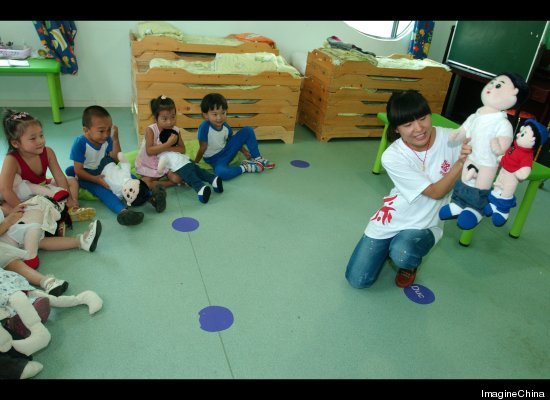
Here I am, innocently browsing through the Huffington Post, and I come across this:
WTF?!?!?! I'm pretty sure that was the only thing in my head for a solid minute. Finally, I caught up to myself and decided to figure out what exactly was going on here.

Turns out the answer is simple. Some schools in Shanghai are using anatomically graphic dolls to teach kindergarteners sexual education. WTF?!?!?! Again, my brain freaked out on me and refused to conform to any standard, logical thought process. Then I saw this picture:
I'm glad to see we are teaching kindergarteners the hairy difference between boys and men. But seriously folks, I can definitely see the need to increase sex ed in China. According to the article, "while two-thirds of adolescents and young adults in China "had very limited levels of sexual reproductive health knowledge," they were also open to premarital sex." Twenty-two percent had already had sex, and only 50% of them used any form of birth control. ARE YOU FREAKING KIDDING ME? They know nothing, use nothing, and are still doing it. Surprisingly, "a 2009 survey of American high schoolers by the U.S. Centers for Disease Control found 46 percent of students had had sex and 85 percent used contraceptives during their most recent sexual activity." Go America!


I'm pretty sure these dollies aren't going to solve the problem. A cultural shift towards the use of birth control would make a huge difference. Preventing sex is just not a good plan. Sex is fun. Teenagers like it. They are going to do it. Accept it (even begrudgingly) and move on.

Our best bet is to give them all the info they need on STDs, self-esteem, pregnancy, and contraception. So unless they are putting condoms on those dolly naughty bits, I'm not sure this is a good idea.

Plus, it's just sort of freaking me out. Anyone else have thoughts?

For the full article, go here.

28 August 2011

Sunday Salon: My Unthought Thoughts on News

I am not exactly a deep thinker when it comes to the news. For the most part, I'm a skimmer, checking out what's in the headlines, forming some initial, non-deep opinions and moving on. If something really strikes my fancy (i.e. is about books, movies, or education) I'll give it a second look and actually take some time contemplating (err....6 out of 10 times anyway). What is the point of all of this you might ask?

Well here are some news tidbits that caught my attention, but I still haven't formed any definite opinions:

Books from Spies, National Security, Free Speech
Ali H. Soufan was a CIA operative working closely with Al Qaeda for years. Now he is writing a memoir, and the CIA is trying to force cuts to the book which apparently claims the CIA withheld information from the FBI which could have stopped the attack on 9/11. He also states the CIA is perhaps a bit overenthusiastic in interrogation techniques. The super-odd part of the CIA's redactions is that none of the information Soufan included is actually new. Most of it has been released during Congressional hearings and the such not. The CIA claims they only redact information which is classified, and that how the information reflects on the Agency is not a consideration.

Having never read the book (obviously) and not being a CIA agent, I don't feel I can make a firm statement as to the validity of the redactions. What the article actually got me thinking about was Free Speech v. National Security. If a CIA agent writes a tell-all book about foreign operations, does it clue others in to CIA procedures and so on? Does it harm American interests? Should final say on what is in the book fall to the CIA? Or is that a violation of free speech and more harmful to America? Thoughts?

Source: Huffington Post

Mothers v. Fathers in Frontline Journalism
Alex Crawford, a reporter for Sky News, boldly stated that it was "really insulting and very, very sexist" when people questioned her ability to be both a war correspondent and a mother. Not surprisingly, her colleague, who has three children, is never asked the same question. He's a father. Because of course, his children have a mother at home to take care of them. Crawford? Yep, she has a husband (who is a STAY-AT-HOME DAD). But we all know that doesn't count.

Obviously, I absolutely agree with Crawford and do think those questions are sexist. What the article got me thinking about is if those questions would be insulting if both mothers and fathers were asked. What sort of reaction would we have if parents with dangerous jobs were questioned (or even attacked) about their ability to juggle being a parent and being a frontline journalist/soldier/race car driver/cop/etc.? Would we still find the question inappropriate?

Source: The Guardian


So what do you guys think?

13 April 2011

The Oddities of Stats

Stats are, in general, something I worry very little about. I am a small-time blogger who is happy that way. The other day, however, I was writing up a public bio for NetGalley and realized most publishers want to know some general statistics about a blog prior to approving review requests. This makes sense of course. So for the first time in probably six or seven months, I checked out my stats on various sites such as Google Analytics, Blogger's Stats, Feedburner, StatCounter, SiteMeter, etc.

And all I heard was blah blah blah blah blah. Seriously, stats are just not my thing. Approximately 500 ABSOLUTE UNIQUE VISITORS (you know that needs to be in all caps) have visited my site today upon writing. Since only about 12 of them actually commented, I am not sure what exactly that means for publishers. As for the rest of it, blah blah blah blah.

For one of my favorite posts on stats, check out Pam's thoughts over at Bookalicio.us. And hey, she like totally has a gazillion followers and she reads eclectic/eccentric, so like if I can convince her to read your book, she'll like convince her gazillion followers to read it, and they will convince their followers, and then like money shall pour forth from the heavens and fill your coffers with their shiny goodness. Or you know, something like that.

On a side note, I did discover a really interesting fact: there are 1,340 pageviews for my post on The Odyssey: Books 7-12 and 1,018 for Books 1-6. I really get a chuckle out of the fact that two of my most popular posts are on an ancient text. While I would like to believe that indicates a renewed interest in ancient lit, I am inclined to think it's students cheating searching for an aid to understanding the text.

What about you guys..any particular STAT FACT that you find actually interesting?

07 March 2011

The Importance of Tenure

On February 21, one hundred students at Northwestern University watched as a couple demonstrated the use of a motorized sex toy after their class on human sexuality taught by Professor John Michael Bailey. The toy in question was, uh, unique: a reciprocating saw with a dildo attached. And yes, our lovely female demonstrator got her just desserts from the device run by her boyfriend (neither were students at the college).

Professor Bailey is quoted as saying, "Sticks and stones may break your bones, but watching naked people on stage doing pleasurable things will never hurt you." Apparently a lot of people disagree, and a nationwide hullabaloo ensued. The president of the college has opened an "investigation", and once again, people are talking about The Evils of Tenure.

Tenure refers to a professor's permanent job contract, guaranteeing employment except in instances of rather severe misconduct. Granted after a probationary period (typically about 7 years for larger universities) where the professor is continually evaluated, tenure is not easy to get. And it shouldn't be. But it is necessary.

The reason is simple: teachers must be able to teach, a wide variety of subjects and views, without fear of reprimand from administration. The teaching of unpopular ideas is integral to education, an activity which should stretch the minds of the students, exposing them to new ways of looking at the world. Without tenure, any teacher who discussed content which contradicted the opinion, views, or bias of the administration would be without a job.

You may think, so what? But think about this. Teachers have been fired for promoting the scientific idea that humans evolved from animals instead of the religious view of God making man. School administrators have gone up in arms over teachers who help students organize protests or make petitions to teach responsible sex instead of abstinence. Teachers have been fired for promoting tolerance of homosexuality. And the list goes on.

A discussion of The Evils of Tenure always focuses on the extreme examples of teachers pushing the boundaries - like mechanized sex toy demonstrations - but we can not forget that what it comes down to is freedom and the protection of that freedom from persecution by those who think different from us. While dominant ideology is still rather Puritan, thinking of sex as a dirty thing which should be relegated to the private bedroom of married couples, that is not how everyone thinks.

Prof. Bailey's students were told about the demonstration, explicitly made aware of its graphic nature, and given the option of attending or not with no impact to their grade. It was their choice. And if 100 adults want to watch two people going at it with a reciprocating saw, who's to stop them?

Okay, so I would never organize an event like this for my students, but not everything I do in class would be wildly popular among the more conservative. I've been known to let a four-letter word slip out. My socially liberal views are not exactly kept secret from my students. Some of the films we watch and books we read feature sex and drugs and violence and all those other controversial issues. And thanks to tenure, I can't be fired for holding an intelligent academic discussion on the evolution of sex scenes in film and how that relates to changing ideology.

I readily admit that tenure has its drawbacks, in particular protecting incompetent teachers from being fired. I know tenured professors who need to get the boot something fierce. But let's try to think of a solution that doesn't prohibit academic freedom. Maybe money? As it stands, a teacher's salary is determined by education and years of service. Excellence in teaching has nothing to do with it, so a crappy teacher who puts in minimal effort is paid the same as a creative, hardworking teacher. Yep, that makes sense.

Keep the standard pay scale, but offer bonuses for those teachers who are excelling in their career. It may sound callous, but money is a great motivator, and the possibility of more money may limit those lazy teachers who stop caring once they receive tenure. Of course, this could be used to curtail controversial instruction - no extra money to those who teach evolution - but for those of us who are passionate in our jobs, we'll teach our students to think outside the box even if we don't make the extra $5,000 a year.

Getting rid of tenure is not the answer. A school is teachers and students; the administration and staff should be there to ensure that those two groups of people have what they need to get the job done: the job of course being the education of the students. Removing tenure from colleges and universities puts too much power in the hands of too few people who can then ensure that every teacher is toeing the party line.

What do you guys think of tenure for college professors? Keep in mind when answering that I am not only tolerant of, but desirous of, opinions which differ from mine. I like debates, and the only way I can form definite opinions is if people disagree with me. Another reason I love professors who teach the controversial issues. :)

06 March 2011

Sunday Salon: Remembering Books

This past week I read Moonwalking with Einstein by Joshua Foer, a nonfiction accounting of his sudden interest in memory studies and his journey to the U.S. Memory Championships. One section of the book really grabbed my attention, specifically his thoughts on how reading today is about quantity and not quality. He wasn't weighing in on the popular argument of numbers versus difficulty of books. Instead he was arguing that we read more books, but interact with each one less. For him, "quality" was not about the book being read, but about the way the reader remembered the book.

He even made the point that sometimes we can't even remember if we've read a book or not. Since that recently happened to me - with Bill Bryson's A Walk in the Woods - I found myself seriously thinking about this issue. Does quality reading only happen when you remember the details of a book?

There are certain books I remember more than others. For some, it's because I've read them multiple times (Harry Potter); for others, something about them captured me so completely that images and feelings are stamped on my brain (Fingersmith). Yet those two reasons don't feel sufficient because I've read Gaiman and Pratchett's Good Omens many, many times but the details of it elude me, and Rebecca by Daphne du Maurier rocked my world, but I can't recount the plot step by step or name all of the characters. I very, very rarely remember the details of a book, and the longer the time span, the less I remember.

This could be fixed. I could read less, read slower, annotate more, think more about what I'm reading. I know the tricks of memory as far as burning a book into your brain. That's studying...school if you will...and I'm good at school. But my question isn't how to engage in more quality reading; my question is is it necessary or beneficial in any way? Does remembering the details of books benefit your life?

My thoughts are a confused mess on the subject. My gut reaction is that this sort of reading, study and memorization, has its place, but for the most part, reading is a pleasurable activity which need not be taken so seriously. Then my geek brain kicks in and reminds me how annoyed I get when people read a book without even trying to "get it". While I may not remember the details of a book after reading, I do remember themes and impressions and feelings, the more abstract, universal importance type issues. And I do not believe that skimming and skipping through books counts as reading. I have actual finished books without putting them on my yearly book list because while I may have turned the last page, I probably only really read 1/2 the book. I wasn't engaged, I wasn't reading every word, and as such I wasn't "reading" the book.

So I guess I'm stuck in the middle on this question. I do believe that we should read carefully enough to engage with and understand the story, but I do not believe that remembering quotes, plot details, character names, etc. is necessary for good reading. What about you? Do you think that memory plays a role in quality reading?

15 February 2011

Annotating in an eReader

Marginalia and I are friends. I realize that the very idea of writing in books freaks out many a book blogger; I just happen to not be one of them. I put little stars by quotes I like; put question marks by places I don't understand; write the names of other books or movies I was reminded of in the margins; sometimes I even write complete sentences. For example, at the end of every chapter, I write a quick summary on the last page. What can I say? It's how I roll.

While I very rarely do this for contemporary novels or the "easier" reads, I am all over it with classics and difficult texts. It's how I make sense of things. The problem is that now I'm doing a lot of classic reading on my nook: all those free books. An eReader is not ideal for this activity. My nook - Lali if you were wondering what I named her - has the capability: I can highlight passages, bookmark pages, type up little notes to myself. But it's just not the same.

The big problem is referencing my notes. Flipping back and forth to look at my notes/highlights is not easy. I practically have to remember on which page I made a notation - which is just not happening. Then there's the keyboard which, for my non-text-savvy self, is small and a bit frustrating. The bookmarking works best for me, but it really only allows me to refer to significant passages, which of course helps with writing reviews, but I am more concerned with actively reading the text, with interacting with it physically and mentally instead of just immersing myself in the experience.

Obviously, I could just grab a notebook and take notes there while reading on Lali, but that has never really been an option for me. I don't read at a table, pen and notebook in front of me. I curl up on a couch and get comfy. So what's your point, you may ask? Well, honestly, nothing. I'm just doing a bit of bitching. :)

I love my nook. Lali has saved me on vacations, offered me the opportunity to spontaneously buy the second book in the series immediately after reading the first, and of course provided me with the joys of Sudoku at my fingertips. This is just one of those problems that reminds me how much I prefer printed books. How easy it is to flip back and forth between pages, to highlight specific passages and easily access them, to write in those wonderful margins.

12 February 2011

Quick Hits: Outside the Blog

While I am MIA, I thought I would share with you some of the interesting articles I've been reading lately (although by this time it may all be old news).

In October, I read The Odyssey finally from cover to cover and loved it. In my pre-blogging days, I read and loved Toni Morrison's Beloved. Then I see this article at The Millions about how Beloved draws heavily on The Odyssey, and my mind was blown. Now I really want to re-read Beloved. Great quote from the article: "By making Beloved a reworking of the Odyssey, Toni Morrison puts her story next to Homer’s—placing the lives and struggles of African Americans past and present into an epic context. She places these experiences alongside a story that is central to Western civilization, thereby asserting their own worthiness and importance in that tradition."

Paravion Press features the most awesome postcards I have ever seen: "Each title is the size of a standard postcard. The first page is dedicated 'to your correspondence' and left blank for you to write an introductory note before you share the story. Our books are produced in a limited edition, printed on fine paper and individually hand-finished. Each title is supplied in a custom-designed envelope, ready for you to mail onward.
We also include a postcard and bookmark from our bookshop." How awesome is that? Postcard sized stories you can send to your friends.

I find Ricky Gervais funny, and his explanation of why he's an atheist is at once insightful and hilarious. The part that really got me: "As an atheist, I see nothing “wrong” in believing in a god. I don’t think there is a god, but belief in him does no harm. If it helps you in any way, then that’s fine with me. It’s when belief starts infringing on other people’s rights when it worries me. I would never deny your right to believe in a god. I would just rather you didn’t kill people who believe in a different god, say. Or stone someone to death because your rulebook says their sexuality is immoral. It’s strange that anyone who believes that an all-powerful all-knowing, omniscient power responsible for everything that happens, would also want to judge and punish people for what they are."

So there are three articles I think you should read. Let me know what you think of them!

16 January 2011

Sunday Salon: Straight Girl, Gay Girl

The Sunday Salon.comI am currently reading a ton of books with a GLBTQ focus because as a panelist for the GLBTQ category for the Indie Lit Awards, I have access to a large list of books published in 2010 that fall into this category. Recently, I was questioned about my current read, Missed Her by Ivan Coyote, and after telling this person – whom I barely knew – about the book and why I was reading it, I was asked the following two questions: “Why would you want to read books about gay people?” And “How can a straight person review books about gay people?” Followed up by the line: “That doesn’t make sense.” Typically, this wouldn’t bother me, but it is not the first time in the last year that my reading of GLBTQ literature has been questioned. I have even received a few emails based on the blog. Some of the self-righteous emailers believe I am going to hell because I am "promoting sins against God and man"; others think I am "trying to identify with a set I have no relation to" and that "reading queer does not make me cool". But back to the face-to-face conversation.

My first task was to educate this person about GLBTQ and how the term gay is not some sort of catchall for everyone who doesn’t fit normative definitions of gender and sexuality. At which point, it seemed both questions were still perfectly relevant according to my questioner. After all, I am biologically, culturally, and socially female. I like men. A lot. Primarily straight, stereotypically manly looking men. I prefer my men to be rather male, lacking effeminate qualities, although I do like my men to shower regularly, be clean-shaven, and keep the bodily expulsions to a minimum.


So, back to tackling the two questions: Why would I want to read books about GLBTQ people? Uh, because it’s interesting and important and universally relevant. To me, the question is ridiculous. Why would I want to read books about covert spies or people living in Victorian London or little trains that think they can? I am not a train in case you were wondering.

As for the second question: How can a straight person review books about GLBTQ people? Well, that one may be a little more complicated, but I will give it a shot. Wait, did I mention I am not a train? I did? Okay. If I can review a book about a warrior from ancient Greece, I can review a book about a trans female in contemporary New York. Actually, I am willing to bet some seriously large amounts of cash that I have a great deal more in common with the second than the first. But to be clear, I still think I could review a book about a trans female warrior from ancient Greece too. Actually, someone should write a book about that; it would be interesting.

I am not going to pretend that I can fully relate to every GLBTQ experience. For one, I, as mentioned previously, am straight. For two, any lesbian experiences or tendencies I may exhibit are generally met with quite positive reinforcement as I am female and straight, and, as I’m sure you all know, that’s just freaking hot to my preferred pool of partner possibilities, straight men.

At the same time, all people have struggles. Every group (and individual) suffers from the weight of stereotypes, expectations, biases, and otherwise limiting perspectives based on preconceived notions of who a person should be (whether because of gender, race, religion, career, physicality, etc.). I can sympathize with the struggle to be accepted, to be appreciated, to be taken seriously. Hell I can empathize. I think we all can. At the core of it all, we are all human beings, as Ana pointed out in the comments to my post yesterday.

Yet despite what is, to me, the obviousness of why I want to and can read GLBTQ literature, it would appear that quite a few people don’t get it. At all. So if it will make it easier for everyone, I’ll just start saying I am gay. That’s right people I am coming out. I own The L Word, Queer as Folk, and a host of other GLBTQ shows; I read a ton of GLBTQ literature and watch GLBTQ movies; I think guy-on-guy or girl-on-girl action can be hot; Angelina Jolie, Salma Hayek, and Halle Berry make me reconsider my straightness;  I can belt out show tunes and rock out to Cher; I very rarely wear skirts or make-up or pink or ribbons (actually, no ribbons ever); I can say butch, femme, dandy, fag hag, gay boy, and queen in completely non-derogatory, “you-are-my-homey” ways; I have been friends with men without ever experiencing sexual tension, and I have been friends with women with sexual tension; I think Columbia, Magenta, Rocky, Frank-N-furter, Brad, and Janet are awesome;  I love Stephen Fry; I can and do use words like heteronormativity, cisgender, intersex, and top surgery correctly. I could keep going, but I think you get the picture. I am clearly gay.

And if coming out as the straightest gay person ever isn't enough for you (or the gayest straight person), well there's always this: I have permission from Cass who is awesome. "As a self-professed queer person and on behalf of the GLBTQ community, I hereby give Trisha permission to read and review books which include GLBTQ characters or are about topics relating to the GLBTQ community."

Now is it okay if I read GLBTQ books in public?

21 November 2010

Talking to Your Kids About Star Wars

We interrupt the regularly scheduled programming - Echoes of Man - to bring you this very special public service announcement:


You’re watching Talking to Your Kids About Star Wars. See the Web's top videos on AOL Video


Big thanks to my boss, Mark, for pointing out this important video.

26 October 2010

Shared Cultural Experience

In the beginning there were books. Books everyone read. We could talk about them with each other; we found it strange if someone hadn't read one of our "cultural canon" texts. Today, things are different. For many reasons, people are reading disparate works - those who are reading anyway - and the concept of a set list of books everyone should/must/will read has all but disappeared. Good points come out of this of course: the opening of the canon to more diverse authors/subjects/styles; people can intelligently and acceptably read what interests them instead of what is expected; and so on. We have, however, lost something - our ability to share reading experiences over the masses. Shared cultural experience helps us make meaning, gives us a common language with which to talk to each other.

For example, I try to use examples in class to illustrate points, and I draw from music, television, books, and film. Unfortunately, I can never find an example the whole class can relate to; most of the time I can't find one to suit half the class. Even referencing the billion-dollar, blockbuster stories of their time doesn't mean much. When only half of your college literature course has read Harry Potter, you can be sure that you won't have a majority having read Hamlet. The closest I've ever come to an entire class having seen or read the same story is fairy tales; and even then, many of them know the story without ever having actually read or watched it. They don't have the same shared cultural experiences as did past generations.

I find this to be rather worrisome although I have as of yet to determine my exact reasoning for the annoyance. Perhaps it's just a sign of me getting older. Who knows? In What Happened to Essential Books? Rick Gekoski mourns the loss of this shared reading in an article for The Guardian.

I'm interested to know what you guys think of this. Have we lost something by moving towards individualistic reading?

18 September 2010

BiP: Where it all Began

I'm a bit behind on the Blog Improvement Project, but I'm hoping to catch up. The last challenge offered up called on participants to highlight older posts. Now, as you all know, old posts can be quite the source of embarrassment, snippets of thoughts which you (er..I) were convinced no one was reading and hence paid very little attention to doing properly. I do, however, have a few older posts that I still like.

One of my favorite older posts came about after reading Mary Roach's Stiff, specifically an essay in which she discussed the various methods doctors have used to determine when someone was actually dead. Like dead dead.  I thought I'd re-post this strange note here:

In the beginning there was death. People got sick and died; got stabbed and died; fell off a giant cliff and died; ate the wrong berry and died; or just died. Man on the battle field with blood all over him and he isn't moving = he's dead. Woman gives birth and just lays there with her eyes closed and an unmoving chest = she's dead.

Now, it is a bit more complicated. We aren't really sure when a person is dead: Is it when the person stops breathing? When the heart stops? When the brain isn't functioning any more? And if we have machines which can keep the lungs and heart pumping, is the person really dead?

I have heard that there are a few instances where identifying a body as being dead is definite, including decapitation and incineration. So obviously a person is dead if they are missing their head or if the body has been burned to ash. Excellent. So outside of these rather obvious signs, how do we determine if a person has really died? Throughout history tactics been a bit...strange.

One method used to determine if whether a person is dead or not is pain. This was quite popular in past centuries. Doctors, or people on the scene, would stick hot pokers into various parts of a person's body to see if there was any reaction. Or maybe they would pinch nipples or the ever popular tongue-yanking. No reaction = Dead Person.

Because death is so hard to ascertain, 17th centuries doctors came up with the absolutely morbid idea of putting the questionably dead in a nice place together for a while before burial. Just to be sure you know. These bodies were laid out in a warm room (we hope for decomp at this point) and they were given a string attached to a bell; this way if these poor undead woke up, they could notify people. I find it doubtful that they were told about this string and its significance prior to being placed in the room; although, part of me pictures some old doctor screaming instructions at a (maybe) dead body.

My great grandfather worked with a mortician for awhile and I remember him telling me a story about a stormy night (aren't they always) when he was in a room with a dead body. Dead-dead, not maybe-dead. Before the various I-don't-want-to-know procedures for embalming the body could begin, the dead dead guy managed to move a bit due to a release of gas. I'm now picturing a dead-dead person in one of these death hospitals letting out a bit of gas and quite accidentally causing a fuss by moving the string, and hence the bell, and freaking out the poor doctor in another room who now thinks that one of the bodies is really alive.

Today, we define death as a loss of electrical activity in the brain. A person can be breathing and have blood flowing around but if nothing is happening upstairs the person is dead. Of course in these cases all that blood flow and breathing is probably the result of being hooked up to some marvel of modern technology.

What does all of this mean to me? When I die, I want to be decapitated and then incinerated. Just to ensure that I am dead-dead and not some strange in between. Besides I've never wanted to be buried as I believe that to be a huge waste of space, time, and money. This? This is just another reason to not be buried.
~~~~~~~~~~~~~~~~~~~~~
If you are interested in reading some of my other favorite older posts....

Damn My Foot: in which I explain how my foot pissed me off

Hahahahahaha: where I reveal my evil side as I laugh at death

World's Sexiest Couple: Heath and Jake, Humphrey and Lauren, and Johnny and Helena...yummy


Heath and Jake Humphrey and Lauren Johnny and Helena

05 September 2010

Sunday Salon: Semantics, Pulp Fiction, and Remakes


I am finally feeling back to normal now that the family has traveled back to their respective homes and school's evened out as we start week 3. My reading and blogging is getting back to normal as well. Thank the book gods.

This past week I've read Dust by Joan Francis Turner, a zombie book which didn't quite do it for me. My full review will be up Tuesday when the book releases. Dust was my BUYA (pronounced boo-yah), meaning it was my Break Using Young Adult. After, I grabbed up Mary Roach's Packing for Mars, and while I am completely loving her snarky intellectual wit, I do need a break from it every now and then. Plus the third volume of Fables, Storybook Love, was just calling to me from the shelf, so I had no choice but to read it.  Still not wanting to jump back into space with Mary, I read Suzanne Collins' Gregor the Overlander, the first book in one of my favorite YYA (young young adult)/middle grade fiction series. My fingers were itching to pick up book 2, but I thought "Geez Trish, get back to Mary." So I went over to pick it up, and then I saw volume 4 of Fables and my good intentions went out the window. It's back to Mary today though, and I'm really going to try to stay focused on read the rest of Packing for Mars.

Why am I telling you all this you might ask? Well, it got me thinking about how I read books. I'm always in shock that people will read multiple books simultaneously, and I always claim that I'm a one-book-at-a-time kind of reader. I still maintain that I am despite what may seem like damning evidence above. Let me explain:

When I envision someone reading multiple books, I see them bouncing back and forth, reading twenty pages of Book A one day, thirty pages of Book B the next morning, floating back to Book A that night, and so on. I do not do this. I do, however, stop reading one book and read one whole book before going back to the first. For me, this does not qualify as reading more than one book at a time. Semantics right?

My question for you today is: Do you guys 1) read one and only one book; 2) read many books simultaneously; or 3) read one book in the middle of reading another?
~~~~~~~~~~~~~

I put up a Top Covers post yesterday focused on pulp fiction covers. The top two:
I have little postcardish versions of both of these in my office at the college. They are just so wonderfully strange. The more I looked at the post though, the more I thought I should elaborate a bit. Some points I want everyone to know as they peruse my pulp fiction covers:
  • I do not believe Satan was a Lesbian. I like these covers for their ridiculousness, not any sort of sympathetic feeling.
  • I have never read these books, and probably never will as I'm sure they are horribly sexist and full of frustrating gender and sexual cliches.
  • I do not prefer girls; although I sometimes wish I did.

~~~~~~~~~~~~~
Enough of the me-me-me. Greg over at The New Dork Review of Books put up a wonderful post about remakes that I think you should all check out. After reading Dracula, My Love by Syrie James, I really got to thinking about retellings and how much I like them (this is of course based on the very very few retellings I've actually read). I had not considered the relationship to film remakes, however, something I generally despise. I wondered why remaking a movie would tick me off in a way book retellings do not, but then I realized. When they revisit a book, it is typically manipulated heavily. The story is told from an entirely new perspective, they change the setting/time period, etc. They intervene within the text dramatically, and in essence create something new. In film, however, they tend to just remake the original with very little creative changes. I am, of course, making generalizations here. But what do you guys think about book v. film remakes?

Okay, now I'll stop jabbering and go head off to space with Mary.

11 August 2010

Guest Post: Stephanie, Well-Rounded and Eclectic


I am currently buried under family members, food, festival, and fun, so some kind bloggers have graciously agreed to guest post here on eclectic / eccentric.

Today, the wonderful Stephanie, who blogs at Reviews by Lola joins us with her thoughts on being an eclectic reader.

~~~~~~~~~~~~~~~~~~~~~~~~~~~~~~~~~~
I think it would be safe to assume that most (if not all) of the readers of this blog are devoted readers.  I don’t know about you, but when people find out how much I love to read, they inevitably ask the million dollar question—What do you like to read?  My response is usually along the lines of Ummmm . . . . books??  I mean, how can I simplify my love of reading into one or two categories?  I guess I would say I am a reader of literary fiction, but that is so broad and of course that is not all I read.  Such is the life of an eclectic reader.

When Trisha asked me to write a guest post for her blog, she threw out a list of topic ideas, one of which was what are the joys/hardships of being an eclectic reader?  I was immediately certain that was what I wanted to blog about.  I think most readers probably fall into the category of being an “eclectic” reader.  I feel like most of the blogs I frequent review a whole spectrum of genres instead of just focusing on one or two, and I love that!  There are so many great books AND genres out there, so why tie yourself down to just one or two?

I got my bachelors degree (in English Literature—go figure!) from a small liberal arts college.  I have always loved the philosophy of the liberal arts; to be a well rounded person you have to have a bit of knowledge about everything.  Reading is no different.  I think if I were to limit myself to only one or two different types of literature, I wouldn’t be learning as much or broadening my horizons.  By dabbling in a bunch of different genres, my perspective is widening and I am also able to discover books that I might not otherwise have read.   

Book blogging has encouraged me to be more eclectic in my reading choices.  For one, I participate a lot in the Classics Circuit.  Almost all the books I have read for the circuit are books I may not have chosen on my own.  Sylvia’s Lover, by Elizabeth Gaskell springs to mind.  Then you have all the bloggers in general posting about great books that I may not otherwise have noticed.  I have even discovered entire new genres that I hadn’t even given a thought to before I started blogging.  YA Dystopian fiction, I am talking to you!

Being an eclectic reader is so rewarding, so embrace it!  I know if I didn’t, I would never have discovered the horrifying life of Offred, the repressed woman from Margaret Atwood’s The Handmaid’s Tale.  I am sure I would have never found the loveable and enigmatic Mitford Sisters had I not branched out and read The Sisters, by Mary Lovell, which only then induced me to read The American Way of Death Revisited, by Jessica Mitford, as well as The Pursuit of Love and Love in a Cold Climate, both by Nancy Mitford.  Even my penchant for Evelyn Waugh was as a result of The Sisters.  So as you can see, I now have a few classics under my belt, not to mention the fact that I now know more about the funeral industry than I ever thought possible.

Next time someone asks me what type of books I like to read, I guess my answer should be What don’t I like to read?!