I first read Hemingway's The Sun Also Rises in an unknown time and place; my second reading took place in 2009 upon the recommendation of a friend; my third reading was for a graduate course as part of my Masters in Literature.
The novel focuses on a group of expats living in Europe in the 1920s as they travel around Paris and Spain in search of nothing more than a good time. Jake Barnes, the protagonist, is a war veteran come newspaperman who is in requited but unfulfilled love with Lady Brett Ashley. Through the story we see Jake and Brett commiserate on their untenable love while Brett blows her way through a handful of lovers, all while engaged to another man.
Lady Brett Ashley is an absolutely fascinating character to read. All of the twists and turns of the novel revolve around her, and yet it is Jake who narrates and centers the plot. Her personality and her behavior are all filtered through a man who loves but cannot possess her, and this removal presents a wonderful dilemma. Who is she really? At every read, I have developed different impressions of Lady Brett.
She is not the only enigma here. The characters here are all damaged, melancholic, and honestly tragic. Representative of the Lost Generation, they are all post-World War I young adults, unsure how to adapt to the new world. These characters inner demons drive them to a sort of ennui that I find a tad melodramatic at my current age. Still, their conflicting and crazy personalities are fascinating.
One nagging bit of the novel for me has to do with the barrier to Jake and Brett's love. It feels like a MacGuffin - something that seems remarkably important but in actuality is relatively, well, nothing. Read the novel and then come back and tell me what you think.
Showing posts with label book review. Show all posts
01 May 2020
10 April 2016
Sunday Highlight: Sexing the Cherry
Every Sunday, I highlight one thing: one book, one idea, one dish, one person, one show, one anything. Today, the spotlight is on:
Sexing the Cherry by Jeanette Winterson
Before I delve into the what of it, may I remark on the why of it. Why focus on this for a Sunday Spotlight - and before I've even finished it - because I am finding it awesome, truly amazing work that I am consuming in a consciously slow manner in an effort to draw out the experience. Now then, the what of it from our friends at GoodReads:
In a fantastic world that is and is not seventeenth-century England, a baby is found floating in the Thames. The child, Jordan, is rescued by Dog Woman and grows up to travel the world like Gulliver, though he finds that the world’s most curious oddities come from his own mind. Winterson leads the reader from discussions on the nature of time to Jordan’s fascination with journeys concealed within other journeys, all with a dizzying speed that shoots the reader from epiphany to shimmering epiphany.
And one from Winterson's website:
Sexing the Cherry celebrates the power of the imagination as it playfully juggles with our perception of history and reality. It is a story about love and sex; lies and truths; and twelve dancing princesses who lived happily ever after, but not with their husbands.
Typically I prefer my own summary, but I find that what I focus on in the novel seems to be not what others highlight and what I am getting out of it offshoots of the interpretations of others. All of this is why I am loving this experimental and eccentric work. The writing is gorgeous, magical even, but it is also chaotic. Winterson's non-linear, ambiguous narrative which beautifully blurs the line between the world and the mind, the past and the future, fascinates the reader into falling into the world of the story for long stretches of time.
Side Note: Way back in 2010, Ana over at things mean a lot posted a mini-review of this novella, and I said I really needed to pick it up since I'd had it on the shelves for quite some time. Six years later, I finally am reading it. In other words, WIN.
Side Side Note: The title is really deceptive. This book is, more than likely, not at all at all what you think it's about.
07 April 2016
Review: Lady Audley's Secret
Lady Audley's Secret by Mary Elizabeth Braddon is the novel I am analyzing for my final research paper in Graduate Studies in Victorian Literature. I am a huge fan of Wilkie Collins and sensationalism, and yet I had never read this novel which, along with Collins's The Woman in White, is a hallmark of sensational fiction.
In this strangely swirling tale, Lucy, a governess, marries Sir Michael Audley, a much wealthier man. It is their story. Simultaneously, Robert Audley reunites with an old friend, George, recently returned from Australia and looking for a happy homecoming with his wife. It is their story. And it is the marriage of these two stories that really sets off the mystery.
This is one of those books that is difficult to talk about for fear of revealing anything that will be more exciting if revealed by the text. Of course, the mystery itself is actually not much of a mystery in my opinion. I - and I think most readers - knew very early on what Lady Audley's secret is. Sort of like Victoria's secret, Lady Audley's is not exactly well hidden.
What is so intriguing about this tale is not the mystery, it's watching Robert decide if he wants to actually solve it and it's contemplating Lady Audley's actual culpability and motivation. Despite the relative obviousness of the text's twists, the novel remains suspenseful throughout, and I was flipping the pages as fast as I could without losing the intricacies of the plot.
The real niggling sensation for Victorian readers, the tingle up their backs, probably centers on the destruction of the domestic sphere. The home was a place of safety, wives a tranquil calm away from the storm of the public sphere, and yet in Lady Audley's Secret the home becomes a place of horror - and not in any Gothic, supernatural way. By taking a basic tenet of traditional Victorian ideology, a truth they held dear, and defamiliarizing it, Braddon certainly increased both shock value and social commentary.
The novel brings up very powerful points regarding womanhood in the Victorian Age and specifically the role of a wife and mother - the two roles a woman was encouraged (required?) to strive for and succeed at according to a strict set of guidelines and traditions. Still, this is a sensational novel, not a realist one, and any social commentary is secondary to the spectacle which is the focus. A thinking reader can see the difficulty of Lucy's position and pontificate on what Victorians called "The Woman Question". The problem of direct social commentary on the role of women is complicated by Braddon's - and many other author's - contrary desires: to say something important and to have a bestseller, an issue I may actually tackle in a future post.
Of course any discussion of the novel would be remiss without pointing out the amazingly obvious, in my opinion, homosexual undertones in the relationship between Robert and George. An even more controversial issue than The Woman Question, homosexuality, or at least homosocial desire, abounded in Victorian literature, and yet it was a subtle inclusion, a suggestion, a coded language even. Perhaps a Victorian can read the novel and see a simple friendship, but many a modern reader sees much, much more in the relationship between Robert and George.
Ultimately, this is a riveting tale that is both a landmark novel in Victorian and sensationalist literature and also simply good read.
In this strangely swirling tale, Lucy, a governess, marries Sir Michael Audley, a much wealthier man. It is their story. Simultaneously, Robert Audley reunites with an old friend, George, recently returned from Australia and looking for a happy homecoming with his wife. It is their story. And it is the marriage of these two stories that really sets off the mystery.
This is one of those books that is difficult to talk about for fear of revealing anything that will be more exciting if revealed by the text. Of course, the mystery itself is actually not much of a mystery in my opinion. I - and I think most readers - knew very early on what Lady Audley's secret is. Sort of like Victoria's secret, Lady Audley's is not exactly well hidden.
What is so intriguing about this tale is not the mystery, it's watching Robert decide if he wants to actually solve it and it's contemplating Lady Audley's actual culpability and motivation. Despite the relative obviousness of the text's twists, the novel remains suspenseful throughout, and I was flipping the pages as fast as I could without losing the intricacies of the plot.
The real niggling sensation for Victorian readers, the tingle up their backs, probably centers on the destruction of the domestic sphere. The home was a place of safety, wives a tranquil calm away from the storm of the public sphere, and yet in Lady Audley's Secret the home becomes a place of horror - and not in any Gothic, supernatural way. By taking a basic tenet of traditional Victorian ideology, a truth they held dear, and defamiliarizing it, Braddon certainly increased both shock value and social commentary.
The novel brings up very powerful points regarding womanhood in the Victorian Age and specifically the role of a wife and mother - the two roles a woman was encouraged (required?) to strive for and succeed at according to a strict set of guidelines and traditions. Still, this is a sensational novel, not a realist one, and any social commentary is secondary to the spectacle which is the focus. A thinking reader can see the difficulty of Lucy's position and pontificate on what Victorians called "The Woman Question". The problem of direct social commentary on the role of women is complicated by Braddon's - and many other author's - contrary desires: to say something important and to have a bestseller, an issue I may actually tackle in a future post.
Of course any discussion of the novel would be remiss without pointing out the amazingly obvious, in my opinion, homosexual undertones in the relationship between Robert and George. An even more controversial issue than The Woman Question, homosexuality, or at least homosocial desire, abounded in Victorian literature, and yet it was a subtle inclusion, a suggestion, a coded language even. Perhaps a Victorian can read the novel and see a simple friendship, but many a modern reader sees much, much more in the relationship between Robert and George.
Ultimately, this is a riveting tale that is both a landmark novel in Victorian and sensationalist literature and also simply good read.
23 March 2016
Book Review: Daisy Miller
Henry James and I have a tenuous relationship. I flit back and forth between admiring his work and being pissed at it (pardon the language). Reading The Turn of the Screw always makes me want to hit something despite the fact I think everyone should read it.
Unlike my experience with The Turn of the Screw, with Daisy Miller, I was thoroughly enjoying myself for the majority anyway, but more on that later. Daisy Miller is a novella focused on an expat in Europe's response to a visiting American girl who defies the traditional values and behaviors that restrict other girls her age.
In Daisy, James has a female character that embodies the spirit of the American as an ideological concept. She is free spirited, independent, and in defiance of societal expectations. In contrast to gender expectations of her time, Daisy bluntly states that she has “never allowed a gentleman to dictate to me, or to interfere with anything I do”. She clearly doesn’t allow women to instruct her either as she defies Mrs. Walker’s admonitions to adhere to the European social morays saying that she doesn’t “see why [she] should change [her] habits” for European society. Instead, Daisy does what she wants, indicating that “if this is what’s improper…then I am all improper” and European society and Old World values be damned.
Winterbourne, our wishing-he-was-rebellious-but-actually-quite-staid narrator, becomes infatuated with Daisy upon first meeting her, and he spends the time he knows her, wavering between fascination and horror. Daisy's laid-back, do-as-I-please attitude and behavior intrigue him, but he simultaneous judges her behavior. Winterbourne is both intrigued and horrified by Daisy’s behavior: “he was vexed at his want of instinctive certitude as to how far her eccentricities were generic, national, and how far they were personal” (James 51). He continually attempts to figure her out, but no matter how he looks at it, Daisy “continue[s] to present herself as an inscrutable combination of audacity and innocence”. She is a truly fascinating character.
Warning, there be spoilers below.
But then James goes back to pissing me off since he has Daisy die. Seriously. Then anger. Why did she have to die? Was it punishment for her eccentric behavior? Is James arguing that Daisy should have conformed to the expectations of European society? Her death certainly seems to indicate such. It reminds me of Jenny's death in Forrest Gump, a movie that clearly suggests maintaining the status quo and doing your part to further the dominant ideology is the proper way.
In both tales, when two cultures clash, it is the traditional, formal, and staid culture that wins. Clearly, Winterbourne is effected by his meeting Daisy - to what extent is a bit vague - and one would think that other members of the European society Daisy came in contact with may be affected too. But in the end, traditional values win out as Daisy pays the ultimate price for her rebellion. Whether this is the author's way of promoting the dominant culture or just a way of showing how difficult it is to break away from said culture, well, that is another question.
End of spoilers.
This short, fast-paced, tightly focused novella is well worth the read.
Unlike my experience with The Turn of the Screw, with Daisy Miller, I was thoroughly enjoying myself for the majority anyway, but more on that later. Daisy Miller is a novella focused on an expat in Europe's response to a visiting American girl who defies the traditional values and behaviors that restrict other girls her age.
In Daisy, James has a female character that embodies the spirit of the American as an ideological concept. She is free spirited, independent, and in defiance of societal expectations. In contrast to gender expectations of her time, Daisy bluntly states that she has “never allowed a gentleman to dictate to me, or to interfere with anything I do”. She clearly doesn’t allow women to instruct her either as she defies Mrs. Walker’s admonitions to adhere to the European social morays saying that she doesn’t “see why [she] should change [her] habits” for European society. Instead, Daisy does what she wants, indicating that “if this is what’s improper…then I am all improper” and European society and Old World values be damned.
Winterbourne, our wishing-he-was-rebellious-but-actually-quite-staid narrator, becomes infatuated with Daisy upon first meeting her, and he spends the time he knows her, wavering between fascination and horror. Daisy's laid-back, do-as-I-please attitude and behavior intrigue him, but he simultaneous judges her behavior. Winterbourne is both intrigued and horrified by Daisy’s behavior: “he was vexed at his want of instinctive certitude as to how far her eccentricities were generic, national, and how far they were personal” (James 51). He continually attempts to figure her out, but no matter how he looks at it, Daisy “continue[s] to present herself as an inscrutable combination of audacity and innocence”. She is a truly fascinating character.
Warning, there be spoilers below.
But then James goes back to pissing me off since he has Daisy die. Seriously. Then anger. Why did she have to die? Was it punishment for her eccentric behavior? Is James arguing that Daisy should have conformed to the expectations of European society? Her death certainly seems to indicate such. It reminds me of Jenny's death in Forrest Gump, a movie that clearly suggests maintaining the status quo and doing your part to further the dominant ideology is the proper way.
In both tales, when two cultures clash, it is the traditional, formal, and staid culture that wins. Clearly, Winterbourne is effected by his meeting Daisy - to what extent is a bit vague - and one would think that other members of the European society Daisy came in contact with may be affected too. But in the end, traditional values win out as Daisy pays the ultimate price for her rebellion. Whether this is the author's way of promoting the dominant culture or just a way of showing how difficult it is to break away from said culture, well, that is another question.
End of spoilers.
This short, fast-paced, tightly focused novella is well worth the read.
30 July 2015
Book Review: Tales of Innocence and Experience
Tales of Innocence and Experience by Eva Figes first came to my attention on things mean a lot when Ana wrote a wonderful review that stuck in my mind.
The main thematic focus of the book is the loss of childhood innocence we all suffer and the varied forms that loss can take. For our narrator, a grandmother, the loss was sudden, inexplicable, and difficult. The story is told through fairy tales, how they help us make meaning, how they connect adult to child, how they teach children fear, darkness, and survival.
One of my favorite sections in the book is a collection of three consecutive chapters that reveal Snow White, Little Red Riding Hood, Hansel and Gretel, Sleeping Beauty in the after, the demons and nightmares and challenges that face them once their tale is over. Figes's predictions of these heroes' lives feel authentic and are certainly evocative and melancholy.
I don't think I've ever read a book and marked so many passages. These pages are full of beauty, in thought and word. A few gems:
"Absolute innocence is absolute trust, which is so horrifying."
"The forest, I think but do not say, represents darkness, that which cannot be civilized, or brought under control. Cut down the trees, tame the landscape, but its shadow will always lurk on the edge of human consciousness...the heart of darkness still beats in its modern guise.
For obvious reasons, this quote truly speaks to me: "For days my daughter looks bruised and battered by the experience...She knows what she did not know before, that she is merely a link in the chain, to be used and discarded. Women lose their innocence, not with the loss of virginity, but with childbirth...our eyes meet in a new understanding...Now the shock of the oldest law, spoken by God to the first woman, is in her eyes...the purpose of birth is also the purpose of death". There is nothing quite like children to remind you of your inescapable death.
The one quote that truly sums up this book: "How old is old enough for a child to know the world for what it is?" A question I struggle with almost daily.
Even after revising this review, I'm just not pleased. I can't seem to find the right words to convey how powerful I found this book. Apparently this will be one of those books that I just can't talk about properly. I guess I'll just leave you with: I heartily recommend reading this one. It's beautiful in form and content.
The main thematic focus of the book is the loss of childhood innocence we all suffer and the varied forms that loss can take. For our narrator, a grandmother, the loss was sudden, inexplicable, and difficult. The story is told through fairy tales, how they help us make meaning, how they connect adult to child, how they teach children fear, darkness, and survival.
One of my favorite sections in the book is a collection of three consecutive chapters that reveal Snow White, Little Red Riding Hood, Hansel and Gretel, Sleeping Beauty in the after, the demons and nightmares and challenges that face them once their tale is over. Figes's predictions of these heroes' lives feel authentic and are certainly evocative and melancholy.
I don't think I've ever read a book and marked so many passages. These pages are full of beauty, in thought and word. A few gems:
"Absolute innocence is absolute trust, which is so horrifying."
"The forest, I think but do not say, represents darkness, that which cannot be civilized, or brought under control. Cut down the trees, tame the landscape, but its shadow will always lurk on the edge of human consciousness...the heart of darkness still beats in its modern guise.
For obvious reasons, this quote truly speaks to me: "For days my daughter looks bruised and battered by the experience...She knows what she did not know before, that she is merely a link in the chain, to be used and discarded. Women lose their innocence, not with the loss of virginity, but with childbirth...our eyes meet in a new understanding...Now the shock of the oldest law, spoken by God to the first woman, is in her eyes...the purpose of birth is also the purpose of death". There is nothing quite like children to remind you of your inescapable death.
The one quote that truly sums up this book: "How old is old enough for a child to know the world for what it is?" A question I struggle with almost daily.
Even after revising this review, I'm just not pleased. I can't seem to find the right words to convey how powerful I found this book. Apparently this will be one of those books that I just can't talk about properly. I guess I'll just leave you with: I heartily recommend reading this one. It's beautiful in form and content.
23 July 2015
Book Review: The Absolutely True Diary of a Part-Time Indian
Sherman Alexie's The Absolutely True Diary of a Part-Time Indian found its way into the hands and hearts of many a book blogger years ago. At the time, I kept meaning to read it, but as often happens, I never got around to it. Now years later, and I do mean yeeaarrss, I read the sucker. And it was awesome.
Told from the first-person perspective of Junior, cartoonist/Indian/traitor, the book is hilarious, poignant, and creative. It follows Junior as he leaves the reservation in hopes of a better education in a nearby community. Some days he walks miles and miles to and from school, a hardship only emphasized by those on the reservation seeing Junior as a traitor to his people and those in his new school seeing him as nothing more than a scrawny, loser Indian from the rez.
A remarkably emotional book, the story reveals the sad truths of many Native Americans still living on the reservations without being overly sensational or preachy. Never did I feel like an event or description was included merely to shock or evoke emotion. Everything, even the worst bits, felt very real.
My favorite part of the book is the illustrations by Ellen Forney. The drawings are Junior's cartoons which perfectly illustrate the concepts he discusses. One of my favorite images shows the distinctions Junior is making between the white kids in his new school and his Indian friends back on the rez:
This image struck me as being particularly powerful and a wonderful illustration of the book's form: it is simple, stark and notably complex and thought-provoking.
Like the artwork, the language is very straightforward, no flowery pontifications here, just simple truths. Junior's thoughts on poverty really struck me: “Poverty doesn’t give you strength or teach you lessons about perseverance. No, poverty only teaches you how to be poor.” The book is full of quotes like this, simple and important.
If you haven't read this yet - and I'm sure you have - do so as soon as possible. It is quick, powerful, fun, and maddening.
Told from the first-person perspective of Junior, cartoonist/Indian/traitor, the book is hilarious, poignant, and creative. It follows Junior as he leaves the reservation in hopes of a better education in a nearby community. Some days he walks miles and miles to and from school, a hardship only emphasized by those on the reservation seeing Junior as a traitor to his people and those in his new school seeing him as nothing more than a scrawny, loser Indian from the rez.
A remarkably emotional book, the story reveals the sad truths of many Native Americans still living on the reservations without being overly sensational or preachy. Never did I feel like an event or description was included merely to shock or evoke emotion. Everything, even the worst bits, felt very real.
My favorite part of the book is the illustrations by Ellen Forney. The drawings are Junior's cartoons which perfectly illustrate the concepts he discusses. One of my favorite images shows the distinctions Junior is making between the white kids in his new school and his Indian friends back on the rez:
This image struck me as being particularly powerful and a wonderful illustration of the book's form: it is simple, stark and notably complex and thought-provoking.
Like the artwork, the language is very straightforward, no flowery pontifications here, just simple truths. Junior's thoughts on poverty really struck me: “Poverty doesn’t give you strength or teach you lessons about perseverance. No, poverty only teaches you how to be poor.” The book is full of quotes like this, simple and important.
If you haven't read this yet - and I'm sure you have - do so as soon as possible. It is quick, powerful, fun, and maddening.
16 July 2015
Playing Catch Up: Some Mini-Reviews
I've fallen waaaaayyy behind on reviews (9 books read with no review), so it's time to play a bit of catch up with some mini reviews.
The Supernaturalist by Eoin Colfer
Eoin Colfer's main claim to fame is the Artemis Fowl series, which I must admit I did not make it through. I think I finished book 1, and book 2 was a DNF. This book, however, I read happily and quickly. In the story, a 14 year old orphan named Cosmo Hill finds himself abruptly thrown into a group of people who spend their time killing blue parasites, whom only they can see, that suck the life out of people.
A good, solid story with an interesting plot line, The Supernaturalist's real strength is in the characters. Cosmo is a perfectly wonderful reluctant hero, but the members of his parasite-killing gang are just fascinating. First there's Stefan, leader of the group, who is one of those older-than-he-is, suffering and tragic types. Ditto, the most hilarious of the group, is a 28 year old trapped in a 6 year old's body due to experimentation. Finally, there's Mona, a mechanical whiz who used to run with a street racing gang. Their interactions are the highlight of the book for me.
While there were rumors of a second book, no joy yet, and since it's been so long, I'm thinking this won't be turning into a series. No worries though; it works just fine as a standalone.
Veronica Mars: Mr. Kiss and Tell by Rob Thomas and Jennifer Graham
I'm a huge fan of Veronica Mars, both the original series, the movie, and the subsequent books. While the books don't get my juices flowing in quite the same way the tv series did, I find them highly enjoyable and they certainly give me the fix I need to suffer through the painful withdrawal. In Mr. Kiss and Tell, Veronica investigates an accusation of rape at the Neptune Grand, a ritzy hotel in town.
Mr. Kiss and Tell feels very 'in the world of' in that many of the characters from the show appear, and much of the tension in the novel revolves around plot lines from the original series. This is a book for fans of the show; possibly not so much for newcomers to the Mars world.
Now then, when does book three come out?
"The Horla" Guy de Maupassant
Fa.Sci.Nating. My first experience with the short stories of Maupassant was "The Necklace", a story M. Night Shyamalan would love due to the Big Twist ending. I went looking for some more Maupassant, and I found "The Horla" which you can read here. At 30+ pages, the story can feel more like a novella than a short story, but to be honest, I have minimal interest in distinctions like that, so...moving on. Written in 1887, "The Horla" is either a horror story with supernatural beings or a psychological thriller about a man going crazy.
I will be pairing this story with Charlotte Perkins Gilman's "The Yellow Wallpaper," a short story written in 1892 that I am sure you have read. If not, go hear and read now. I'm thinking my students will enjoy these two perspectives on mental hullaballoo, and I'm certain they will enjoy studying mental health thoughts and practices in the late 1800s.
Good Omens by Terry Pratchett & Neil Gaiman
One of my favorite reads of all time, Good Omens is imaginative, irreverent, and flat out awesome. The story features hilarious, complex, creative characters as they fulfill their respective roles in the narrative of the apocalypse, like the religious kind, you know, demons and angels and all out war with lots of dead humans stuck in the middle.
When I found the book on audio for like 5 bucks, I jumped on it; after all I had been enjoying audiobooks immensely, so why not do an audio re-read of one of my favorite books. Bad idea. For some reason, I could not get into the audio version. Maybe I've read the story too many times. Maybe the voices in my head were horrified by the narrator I was listening to. Who knows?
I listened to the whole story, but I will definitely go back to reading the print version next time.
So now I'm down to six reviews remaining. Coming soon.
The Supernaturalist by Eoin Colfer
Eoin Colfer's main claim to fame is the Artemis Fowl series, which I must admit I did not make it through. I think I finished book 1, and book 2 was a DNF. This book, however, I read happily and quickly. In the story, a 14 year old orphan named Cosmo Hill finds himself abruptly thrown into a group of people who spend their time killing blue parasites, whom only they can see, that suck the life out of people.
A good, solid story with an interesting plot line, The Supernaturalist's real strength is in the characters. Cosmo is a perfectly wonderful reluctant hero, but the members of his parasite-killing gang are just fascinating. First there's Stefan, leader of the group, who is one of those older-than-he-is, suffering and tragic types. Ditto, the most hilarious of the group, is a 28 year old trapped in a 6 year old's body due to experimentation. Finally, there's Mona, a mechanical whiz who used to run with a street racing gang. Their interactions are the highlight of the book for me.
While there were rumors of a second book, no joy yet, and since it's been so long, I'm thinking this won't be turning into a series. No worries though; it works just fine as a standalone.
Veronica Mars: Mr. Kiss and Tell by Rob Thomas and Jennifer Graham
I'm a huge fan of Veronica Mars, both the original series, the movie, and the subsequent books. While the books don't get my juices flowing in quite the same way the tv series did, I find them highly enjoyable and they certainly give me the fix I need to suffer through the painful withdrawal. In Mr. Kiss and Tell, Veronica investigates an accusation of rape at the Neptune Grand, a ritzy hotel in town.
Mr. Kiss and Tell feels very 'in the world of' in that many of the characters from the show appear, and much of the tension in the novel revolves around plot lines from the original series. This is a book for fans of the show; possibly not so much for newcomers to the Mars world.
Now then, when does book three come out?
"The Horla" Guy de Maupassant
Fa.Sci.Nating. My first experience with the short stories of Maupassant was "The Necklace", a story M. Night Shyamalan would love due to the Big Twist ending. I went looking for some more Maupassant, and I found "The Horla" which you can read here. At 30+ pages, the story can feel more like a novella than a short story, but to be honest, I have minimal interest in distinctions like that, so...moving on. Written in 1887, "The Horla" is either a horror story with supernatural beings or a psychological thriller about a man going crazy.
I will be pairing this story with Charlotte Perkins Gilman's "The Yellow Wallpaper," a short story written in 1892 that I am sure you have read. If not, go hear and read now. I'm thinking my students will enjoy these two perspectives on mental hullaballoo, and I'm certain they will enjoy studying mental health thoughts and practices in the late 1800s.
Good Omens by Terry Pratchett & Neil Gaiman
One of my favorite reads of all time, Good Omens is imaginative, irreverent, and flat out awesome. The story features hilarious, complex, creative characters as they fulfill their respective roles in the narrative of the apocalypse, like the religious kind, you know, demons and angels and all out war with lots of dead humans stuck in the middle.
When I found the book on audio for like 5 bucks, I jumped on it; after all I had been enjoying audiobooks immensely, so why not do an audio re-read of one of my favorite books. Bad idea. For some reason, I could not get into the audio version. Maybe I've read the story too many times. Maybe the voices in my head were horrified by the narrator I was listening to. Who knows?
I listened to the whole story, but I will definitely go back to reading the print version next time.
So now I'm down to six reviews remaining. Coming soon.
29 June 2015
Medieval Monday: Sir Gawain
Sir Gawain and the Green Knight begins by situating King Arthur in history. The poet places Arthur in a royal line including Aeneas, Romulus, Ticius, Langobard, and Felix Brutus, men who founded new lands, and some even have these lands named after them (Rome, Tuscany, Lombardy). Then the poet introduces Arthur, “honored above all” (26). All of this is to get the audience ready so they will “listen a little while to [his] tale” (30).
When the tale begins, readers are smacked down into a giant party. With a party spanning Christmas and New Year, it seems like the knights and ladies at Camelot were really living it up: “the feasting lasted a full fortnight and one day, / with more food and drink than a fellow could dream of” (45-46). Everyone was “luminous with joy” (49) which after the amount of drinking going on in Beowulf, I read as ‘ridiculously tipsy”.
The happily inebriated company sits down to eat, but as was the custom, the food could not be had until some form of entertainment commenced, whether a song or a fight. This is where we finally meet Gawain who is sitting next to Guinevere, indicating that he is a knight of good standing. Once the poet has described the seating arrangement and the food, my assigned section ends.
I did get a kick out of the rather detailed description of the dining hall. The poet very carefully describes where everyone is sitting, what food is being served, and in what order it is being served. I wonder why such detail was given. Wouldn’t the audience already know the customs? Why include such extensive descriptions?
More interesting, to me, is the idea that the king wouldn’t eat until someone either told a story or challenged a knight to a fight. The story I get, but the fight? The poet says: “till some chancer had challenged his chosen knight, / dared him, with a lance, to lay life on the line, / to stare death face-to-face and accept defeat / should fortune or fate smile more favorably on his foe” (96-99). I find it quite strange that they would chance injury or even death just for some pre-dinner entertainment. Then again, it is possible that the poet is exaggerating the danger. Considering how often knights dueled in one fashion or another, I can’t see the danger being so immediate or wouldn’t they have died out rather quickly? Does anyone have any insight into this?
Marije Pots calls this the "no adventure - no dinner" custom and claims that the danger is quite real. She also states, based on research, that the death of a knight is "a risk which King Arthur and his knights must have been aware of when the tradition was first introduced". For these knights, "whatever the consequence, the custom 'formed a traditional code of chivalrous practice' and the honour which could be gained from it overcame the fear of death or failure (Pots). Amazing to think that honor meant so much one would risk life and limb before dinner. Do we have any equivalent to this today?
This only covers the very first portion of this tale, which I highly recommend reading. Hopefully I'll get my act together and post on the rest of the story soon.
Pots, Marije. "The Function of Food and Dinner in Sir Gawain and the Green Knight." eThesis.net, 2011. Web. 28 May 2015.
“Sir Gawain and the Green Knight”. Trans. Simon Armitage. The Norton Anthology of English Literature. Gen. ed. Stephen Greenblatt. 9th ed. Vol. A. New York: Norton, 2012. 186-238. Print.
When the tale begins, readers are smacked down into a giant party. With a party spanning Christmas and New Year, it seems like the knights and ladies at Camelot were really living it up: “the feasting lasted a full fortnight and one day, / with more food and drink than a fellow could dream of” (45-46). Everyone was “luminous with joy” (49) which after the amount of drinking going on in Beowulf, I read as ‘ridiculously tipsy”.
The happily inebriated company sits down to eat, but as was the custom, the food could not be had until some form of entertainment commenced, whether a song or a fight. This is where we finally meet Gawain who is sitting next to Guinevere, indicating that he is a knight of good standing. Once the poet has described the seating arrangement and the food, my assigned section ends.
I did get a kick out of the rather detailed description of the dining hall. The poet very carefully describes where everyone is sitting, what food is being served, and in what order it is being served. I wonder why such detail was given. Wouldn’t the audience already know the customs? Why include such extensive descriptions?
More interesting, to me, is the idea that the king wouldn’t eat until someone either told a story or challenged a knight to a fight. The story I get, but the fight? The poet says: “till some chancer had challenged his chosen knight, / dared him, with a lance, to lay life on the line, / to stare death face-to-face and accept defeat / should fortune or fate smile more favorably on his foe” (96-99). I find it quite strange that they would chance injury or even death just for some pre-dinner entertainment. Then again, it is possible that the poet is exaggerating the danger. Considering how often knights dueled in one fashion or another, I can’t see the danger being so immediate or wouldn’t they have died out rather quickly? Does anyone have any insight into this?
Marije Pots calls this the "no adventure - no dinner" custom and claims that the danger is quite real. She also states, based on research, that the death of a knight is "a risk which King Arthur and his knights must have been aware of when the tradition was first introduced". For these knights, "whatever the consequence, the custom 'formed a traditional code of chivalrous practice' and the honour which could be gained from it overcame the fear of death or failure (Pots). Amazing to think that honor meant so much one would risk life and limb before dinner. Do we have any equivalent to this today?
This only covers the very first portion of this tale, which I highly recommend reading. Hopefully I'll get my act together and post on the rest of the story soon.
Pots, Marije. "The Function of Food and Dinner in Sir Gawain and the Green Knight." eThesis.net, 2011. Web. 28 May 2015.
“Sir Gawain and the Green Knight”. Trans. Simon Armitage. The Norton Anthology of English Literature. Gen. ed. Stephen Greenblatt. 9th ed. Vol. A. New York: Norton, 2012. 186-238. Print.
04 June 2015
Psychoanalyzing Heart of Darkness
Barry states that psychoanalysis investigates the
interaction between the conscious and unconscious mind (92). Later he
identifies five focal points of a Freudian analysis. For my example, I’ve
chosen the second method, which focuses on the unconscious motives of the
author and the characters (Barry 100). Specifically I want to explore the
unconscious motives for Marlow’s fascination with Kurtz in Heart of Darkness.
Readers are first introduced to Kurtz when Marlow arrives at
the Company’s station in Africa. The information provided indicates Kurtz is “a
first-class agent” and “a very remarkable person” who not only “sends in as
much ivory as all the rest put together” but also “will be somebody in the
Administration someday” (Conrad 19). In the next mention of Kurtz, he is “a
prodigy, an emissary of pity, science, and progress” and “a special being”
(Conrad 25). At his point, Marlow claims he isn’t really interested in Kurtz,
but he “was curious to see whether this man who had come out equipped with
moral ideas of some sort would climb to the top” (Conrad 31).
It isn’t until Marlow overhears the Station Manager and his
uncle talking of Kurtz that Marlow becomes truly interested. And what peaks
Marlow’s interest? Not the moral, on-the-rise Kurtz, but the Kurtz who started
to come back to civilization but only made it 300 miles before returning to the
Inner Station; the Kurtz who is the subject of “strange rumors”; the Kurtz who,
the Uncle believes, should be hung as an example (Conrad 33).
From this point on, Marlow is, rather obsessively, focused
on Kurtz. The river he travels on “crawl[s] towards Kurtz – exclusively”
(Conrad 35). He even equates Kurtz to “an enchanted princess sleeping in a
fabulous castle” (42). Is Marlow Kurtz’s knight-in-shining-armor?
Another possibility is that Marlow sees in Kurtz a freedom,
a projection of Marlow’s own desires to “go ashore for a howl and a dance”, an
action he indicates would be quite possible except he “had not time” (Conrad
36). Kurtz succumbs to the darkness, to the primal urges civilized man
represses. Even Marlow’s description of the land could be equally applicable to
man: “We are accustomed to look upon the shackled form of a conquered monster,
but there – there you could look at a thing monstrous and free” (Conrad 36).
While Marlow is discussing the river, the geography, in this quote, it is quite
easy to replace monster with person. People are “shackled” by civilization,
conquerors of their more primitive impulses, but according to Marlow, this is
not the case in Africa, and a man once civilized can escape those shackles and
be “monstrous and free”.
The Freudian notion of “the uncanny” can explain Marlow’s
obsession with Kurtz. Based on a reading of Sigmund Freud’s “The Uncanny” and
honestly, common knowledge of the term in Western culture, something can be
described as “uncanny” if it is simultaneously familiar and strange, an odd
twist on something a person (felt like) he/she already knew (418-430). In the
case of Kurtz, we have a man originally described as an up-and-comer, a moral,
civilized man. And Marlow still sees him as such, but Marlow also sees the man
with an “impenetrable darkness” (Conrad 68). The uncanny is both fascinating
and repulsive, and that is Kurtz to Marlow.
Or perhaps Marlow’s obsession can be explained by one line:
“Whatever he was, he was not common” (Conrad 50).
Barry, Peter. “Pyschoanalytic
Criticism.” Beginning Theory: An
Introduction to Literary and Cultural Theory. 3rd ed. Manchester: Manchester University
Press, 2009. 92-115. Print.
Conrad, Joseph. Heart of Darkness (Norton Critical Edition).
Ed. Paul B. Armstrong. 4th ed. New York: Norton, 2006. Print.
Freud, Sigmund.
“The Uncanny.” Literary Theory: An
Anthology. Eds. Julie Rivkin and Michael Ryan. 2nd ed. Malden,
MA: Blackwell Publishing, 2004. 418-430. Print.
07 May 2015
Heart of Darkness by Joseph Conrad
As I've said in posts past, I hated Heart of Darkness on my first reading (way back in high school). Normally I wouldn't touch this book again with a ten foot pole, but the grad course I signed up for decided this was one of the novels I had to read, so....
Upon re-reading, I now remember why I hated this book so much.
Ambiguity.
So Marlowe heads into the Congo in search of the legendary Kurtz; he meets him for like two seconds, and in essence finds out the dude is quite the douche, but still Marlowe insists on admiring this man...or at least protecting his reputation, preserving his words.
This book is hailed as a scathing condemnation of colonialism and despised for being the exact opposite, a disgusting perpetuation of racism. I'm not sure if this is an argument in favor of the book sucking or being truly great. There is definitely an argument to be made that the book is one of the greats because of its ability to 1) cause intense emotion and 2) provoke controversial discourse.
The only redeeming feature of this book for me is that it is short.
Okay, maybe that was a bit harsh. I will admit that my second reading and subsequent 20 page paper on the novella did make me hate it a bit less. While I don't particularly care for the story, I do see its relevance, its impact, and its skill. After all, I don't think it's easy to write a cohesive, chronological narrative that is so indeterminate, so cryptic.
For more reviews, check out:
Upon re-reading, I now remember why I hated this book so much.
Ambiguity.
So Marlowe heads into the Congo in search of the legendary Kurtz; he meets him for like two seconds, and in essence finds out the dude is quite the douche, but still Marlowe insists on admiring this man...or at least protecting his reputation, preserving his words.
This book is hailed as a scathing condemnation of colonialism and despised for being the exact opposite, a disgusting perpetuation of racism. I'm not sure if this is an argument in favor of the book sucking or being truly great. There is definitely an argument to be made that the book is one of the greats because of its ability to 1) cause intense emotion and 2) provoke controversial discourse.
The only redeeming feature of this book for me is that it is short.
Okay, maybe that was a bit harsh. I will admit that my second reading and subsequent 20 page paper on the novella did make me hate it a bit less. While I don't particularly care for the story, I do see its relevance, its impact, and its skill. After all, I don't think it's easy to write a cohesive, chronological narrative that is so indeterminate, so cryptic.
For more reviews, check out:
- Goodreads
- A Literary Odyssey
- Rebecca Reads
- Trish's Reading Nook - I'm going old school on you here. :)
23 April 2015
Book Review: House of Night 1-4
I read Marked, the first in the series, way back in 2010, and as far as I can remember, I never picked up the second. This time around, I read the first four books of the series in two weeks, not because I loved the books but more because they are easy reads.
Zoey Redbird enters the House of Night a fledgling vampire, specially marked by the goddess Nyx. She quickly becomes embroiled in vampyre politics and Native American lore....and boys. You have your typical amount of mentor betrayal, miscommunication, and romantic confusion that permeates young adult lit. I was intrigued, annoyed, and frustrated throughout the four books.
The emphasis on sex and bloodlust reminded me a bit of Anastasia Steele's inner goddess: one more mention of it and I was going to jump into the book and start slapping people. Drinking blood gets Zoey hot and bothered. I get it. I don't need it repeated every other page. And that is the BIG THING that stuck with me from these four books. I think there's something in there about another type of vampyre (why can't it be vampire?) and the morality of said vamps is in question. And Zoey's grandma is pretty cool, as is the nun, and I want more of these two women. Zoey's main love interest, Eric, is alternately hot and douchy, and her other love interest reminds me of a big, sloppy, slow puppy.
Overall, I think I just find these books remarkably forgettable. A few pieces stuck but I'm hardpressed to give you a plot summary in any detail. I simply speed through the book, put it down, and promptly forget about it. This is not necessarily a bad thing, but I can't guarantee that it will be another 5 years before I pick up the series again.
Zoey Redbird enters the House of Night a fledgling vampire, specially marked by the goddess Nyx. She quickly becomes embroiled in vampyre politics and Native American lore....and boys. You have your typical amount of mentor betrayal, miscommunication, and romantic confusion that permeates young adult lit. I was intrigued, annoyed, and frustrated throughout the four books.
The emphasis on sex and bloodlust reminded me a bit of Anastasia Steele's inner goddess: one more mention of it and I was going to jump into the book and start slapping people. Drinking blood gets Zoey hot and bothered. I get it. I don't need it repeated every other page. And that is the BIG THING that stuck with me from these four books. I think there's something in there about another type of vampyre (why can't it be vampire?) and the morality of said vamps is in question. And Zoey's grandma is pretty cool, as is the nun, and I want more of these two women. Zoey's main love interest, Eric, is alternately hot and douchy, and her other love interest reminds me of a big, sloppy, slow puppy.
Overall, I think I just find these books remarkably forgettable. A few pieces stuck but I'm hardpressed to give you a plot summary in any detail. I simply speed through the book, put it down, and promptly forget about it. This is not necessarily a bad thing, but I can't guarantee that it will be another 5 years before I pick up the series again.
20 April 2015
Book Review: The Help
First off, may I say that I enjoy this cover of Kathryn Stockett's The Help so much more than the typical yellow cover with the birds or even the movie version cover which is also yellow but has the stars of the film on it rather than birds. I'm not sure this cover is particularly reflective of the book's contents and the pairing of the image and the font seems off, but I do still quite like it.
Now to the book. I listened to The Help. Yes, my friends, another audiobook for the woman who used to NEVER listen and proclaimed to seriously dislike audiobooks.
The Help was my first audio with multiple narrators (at least that I can remember). I loved it. LOVED IT. Each voice was unique and perfect for the character. Is this due to the skill of the narrators or Stockett? Well, I'm going with both.
Skeeter, Minny, Aibileen, Miss Hilly, Miss Elizabeth, Miss Celia, Constantine, Skeeter's mother, each character is so unique and perfectly drawn and believable (even if you can't fathom her racism as with Miss Hilly or her treatment of her daughter as with Miss Elizabeth). This book is about the people not the plot.
Not to say the plot isn't wonderful though. The Help is a slow read, languid like the south. The plot revolves around Skeeter (white, naive, writer), Aibileen (black, sweet, maid), and Minny (black, brash, maid) as the three women work together to create a book of stories about black maids and the white families they work for. As this is Jackson, Mississippi in the 1960s such an undertaking is both radical and brave.
Each of the three main characters is given her own story within the overarching book-writing plot. Skeeter is struggling to become an independent woman free from the traditional expectations of her mother who wants nothing more than a happy husband and a few kids for her daughter. As she works alongside Aibileen and Minny, she sees more and more the injustice in Jackson and the racism in her friends.
Minny is an outspoken woman honest in her resentment over the inequality between blacks and whites. Watching her bond with "her white woman", Miss Celia, was, quite honestly, hilarious. She's also given a heartbreaking side story which I shall not get into.
Aibileen, my favorite, is a soft-spoken, sweet woman, who made me tear up from time to time. Aibileen has raised almost 20 white children over the years, leaving around the time the children become indoctrinated into the racism of their families. Listening to her love for Mae Mobley, especially when coupled with Mae Mobley's lack of love from her own mother, made my heart sing and cry. And may I say that I really want to pick up that sweet little girl and give her lots of cuddles.
Okay, maybe my hormones are not quite back to normal yet. And my reaction to children, especially neglected children, may be a bit over the top. I've actually had to stop myself from sobbing over episodes of Criminal Minds - and every other show involving bad things and children.
But back to The Help. I could go into the thought-provoking views on gender presented in the text, or the issues of race, power, class, and so on, but when it comes down to it, all I have to say is: it's awesome. Go listen to it.
Now to the book. I listened to The Help. Yes, my friends, another audiobook for the woman who used to NEVER listen and proclaimed to seriously dislike audiobooks.
The Help was my first audio with multiple narrators (at least that I can remember). I loved it. LOVED IT. Each voice was unique and perfect for the character. Is this due to the skill of the narrators or Stockett? Well, I'm going with both.
Skeeter, Minny, Aibileen, Miss Hilly, Miss Elizabeth, Miss Celia, Constantine, Skeeter's mother, each character is so unique and perfectly drawn and believable (even if you can't fathom her racism as with Miss Hilly or her treatment of her daughter as with Miss Elizabeth). This book is about the people not the plot.
Not to say the plot isn't wonderful though. The Help is a slow read, languid like the south. The plot revolves around Skeeter (white, naive, writer), Aibileen (black, sweet, maid), and Minny (black, brash, maid) as the three women work together to create a book of stories about black maids and the white families they work for. As this is Jackson, Mississippi in the 1960s such an undertaking is both radical and brave.
Each of the three main characters is given her own story within the overarching book-writing plot. Skeeter is struggling to become an independent woman free from the traditional expectations of her mother who wants nothing more than a happy husband and a few kids for her daughter. As she works alongside Aibileen and Minny, she sees more and more the injustice in Jackson and the racism in her friends.
Minny is an outspoken woman honest in her resentment over the inequality between blacks and whites. Watching her bond with "her white woman", Miss Celia, was, quite honestly, hilarious. She's also given a heartbreaking side story which I shall not get into.
Aibileen, my favorite, is a soft-spoken, sweet woman, who made me tear up from time to time. Aibileen has raised almost 20 white children over the years, leaving around the time the children become indoctrinated into the racism of their families. Listening to her love for Mae Mobley, especially when coupled with Mae Mobley's lack of love from her own mother, made my heart sing and cry. And may I say that I really want to pick up that sweet little girl and give her lots of cuddles.
Okay, maybe my hormones are not quite back to normal yet. And my reaction to children, especially neglected children, may be a bit over the top. I've actually had to stop myself from sobbing over episodes of Criminal Minds - and every other show involving bad things and children.
But back to The Help. I could go into the thought-provoking views on gender presented in the text, or the issues of race, power, class, and so on, but when it comes down to it, all I have to say is: it's awesome. Go listen to it.
25 March 2015
Book Review: Ms. Marvel
The hype over the Ms. Marvel comic has been poking me in the shoulder, nagging me to read it and all the other comics I have on the to-read shelves. To start my journey back into graphic novel/comic territory, I inhaled the first 5 installments of Ms. Marvel, nicely collected into one book titled "No Normal".
Fun art, good humor, unique protagonist. I was very, very happy with my choice to read this one.
The protagonist is probably the lynchpin for this series: she is female, Muslim, 15 years old, and Pakistani American. She's also wonderfully geeky. Her difficulty syncing up her Muslim and American identit(ies) really speaks to readers; everyone has sides to resolve, contradictions within that are difficult to deal with.
My only complaint is the story seems a bit preachy at times with Ms. Marvel directly stating the lessons we are to learn. This sort of directness with themes annoys me, only slightly, but still.
I will definitely continue reading this series, and Madison has given it her stamp of approval. I'm not reading it to her, but she loves looking at the pages.
For much more intelligent and articulate reviews: S. Krishna's Books' review of Ms. Marvel has a great personal touch; Ana at things mean a lot offers great insight into the novel; and Aarti over at Book Lust makes great points about diversity. Go check them out!
Fun art, good humor, unique protagonist. I was very, very happy with my choice to read this one.
The protagonist is probably the lynchpin for this series: she is female, Muslim, 15 years old, and Pakistani American. She's also wonderfully geeky. Her difficulty syncing up her Muslim and American identit(ies) really speaks to readers; everyone has sides to resolve, contradictions within that are difficult to deal with.
My only complaint is the story seems a bit preachy at times with Ms. Marvel directly stating the lessons we are to learn. This sort of directness with themes annoys me, only slightly, but still.
I will definitely continue reading this series, and Madison has given it her stamp of approval. I'm not reading it to her, but she loves looking at the pages.
For much more intelligent and articulate reviews: S. Krishna's Books' review of Ms. Marvel has a great personal touch; Ana at things mean a lot offers great insight into the novel; and Aarti over at Book Lust makes great points about diversity. Go check them out!
05 March 2015
Book Review: The Duff
I first heard of The DUFF at BEA 2010 during a YA panel including the author, Kody Keplinger. At the time, I didn't buy the book despite the fact I was intrigued. When I saw the trailer for the movie version a week or so ago, I decided to buy and read. I am very glad I did. Not only did I enjoy the book, I'm also rather fascinated in this particular adaptation.
First the book: Bianca Piper makes a spur of the moment decision and kisses Wesley Rush despite her sincere hatred of the entitled man-whore. From there, the sex-based relationship escalates as Bianca uses Wesley as a distraction from her less-than-perfect home life. But as she spends more time with Wesley, she realizes that he may be more than a simple distraction.
Bring on the unapologetic sex. Bianca uses Wesley; Wesley uses Bianca. Both are fully aware of the situation, and both are perfectly a-okay with it.
Even when the relationship becomes more than just sex, the transition is calm. One doesn't fall madly in love with the other and then subjugate him/herself to the other who has not yet realized his/her true feelings. Neither spends any great deal of time hiding their feelings from the other; in other words, we escape the lack of communication dilemma.
Another check in the plus column for me is the complete and utter lack of transformation in the main characters. Bianca doesn't suddenly pull out her pony tail, throw on a tight dress, and become the stereotypical pretty girl. Wesley doesn't hate being popular or feel like he is putting on this big show. And Wesley doesn't try to change Bianca into anything other than what she is, unlike so many other teen romance heroes.
The third point of awesome - there are NO MEAN GIRLS in this book. No perky, tan, thin. blonde, bitch is trying to hold Bianca down. Actually both of Bianca's best friends are attractive; one is even a cheerleader. And they are good, sweet, true friends. I hate mean girls. I don't mean I hate them in real life. I mean I hate the use of them in fiction because I don't believe these girls exist in real life - or if they do, they're only in like 1 in 100 high schools. And I think it's quite possible that they were only in 1 in 1000 before they became so popular in media.
These three reasons I love the book are also the three reasons I will probably hate the movie. I know next to nothing about the film version, but I'm willing to bet that the Bianca-Wesley sex-for-distraction plot line has been removed, and I bet Bianca pretties herself up a bit or at least Wesley suggests it, and I bet there are mean girls in the movie. Maybe I'm wrong, but I doubt it.
The one problem I had with the book is also more than likely absent in the film. SPOILER ALERT In the book, Bianca's parents are divorcing which causes her father to fall off the wagon (after 18 years). While drunk, he hits Bianca. It only happens once, and he is normally a very sweet man. This event is treated rather superficially in the book, functioning more as a bonding experience for Bianca and Wesley than a look at alcoholism. Let me guess, in the movie Bianca doesn't get hit by her drunk father....END SPOILER
Back to the book. If you haven't read it yet, I suggest you do - and definitely before watching the movie, if you plan on doing so. Anyone who has seen the movie, let me know if I should watch or not.
First the book: Bianca Piper makes a spur of the moment decision and kisses Wesley Rush despite her sincere hatred of the entitled man-whore. From there, the sex-based relationship escalates as Bianca uses Wesley as a distraction from her less-than-perfect home life. But as she spends more time with Wesley, she realizes that he may be more than a simple distraction.
Bring on the unapologetic sex. Bianca uses Wesley; Wesley uses Bianca. Both are fully aware of the situation, and both are perfectly a-okay with it.
Even when the relationship becomes more than just sex, the transition is calm. One doesn't fall madly in love with the other and then subjugate him/herself to the other who has not yet realized his/her true feelings. Neither spends any great deal of time hiding their feelings from the other; in other words, we escape the lack of communication dilemma.
Another check in the plus column for me is the complete and utter lack of transformation in the main characters. Bianca doesn't suddenly pull out her pony tail, throw on a tight dress, and become the stereotypical pretty girl. Wesley doesn't hate being popular or feel like he is putting on this big show. And Wesley doesn't try to change Bianca into anything other than what she is, unlike so many other teen romance heroes.
The third point of awesome - there are NO MEAN GIRLS in this book. No perky, tan, thin. blonde, bitch is trying to hold Bianca down. Actually both of Bianca's best friends are attractive; one is even a cheerleader. And they are good, sweet, true friends. I hate mean girls. I don't mean I hate them in real life. I mean I hate the use of them in fiction because I don't believe these girls exist in real life - or if they do, they're only in like 1 in 100 high schools. And I think it's quite possible that they were only in 1 in 1000 before they became so popular in media.
These three reasons I love the book are also the three reasons I will probably hate the movie. I know next to nothing about the film version, but I'm willing to bet that the Bianca-Wesley sex-for-distraction plot line has been removed, and I bet Bianca pretties herself up a bit or at least Wesley suggests it, and I bet there are mean girls in the movie. Maybe I'm wrong, but I doubt it.
The one problem I had with the book is also more than likely absent in the film. SPOILER ALERT In the book, Bianca's parents are divorcing which causes her father to fall off the wagon (after 18 years). While drunk, he hits Bianca. It only happens once, and he is normally a very sweet man. This event is treated rather superficially in the book, functioning more as a bonding experience for Bianca and Wesley than a look at alcoholism. Let me guess, in the movie Bianca doesn't get hit by her drunk father....END SPOILER
Back to the book. If you haven't read it yet, I suggest you do - and definitely before watching the movie, if you plan on doing so. Anyone who has seen the movie, let me know if I should watch or not.
19 February 2015
Book Review: The Kids from Nowhere
The Kids from Nowhere: The Story Behind the Arctic Educational Miracle by George Guthrie is a moving story about a group of students and their determined teacher on their journey to nationals in the Future Problem Solvers educational competition.
The Kids from Nowhere is one of those inspirational tales a la Dangerous Minds, Dead Poets Society, Freedom Writers, etc. As a professor, I love stories like this; they motivate me to be better and remind me that students do actually want to learn, something not so obvious on a daily basis.
What makes this addition to the educational-inspiration oeuvre unique is its cast of characters. The students are mainly Yupik Eskimos on a small island in Alaska who are thought of as ineducable. Then there is the teacher, who differs from the standard motivational teacher in his readily admitted flaws including continuous thoughts of giving up and honestly, his very understandable right to do so. His family, in particular his daughters, brings a whole new level to the tale in the discrimination they face for being white. Add on administrators and other teachers who are completely (and irrationally) opposed to the students' success and you have a believable, frustrating, amazing, very real group of people that I wanted to know more about.
Another giant plus for me is the applicability of the educational pedagogy to my own students' learning. I had never heard of the Future Problem Solvers before; now I am determined to learn more and to apply the strategy in my own classes. Guthridge personalized the experience for his students, using their particular culture not just as content but as method. For more information about the competition, visit the Future Problem Solving Program International website. I know I will be.
My only problem with this story is the random perspective changes. The story is predominantly from Guthridge's point of view; he is both the narrator and the focaliser. From time to time, however, the story shifts to the point of view of one of the students, not often and not all of the students or even all the primary students receive this honor though; this makes these perspective shifts unbelievable and relatively pointless. Am I supposed to believe Guthridge is privy to the private thoughts of these students or that the students themselves wrote these passages? This is a slight annoyance however, and I was mainly reading for the content not the form.
Whether you enjoy David and Goliath stories, educational-inspiration tales, stories set in unique locations, or diverse and interesting characters, I recommend picking this book up. While it will certainly appeal to educators of all grade levels, I firmly believe the book is both entertaining and edifying for those outside the educational system as well.
I must thank Bree from The Things We Read for introducing me to this book through her review of it and for sending it to me!
The Kids from Nowhere is one of those inspirational tales a la Dangerous Minds, Dead Poets Society, Freedom Writers, etc. As a professor, I love stories like this; they motivate me to be better and remind me that students do actually want to learn, something not so obvious on a daily basis.
What makes this addition to the educational-inspiration oeuvre unique is its cast of characters. The students are mainly Yupik Eskimos on a small island in Alaska who are thought of as ineducable. Then there is the teacher, who differs from the standard motivational teacher in his readily admitted flaws including continuous thoughts of giving up and honestly, his very understandable right to do so. His family, in particular his daughters, brings a whole new level to the tale in the discrimination they face for being white. Add on administrators and other teachers who are completely (and irrationally) opposed to the students' success and you have a believable, frustrating, amazing, very real group of people that I wanted to know more about.
Another giant plus for me is the applicability of the educational pedagogy to my own students' learning. I had never heard of the Future Problem Solvers before; now I am determined to learn more and to apply the strategy in my own classes. Guthridge personalized the experience for his students, using their particular culture not just as content but as method. For more information about the competition, visit the Future Problem Solving Program International website. I know I will be.
My only problem with this story is the random perspective changes. The story is predominantly from Guthridge's point of view; he is both the narrator and the focaliser. From time to time, however, the story shifts to the point of view of one of the students, not often and not all of the students or even all the primary students receive this honor though; this makes these perspective shifts unbelievable and relatively pointless. Am I supposed to believe Guthridge is privy to the private thoughts of these students or that the students themselves wrote these passages? This is a slight annoyance however, and I was mainly reading for the content not the form.
Whether you enjoy David and Goliath stories, educational-inspiration tales, stories set in unique locations, or diverse and interesting characters, I recommend picking this book up. While it will certainly appeal to educators of all grade levels, I firmly believe the book is both entertaining and edifying for those outside the educational system as well.
I must thank Bree from The Things We Read for introducing me to this book through her review of it and for sending it to me!
05 February 2015
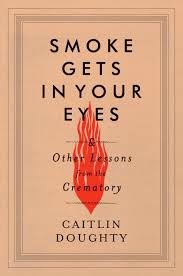
Smoke Gets in Your Eyes by Caitlin Doughty
Doughty's obsession with death began young after a tragedy at the mall. Continuing into adulthood, this obsession led her to a job at a crematory, collecting, prepping, and burning the dead. Smoke Gets in Your Eyes is a collection of essays combining her experiences at the crematory and her strong, non-traditional views on death and our treatment of the dead.
My expectations going into this book were rather high. And rather incorrect. I expected a book more focused on death and dying a la Mary Roach's Stiff. Eagerly opening the book, expecting information, history, cultural analysis, I was quickly disappointed in that the book was more focused on Doughty than on death. This is a memoir, not narrative nonfiction as I believed. Unfortunately it took my mind too long to flip switches, and I ended up feeling very lukewarm about the book.
Sprinkled throughout the collection are tidbits of information on historical and contemporary traditions regarding death and dying. Each time they popped up, I was excited and quickly let down due to the lack of detail and depth. Then there were sections that felt oddly placed to me or even disingenuous such as the strangeness with Luke and the thing at the park that was handled really cavalierly all things considered (trying not to spoil things here).
Had I gone into this book with a different mindset, I do believe I would have enjoyed the read. Doughty has a wonderful voice in her writing, and her humor and wit and insight were prevalent throughout. The bodies, alive and dead, that peopled the book were well developed and unique. Plus, I am definitely in the minority here as almost everyone seems to love this book. For better and more positive reviews, try S. Krishna's Books, Estella's Revenge, and Sophisticated Dorkiness,
This may be one of those books that I have to re-read - without my original notions.
My expectations going into this book were rather high. And rather incorrect. I expected a book more focused on death and dying a la Mary Roach's Stiff. Eagerly opening the book, expecting information, history, cultural analysis, I was quickly disappointed in that the book was more focused on Doughty than on death. This is a memoir, not narrative nonfiction as I believed. Unfortunately it took my mind too long to flip switches, and I ended up feeling very lukewarm about the book.
Sprinkled throughout the collection are tidbits of information on historical and contemporary traditions regarding death and dying. Each time they popped up, I was excited and quickly let down due to the lack of detail and depth. Then there were sections that felt oddly placed to me or even disingenuous such as the strangeness with Luke and the thing at the park that was handled really cavalierly all things considered (trying not to spoil things here).
Had I gone into this book with a different mindset, I do believe I would have enjoyed the read. Doughty has a wonderful voice in her writing, and her humor and wit and insight were prevalent throughout. The bodies, alive and dead, that peopled the book were well developed and unique. Plus, I am definitely in the minority here as almost everyone seems to love this book. For better and more positive reviews, try S. Krishna's Books, Estella's Revenge, and Sophisticated Dorkiness,
This may be one of those books that I have to re-read - without my original notions.
10 December 2014
Beauty by Robin McKinley
Robin McKinley's Beauty is, as its subtitle states, a retelling of the story of Beauty and the Beast. This new reading stays close enough to the original to feel remarkably authentic while changing enough to make it relatively refreshing.
Fascinatingly - to me at least - much of the story takes place before the Beast is even mentioned. Beauty is a three part story, and it isn't until part 3 that Beauty goes off to live with the Beast. Before Beauty is imprisoned - in a beautiful castle where her every need and want is catered to - she is the bookish daughter of a wealthy merchant living in the city; then she is the daughter of a ruined merchant working in the country. This shift in status and her sisters' love lives are told in the first two parts of the story - perhaps as foils for Beauty's love story in part 3?
Speaking of the sisters, I love their relationship. Grace, Hope, and Beauty (Honour) are so wonderfully distinct and so beautifully connected to each other. Neither of Beauty's sisters is developed enough to truly stand out as a complex character; and yet both of them have enough characterization to evoke sympathy and provide a sense of familial camaraderie.
In this version of the tale, the Beast makes a bargain with Beauty's father: give me one of your daughters or die. Creepy. The father, at Beauty's insistence, agrees. Creepy. Then from day one, the Beast asks Beauty to marry him after dinner every night. Creepy. Despite the creepy, I did appreciate Beauty's slow acceptance of the Beast and her even slower fall into love. Her realization that she is in love with the Beast comes late in the game and has been described by some as underwhelming; this doesn't bother me. Actually I kind of like it that Beauty doesn't crash into love with a big bang and fireworks and sudden, shocking awareness. Sometimes realizing you love someone comes softly, easily, it calms rather than excites.
Unfortunately, I'm not entirely convinced of their love. The Beast's need for a woman to marry him, and his apparent "love" for Beauty from day one seems very unbelievable. Then again, the story seems to hint that the Beast knew of Beauty and her family prior to when we, the readers, believe the actual meeting occurred.
This ambiguity is not confined to the Beast's love. There were pivotal moments that seemed undertold, without the necessary in-the-moment detail and without the background information needed. At times, it felt like the generic idea of "magic" could account for a bit too much. At other times, including the ending, it felt like the generic concept of "fairy tales" could justify events with no true cause-and-effect or reasoning.
I have heard wonderful things about McKinley, so I am making it a point to not let this book turn me off. Any advice on which of her novels I should read next?
Fascinatingly - to me at least - much of the story takes place before the Beast is even mentioned. Beauty is a three part story, and it isn't until part 3 that Beauty goes off to live with the Beast. Before Beauty is imprisoned - in a beautiful castle where her every need and want is catered to - she is the bookish daughter of a wealthy merchant living in the city; then she is the daughter of a ruined merchant working in the country. This shift in status and her sisters' love lives are told in the first two parts of the story - perhaps as foils for Beauty's love story in part 3?
Speaking of the sisters, I love their relationship. Grace, Hope, and Beauty (Honour) are so wonderfully distinct and so beautifully connected to each other. Neither of Beauty's sisters is developed enough to truly stand out as a complex character; and yet both of them have enough characterization to evoke sympathy and provide a sense of familial camaraderie.
In this version of the tale, the Beast makes a bargain with Beauty's father: give me one of your daughters or die. Creepy. The father, at Beauty's insistence, agrees. Creepy. Then from day one, the Beast asks Beauty to marry him after dinner every night. Creepy. Despite the creepy, I did appreciate Beauty's slow acceptance of the Beast and her even slower fall into love. Her realization that she is in love with the Beast comes late in the game and has been described by some as underwhelming; this doesn't bother me. Actually I kind of like it that Beauty doesn't crash into love with a big bang and fireworks and sudden, shocking awareness. Sometimes realizing you love someone comes softly, easily, it calms rather than excites.
Unfortunately, I'm not entirely convinced of their love. The Beast's need for a woman to marry him, and his apparent "love" for Beauty from day one seems very unbelievable. Then again, the story seems to hint that the Beast knew of Beauty and her family prior to when we, the readers, believe the actual meeting occurred.
This ambiguity is not confined to the Beast's love. There were pivotal moments that seemed undertold, without the necessary in-the-moment detail and without the background information needed. At times, it felt like the generic idea of "magic" could account for a bit too much. At other times, including the ending, it felt like the generic concept of "fairy tales" could justify events with no true cause-and-effect or reasoning.
I have heard wonderful things about McKinley, so I am making it a point to not let this book turn me off. Any advice on which of her novels I should read next?
19 November 2014
The Secret Garden by Frances Hodgson Burnett
I picked up Frances Hodgson Burnett's The Secret Garden for three reasons:
The story is remarkably simple and sweet. While part of me wishes the story was more fleshed out, I appreciate the easiness of the story as it is told. Basically the story shows Mary's growth from a sickly, spoiled brat into a young girl who can teach another sickly, spoiled brat how to be better. And apparently this rather dramatic change is accomplished by nothing more than being outside and the influence of a friend from the lower class. I may be oversimplifying a bit here, or even sounding condescending, but as I said this is a remarkably simple story.
The personality changes - the kids' and the adult's - may be a bit unbelievable, but there is something sweet and innocent about these transitions, and it is fitting considering the intended audience for the book - NOT a mildly cynical woman in her 30s.
What I find most interesting in this book is the issue of class. Both Mary and Colin are the children of absent, well-off parents. They are left in the charge of servants who give the children anything they want and put up with their tantrums and fits and that horrid tone of voice a spoiled kid can get that makes you re-think your no-spanking-children stance...okay, that last part may be invented by yours truly, but I think it can be reasonably inferred from the details in the story. Not only does this bring up many, many complications arising from positions of power in what is, in essence, parent-child relationships between servants and masters, the story also has a brother of a servant as the model for the ideal child. A Marxist theorist could go crazy with this story.
While I wouldn't urge you to run out and buy this, if you do come across it, it's worth the very short time it takes to read.
- I came across a very, very cheap copy
- I needed a fast read
- I remember this story fondly
The story is remarkably simple and sweet. While part of me wishes the story was more fleshed out, I appreciate the easiness of the story as it is told. Basically the story shows Mary's growth from a sickly, spoiled brat into a young girl who can teach another sickly, spoiled brat how to be better. And apparently this rather dramatic change is accomplished by nothing more than being outside and the influence of a friend from the lower class. I may be oversimplifying a bit here, or even sounding condescending, but as I said this is a remarkably simple story.
The personality changes - the kids' and the adult's - may be a bit unbelievable, but there is something sweet and innocent about these transitions, and it is fitting considering the intended audience for the book - NOT a mildly cynical woman in her 30s.
What I find most interesting in this book is the issue of class. Both Mary and Colin are the children of absent, well-off parents. They are left in the charge of servants who give the children anything they want and put up with their tantrums and fits and that horrid tone of voice a spoiled kid can get that makes you re-think your no-spanking-children stance...okay, that last part may be invented by yours truly, but I think it can be reasonably inferred from the details in the story. Not only does this bring up many, many complications arising from positions of power in what is, in essence, parent-child relationships between servants and masters, the story also has a brother of a servant as the model for the ideal child. A Marxist theorist could go crazy with this story.
While I wouldn't urge you to run out and buy this, if you do come across it, it's worth the very short time it takes to read.
13 November 2014
Blue Lily, Lily Blue by Maggie Stiefvater
Maggie Stiefvater's Raven Cycle is one of the best YA series I've read. In my review of the first book in the series, The Raven Boys, I said the book is "wonderfully mystical, artfully written, and full of unique characters." That works for the whole series. In my review of the second, The Dream Thieves, I said "I am ready to believe Stiefvater can do no wrong." Yep. I'm completely there. I very rarely follow an author, but I'm putting her on my to-read list, and I'm going to start reading everything the woman has written.
So you probably would like me to talk a bit more about this specific installment instead of just gushing like a fan girl. Blue Lily, Lily Blue moves our characters more firmly into their magical journey, and simultaneously progresses their relationships in a gorgeous, subtle, inevitable way. Everything about this book is emotional, moving, poignant, and yet it never feels overblown. The delicate line Stiefvater walks in her writing is artful. Her plot lines are complex without being convoluted. Her characters are deep without being pretentious, unique without being showy. Seriously, Stiefvater's writing is some of the best I've seen in YA.
Her books have soul. There is something alive about the stories; the worlds and the people who inhabit them are so believable and likeable and magical. What stands out the most to me about this cast of characters is their love for each other. They are - self-acknowledgedly - bound together.
My only problem with the book is the lack of answers at the end. Things wrapped up a bit too quickly, in that they really didn't wrap up. This installment felt less contained then the first two which annoyed me a bit, but it does lay out all the ingredients for a quite amazing final book. Plus, I think the faster pace and increased action may be part of the buildup to the fourth book. Upon reflection, my annoyance may be entirely due to my very, very strong desire to NOT have to wait for the last book.
And when oh when will that fourth book come out? Waiting is torture.
So you probably would like me to talk a bit more about this specific installment instead of just gushing like a fan girl. Blue Lily, Lily Blue moves our characters more firmly into their magical journey, and simultaneously progresses their relationships in a gorgeous, subtle, inevitable way. Everything about this book is emotional, moving, poignant, and yet it never feels overblown. The delicate line Stiefvater walks in her writing is artful. Her plot lines are complex without being convoluted. Her characters are deep without being pretentious, unique without being showy. Seriously, Stiefvater's writing is some of the best I've seen in YA.
Her books have soul. There is something alive about the stories; the worlds and the people who inhabit them are so believable and likeable and magical. What stands out the most to me about this cast of characters is their love for each other. They are - self-acknowledgedly - bound together.
My only problem with the book is the lack of answers at the end. Things wrapped up a bit too quickly, in that they really didn't wrap up. This installment felt less contained then the first two which annoyed me a bit, but it does lay out all the ingredients for a quite amazing final book. Plus, I think the faster pace and increased action may be part of the buildup to the fourth book. Upon reflection, my annoyance may be entirely due to my very, very strong desire to NOT have to wait for the last book.
And when oh when will that fourth book come out? Waiting is torture.
15 October 2014
Stitches by David Small
I read this too fast. Emotionally smacking me in the face on page 12, Stitches hooked me in and I devoured this intense graphic novel in about 20 minutes. I clearly did not do this book justice, and I will have to read it again more closely sometime.
While - I am positive - all people react strongly to any mistreatment of children, I also believe that parents are more affected, more horrified, and more likely to have bad dreams. In Stitches, the main character, David, lives a nightmarish life in the midst of a neglectful and abusive family. Then at 14, he enters the hospital for a minor surgery and leaves missing his thyroid and his vocal cords. And, of course, he returns to a home life of neglect and abuse until finally escaping and finding his new voice in art.
Bad enough. Then I realize it is a graphic memoir aka totally not fiction - yeah, sometimes it takes me awhile - and my heart practically stops. I have a very strong desire to beat the living crap out of the adults in David's life. Clearly these adults are suffering from their own issues - secrecy, shame, isolation, and some actual crazy - but yeah, I want them punished.
Okay, enough rant, back to the book. In a lovely choice, Small mirrors form and content, using minimal words to relate a story about loss of voice (both literal and figurative). The images really shine here, telling as much of the story, if not more, than the actual text. The use of black and white, sketch-type images fits perfectly, highlighting the bleakness of the story and mirroring the stark portrayal of a complex life.
My only issue was a slight lack of clarity from time to time with the images. I wasn't sure exactly what was happening every now and again, sometimes due to the blending of David's reality and David's imagination and sometimes because the simplicity of the images didn't differentiate people enough for me. Then again, I really think the problem here is that I plowed through this in 20 minutes.
Random thought: I love the rabbit therapist.
I know I'm totally late to the "Stitches is Awesome" party, like 4 or 5 years behind the game I guess, but hey, better late than never, right?
While - I am positive - all people react strongly to any mistreatment of children, I also believe that parents are more affected, more horrified, and more likely to have bad dreams. In Stitches, the main character, David, lives a nightmarish life in the midst of a neglectful and abusive family. Then at 14, he enters the hospital for a minor surgery and leaves missing his thyroid and his vocal cords. And, of course, he returns to a home life of neglect and abuse until finally escaping and finding his new voice in art.
Bad enough. Then I realize it is a graphic memoir aka totally not fiction - yeah, sometimes it takes me awhile - and my heart practically stops. I have a very strong desire to beat the living crap out of the adults in David's life. Clearly these adults are suffering from their own issues - secrecy, shame, isolation, and some actual crazy - but yeah, I want them punished.
Okay, enough rant, back to the book. In a lovely choice, Small mirrors form and content, using minimal words to relate a story about loss of voice (both literal and figurative). The images really shine here, telling as much of the story, if not more, than the actual text. The use of black and white, sketch-type images fits perfectly, highlighting the bleakness of the story and mirroring the stark portrayal of a complex life.
My only issue was a slight lack of clarity from time to time with the images. I wasn't sure exactly what was happening every now and again, sometimes due to the blending of David's reality and David's imagination and sometimes because the simplicity of the images didn't differentiate people enough for me. Then again, I really think the problem here is that I plowed through this in 20 minutes.
Random thought: I love the rabbit therapist.
I know I'm totally late to the "Stitches is Awesome" party, like 4 or 5 years behind the game I guess, but hey, better late than never, right?
Subscribe to:
Posts (Atom)