Showing posts with label medieval monday. Show all posts

31 August 2015

Medieval Monday: Phaedrus


Okay, now that's you've been minisculely introduced to Socrates and his views on rhetoric as presented in Plato's Gorgias and Phaedrus, here's a more insightful, intellectual, and textual discussion of Phaedrus.

At first glance, Plato’s dialogue Phaedrus appears to be an examination of love. The dialogue begins with Phaedrus reading a speech to Socrates in which the author, Lysias, attempts to convince the audience "that an admirer who is not in love is to be preferred to one who is". In an attempt to prove to Phaedrus that Lysias’s speech is not the grandest in the world, Socrates performs an impromptu speech arguing the same thesis, a speech which puts Lysias’s to shame. Then, because Socrates is freaking out over delivering a speech he finds rather sacrilegious, believing that by his speech he "sinned against Love", he performs a third speech arguing that it is far better to be with someone who does love you. All three conversations are about love, but these conversations are merely the vehicle through which Socrates analyzes oratory and rhetoric.

Phaedrus’s organization seems to be example followed by theory. In the first half of the dialogue, Plato provides us with three speeches. The second speech, which is delivered by Socrates, is designed to provide readers with a well-structured and well-argued speech as a counter to Lysias’s unstructured, generic one. The third speech, again delivered by Socrates, is a second example of what constitutes “good” rhetoric according to Socrates. Once the bad and good examples have been related to the audience, Plato moves the conversation between Socrates and Phaedrus away from love to an attempt at delineating the criteria on which to judge a speech. In other words, the two men begin discussing the art of the rhetoric.

By comparing and analyzing the speeches from the first half, a reader can identify certain elements Socrates believes to be requirements for an effective argument. First, Socrates requires good form. The structure of the argument must be coherent and logical. In his speech, Lysias continually repeats himself; Socrates calls it "an attempt to demonstrate how [Lysias] could say the same thing in two different ways". Also a matter of form, transitions are used in Socrates’s speech to move the reader/listener from one argument or piece of evidence to the next; whereas in Lysias's speech, we merely get the same transition over and over which makes the speech read more like a series of enumerated but unrelated points. Second, Socrates requires good content which is not only skillfully arranged but also original. Again, Lysias's tendency towards repetition offers an example of what not to do. Socrates wonders whether Lysias "could not find sufficient matter to produce variety on a single topic, or perhaps [this was due to] sheer lack of interest" in the subject. Third, based on analyzing Socrates’s speech versus Lysias’s, the reader can easily deduce that Socrates values specificity; whereas Lysias is stuck repeating generalities, Socrates uses specific illustrations of his points through examples and anecdotes. Finally and related to the third point of specificity, the importance, to Socrates, of defining terms is made clear as Socrates spends considerable time defining love, madness, and the soul and providing metaphors and analogies to aid in his definitions. Lysias, however, took their definitions for granted, assuming his audience agreed with his own interpretation of the terms.

The second half of the dialogue makes these criteria explicit through a direct discussion of the art of rhetoric. The first point made is that knowledge of the topic must come before speaking about it whether the speech is meant to enlighten or deceive. Then Socrates attacks Lysias’s introduction and structure as well as his mistake in not defining love. Socrates claims that Lysias’s speech “begins where it should end”, is not logically structured, and merely repeats random points. Socrates asks Phaedrus: "Can you point out any compelling rhetorical reason why [Lysias] should have put his arguments together in the order he has?" This sort of random placement of topics strikes Socrates as bad form. In his opinion, a "speech ought to have its own organic shape, like a living being". After this analysis, Socrates broadens his argument away from a deconstruction of Lysias’s speech to a more general argument in favor of reasoned speaking. Socrates argues that there is a difference between knowing the steps of constructing an argument and knowing how the steps work together to affect change in a specific audience. Otherwise, in Socrates's opinion the speaker is only dabbling in the "preliminaries" of rhetoric, not in the art of rhetoric.

Part of the art of rhetoric appears to be a focus on audience. Socrates spends a large chunk of time proving that an effective argument must be geared towards a specific audience, saying that a true rhetorician must know the answer to a basic question: What type of man is influenced by what type of speech? He claims that "for such and such a reason a certain kind of person can be easily persuaded to adopt a certain course of action by a certain type of speech, whereas for an equally valid reason a different type cannot". A speaker must truly know to whom he is speaking in order to cater his argument to that particular person.

He states that two methods of reasoning should be used in rhetoric: collection and division. Collection is when a speaker “takes a synoptic view of many scattered particulars and collects them under a single term to form a definition”; whereas division is the ability to deconstruct the collection into individual parts. The way in which a rhetor performs these tasks is determined by the individual soul of the person the rhetor is trying to affect. The rhetor must know his audience and adapt his argument.

The dialogue continues with a discussion concerning the validity of speech versus the written word. The definitive conclusion is that speech far outweighs writing. First, writing has a negative effect on the rhetor in that it diminishes memory and wisdom. Writing also negatively affects the argument being made in that, like a painting, a piece of writing offers no ability for interaction between rhetor and audience. This means that the argument cannot defend itself from detractors, it cannot gear itself towards a particular audience, and "a writing cannot distinguish between suitable and unsuitable readers."

The dialogue concludes with a summation of the points that have been made throughout along with a prayer.

24 August 2015

Medieval Monday: Conclusion to the Role of Women

So we are finally at the end of our look at the role of women in medieval literature, a summary of my final research paper in Grad Studies in Medieval Literature.

Some of the female characters in medieval literature spend their time easing tensions, creating bonds, and smoothing out rough edges; others insert wedges, deceive artfully, or ruffle feathers. Whether mischief-makers or peace-weavers, the female characters discussed played active and integral roles in their stories, suggesting a level of engagement and control often denied them. Contemporary, popular opinion seems to perceive medieval women as oppressed, passive damsels in distress who languish helplessly behind castle walls while big, brawny men run about conquering, rescuing, and pillaging. According to Scott Farrell, this perception is in part due to 19th century authors and painters who “melded the stories and images of King Arthur and the Knights of the Round Table with a Victorian sense of gallantry, which delineated a passive role for women.” Despite the contrary portrayal in medieval texts, this image of medieval women as inactive persists.

Farrell argues that “this role would have been quite alien to the audiences of the Middle Ages, for whom tales of Arthur and Guenevere were not wistful reminiscences, but evocative and timely social commentaries.” Even Sir Gawain’s strange, seemingly out-of-place rant about women suggests that women were influencers and initiators:
But no wonder if a fool finds his way into folly
And be wiped of his wits by womanly guile –
It’s the way of the world. Adam fell because of a woman,
And Solomon because of several, and as for Samson,
Delilah was his downfall, and afterwards David
Was bamboozled by Bathsheba and bore the grief. (2414-2419)
In his angry diatribe, Sir Gawain provides a substantive list of influential women who “charmed and changed” (2425) the - rather powerful - men in their lives. If literary representations of women are a reflection of the female role in society, then one must wonder why the passive female paradigm persists despite textual evidence to the contrary.

One truth stands out, the female characters were carefully placed within the texts as active agents. Women such as Wealhtheow, Lanval’s Faerie Queen, Lady Bertilak, Morgan Le Fay, and Grendel’s mother are not mere ornamentation. Their influence rivals that of the male characters.Through their marriages, their words, and their actions, these influential women have substantial effects on the world around them for good or ill, for peace-weaving or mischief-making.

Thanks for reading!

thank-you-0736-stick-man-dance

For more information, I highly recommend the following sources:

Acker, Paul. “Horror and the Maternal in “Beowulf”. PMLA 21.3 (2006): 702-716. Web. 5 June 2015.

Armstrong, Dorsey. “Supernatural Women.” Women and Gender in Medieval Europe: An Encyclopedia. Ed. Margaret Schaus. Routledge, 2006. Web. 19 June 2015.

Dockray-Miller, Mary. “The Masculine Queen of Beowulf.” Woman and Language 21.2 (1998): 31-38. Web. 1 June 2015.

Horner, Sheri. “Voices from the Margins: Women and Textual Enclosure in Beowulf.” The Discourse of Enclosure: Representing Women in Old English Literature. SUNY Press, 2014. 65-100. Web. 22 June 2015.

Jones, Samantha. “The Loathly Lady and the Margins of the Middle Ages.” University of Cincinnati, 2001. Web. 20 June 2015.

Kliman, Bernice W. “Women in Early English Literature, “Beowulf” to the “Ancrene Weiss”. Nottingham Medieval Studies (1 Jan. 1977): 32-49. Web. 29 May 2015.

Morgan, Gerald. “Medieval Misogyny and Gawain’s Outburst Against Women in Sir Gawain and the Green Knight.” The Modern Language Review, 97.2 (April 2002): 265-278. Web. 28 May 2015.

Oswald, Dana. “Unnatural Monsters, Invisible Mothers: Monstrous Female Bodies in the Wonders of the East.” Different Visions: A Journal of New Perspectives on Medieval Art 2 (June 2010): 1-33. Web. 5 June 2015.

17 August 2015

Medieval Monday: The Mischief-Makers

For the past two weeks, I've been posting pieces of my final research paper for Grad Studies in Medieval Lit on the role of women. Last week, I covered the peace-weavers, so this week we move on to the mischief-making females of medieval literature.

Perhaps one of the most studied versions of the female medieval mischief-maker is that of the loathly lady, “a character whose special knowledge and social position combine with her physical undesirability to mark her as marginal” (Jones). Within the texts studied for this paper, appearance can certainly coincide with a woman’s role as either peace-weaver or mischief-maker. For example, the Faerie Queen, a peace-weaver of these tales, is described in great detail, over 34 lines are dedicated to her beauty. Her body “well shaped and elegant” (100) combined with her “eyes bright, her face white / a beautiful mouth, a well-set nose” (565-566) create a woman who is so beautiful “the lily and the young rose / when they appear in the summer / are surpassed by her beauty” (94-96). On the other side of the spectrum, we have Morgan Le Fay who is “noosed and knotted at the neck” (957), “withered by years” (951) with cheeks “wattled and slack” (953) and “buttocks bulged and swelled” (967) who is so unattractive that she is referred to as a “sorrowful sight” (963).

The “special knowledge” and “social position” referred to in Jones’s definition are also evident in females from the analyzed texts. Morgan Le Fay is a witch who occupies a position of power within a family not her own; Grendel’s mother is a powerful woman-beast who is isolated from civilization. Both of these women are privy to knowledge outside of normal human understanding, and both live outside normal societal structure. As Jones argues while classifying the loathly lady as Other, she is an outsider “in part simply because she is female-but more than her gender, her physical constitution and lack of societal connectedness illustrate the multiple, systematic oppressions inherent in medieval culture”. What role could an unattractive, intelligent, non-conforming woman have other than mischief-maker?

Unlike peace-weavers, mischief-makers are easily identified as active agents within their stories. “Through spells, gifts, and shrewd manipulation of conventional gender roles, such female characters often function to produce – rather than merely participate in – the narrative action” (Schaus 786). After all, Sir Gawain and the Green Knight relies entirely on Morgan Le Fay’s desire to irk her sister Guinevere without which there would be no story. As Miyares points out, “men were puppets in the hands of Morgan Le Fay to grieve another powerful woman, Guinevere” (186). Her action starts the narrative. Likewise, without Grendel’s mother, Beowulf would be a much different tale. Her desire to avenge her son’s death launches the longest subplot within the text. Finally, in our third text, The Lay of Lanval, the Faerie Queen is the foundation of the action: she initiates the relationship with Lanval which leads him to insult Guinevere. These women are catalysts, creators (creatures) of action, and rather mischievous; however, they are not all quite the same level of mischief-maker. Some are tricksters; some are a bit more evil.

Lady Bertilak, in Sir Gawain and the Green Knight, is the most pure example of a female trickster within the texts being discussed in this paper. Lady Bertilak’s true nature as trickster is not revealed until the end of the poem when Lord Bertilak tells Sir Gawain that she has been functioning as a co-conspirator: Bertilak says “I know of your courtesies, and conduct, and kisses / and the wooing of my wife – for it was all my work! / I sent her to test you” (2360-2362). Prior to this point, Lady Bertilak could be construed as an evil temptress as she attempts to seduce Gawain on three separate occasions. While her actions appear immoral while reading, they are excused when the reader finds out her attempt at seduction was sanctioned, even ordered, by her husband. Earlier in the paper, Lady Bertilak is referred to as a moderator due to Lord Bertilak’s promise to Sir Gawain that the lady will serve to comfort him in Lord Bertilak’s absence. This promise of comfort fulfills a function of a peace-weaver; however, the promise made is flawed. Lady Bertilak is not a comfort to Sir Gawain; she deceives him and disingenuously seduces him. Represented by her husband as a peace-weaver, she is in fact a mischief-maker.

Another character in Sir Gawain and the Green Knight, Morgan Le Fay, illustrates the role of female trickster. Morgan turns Bertilak into the Green Knight in an effort to frighten her sister, Guinevere. According to Lord Bertilak, Morgan sent him to Arthur and the Round Table “to muddle [their] minds” (2459) in the hopes that “grieving Guinevere would go to her grave / at the sight of a specter making ghostly speeches / with his head in his hands before the high table” (2460-2462). Morgan clearly has control over Lord Bertilak and her actions create a conflict and quest for Sir Gawain, but her influence is not reminiscent of a peace-weaver or even a great beauty who affects the lives of men by her desirability. Her control manifests itself in the game she is playing with her sister in which Lord Bertilak and Sir Gawain function as mere chess pieces. In fact it is possible that “Morgan’s presence expresses an essential feeling in the plot, that woman, a witch, is responsible for it all, rather than the hero himself” (Miyares 186). When her influence over the events is seen in this way, the question becomes: is Morgan a trickster or is she actually evil? After all, Morgan and Lady Bertilak’s “game” could have had dire consequences, Sir Gawain’s death which would certainly push her over from trickster to evil manipulator. Then again, if Morgan controlled the game and knew Bertilak’s axe swing would not harm Gawain, she remains a trickster.

The best example of the evil female, rather than the trickster, is Grendel’s mother. “Identified only by her biological function of having given birth to Grendel,” she fulfills a role in the poem that is significantly larger than her son’s (Horner 82); however, despite her crucial role to the action of the poem, Grendel’s mother is not given the respect of a name. Not only does this reveal the speaker’s and the culture’s indifferent view of her as an individual, but by not having a name, she remains “uncontained…she alone remains outside of the peace-weaving economy of exchange, and thus outside of any kind of physical or cultural enclosure” (Horner 82). She is unmarried and uninterested in maintaining the peace. Another detail that marks her as different from the peace-weaving women of her tale is that Grendel’s mother uses violence instead of words to fulfill her purposes. While Wealhtheow’s careful manipulation of words allows her to subtly influence her husband’s actions, Grendel’s mother’s direct violence seems rather more effective – except of course, that in the end, Grendel’s mother dies because of her difference.

In part, this difference is due to a simple fact of medieval society: gender defined life. Men and women functioned in distinct spheres, and any cross-over was aberrant. Adopting characteristics of the opposite sex did not change one’s sex or gender, as it can today, instead “women who transgressed the expectations for their gender did not thereby become not-women; they became deviant women”; to use this paper’s term, they became mischief-makers (qtd. in Oswald 9). This deviance was deemed monstrous, and the woman was seen as part male; this “collapse of two sexes into one body is perhaps even more troubling” than the monsters in literature who were part man and part animal (Oswald 8). As Oswald states, “while threatening to smash the distinction between man and animal is frightening, eliminating the distinction between male and female would lead to the collapse of the medieval social order” (Oswald 8-9).

Two male characteristics displayed by the vilified females in our texts are vengeance and violence. For example, Grendel’s mother “acts aggressively, arguably in a fashion reserved for men” (Acker 705). Her actions are actually remarkably similar to that of her son, a fact which is emphasized in the poem when the poet remarks that one of the warriors will die “just as had often happened before when Grendel preyed upon the hall” (qtd. in Acker 705). The impropriety of her actions are directly related to gender expectations as her actions would be seen as admirable and even necessary if she were male. If a son was killed, a father would by necessity have to avenge his death. When Grendel’s mother completes the same action, she is vilified, possibly because she “threatens not just an individual man's dominance but the whole system of male dominance” (Acker 708). Jane Chance states it clearly: “It is monstrous for a mother to avenge her son as if she were a retainer, he were her lord, and avenging more important than peacemaking” (qtd. in Horner 84). Her status as a woman makes her revenge monstrous rather than honorable (Acker 705).

Jane Chance draws a connection between the three mothers in Beowulf in relation to this system of vengeance: "The past helplessness of the first mother, Hildeburh, to requite the death of her son counter points the anxiously maternal Wealhtheow's attempt to weave the ties of kinship and obligation, thereby forestalling future danger to her sons. Later that night, Grendel's mother, intent on avenging the loss of her son in the present, attacks Heorot, her masculine aggression contrasting with the feminine passivity of both Hildeburh and Wealhtheow" (qtd. in Acker 704).

Acker then identifies Grendel’s mother as a female antitype (704), an argument well supported by her adoption of male characteristics. Similar to Grendel’s mother, albeit in a less aggressive way, Modthryth from Beowulf, displays male characteristics. Again, she wields power and “her masculine performance manages to subvert the usual use of women as objects in exchanges between men” (Dockray-Miller 32). While Grendel’s mother kills directly, Modthryth merely orchestrates death. This may appear to make her less monstrous than Grendel’s mother, but while Grendel’s mother killed to avenge the murder of her son, Modthryth orders the death of many, apparently just for looking her in the face. Modthryth is presented as the antithesis to Queen Hygd, a mediator and peace-weaver in the tale: "A woman should weave peace, not punish the innocent with loss of life for imagined insults" (1942-1943). Initially, Modthryth is similar to Grendel’s mother, “violent, unviewable in daylight, and fatal for men to encounter” (Horner 89). Eventually both women are tamed, so to speak; Grendel’s mother is slain by Beowulf, and Modthryth becomes docile when she is married off to King Offa. Her marriage reinforces the belief that a woman must be contained within a peace-weaving role and that marriage is “essential for conventional femininity” (Horner 89).

Similar to Modthryth, Guinevere in The Lay of Lanval has her husband dole out her punishments. In this case, she manipulates her husband into punishing the man who refuses her advances. When her attempted seduction of Lanval fails, Guinevere is disappointed, but his subsequent insult to her beauty pushes her past the point of logic. Originally, Lanval merely tells Guinevere that he has “no desire to love [her]” (270) because he has “served the king a long time” (271) and he doesn’t want to “betray [his] faith to him” (272). Guinevere, unhappy with Lanval’s answer, gets angry and “in her wrath, she insulted him” (276), suggesting he is homosexual, saying he is a “base coward, a lousy cripple” (283) and that God may punish Arthur for letting Lanval stay at Camelot (284-286). Understandably upset by Guinevere’s words, Lanval tells Guinevere that even “the poorest girl of all [in the employ of his Faerie Queen] / is better than you, my lady queen / in body, face, and beauty / and in breeding and in goodness” (299-302). In response, Guinevere tells her husband, Arthur, that Lanval tried to seduce her and “insulted and offended her” (319). Her manipulations cause Arthur to arrest Lanval. While Lanval’s incarceration may seem trivial and not worth classifying Guinevere as ‘evil’, readers must realize that her deceit could cost Lanval his life. After all, Arthur states that if Lanval “could not defend himself in court / he would have him burned or hanged” (327-328). Guinevere is willing to architect Lanval’s death solely from injury to her pride. Pride, of course, being an emotion and motivator reserved for men…and mischief-makers.


For the thrilling conclusion, see next week's Medieval Monday!

10 August 2015

Medieval Monday: The Peace-Weavers

As I said in last week's Medieval Monday post, I wrote my final research paper in Grad Studies in Medieval Lit on the role of women, focusing on how medieval literature portrays women as either peace-weavers or mischief-makers. This week, I focus on the peace-weavers.

The term peace-weaver itself suggests action. The term is a kenning, a literary trope common to medieval literature. A kenning “consists of two words, usually hyphenated, to describe something instead of using the customary noun” (“How is a Kenning Used”). The choice of words attaches specific connotations to the referent (the noun the kenning is replacing). For example, the kenning peace-weaver suggests a delicate threading through the use of the term “weaver” expressing the skill needed to keep the peace. It also suggests a woman by the use of the term “weaver” as this was typically a female role. Similarly, mischief-maker is a kenning; although unlike peace-weaver, it is not gendered.

According to Andrew Welsh in his article “Branwen, Beowulf, and the Tragic Peaceweaver Tale”, the peace-weaver’s role carries two purposes: “to create by her marriage peaceful bonds between two previously or potentially hostile kin-groups, or tribes, and after her marriage to encourage and support peaceful and harmonious relations among the members of the kin-group…that she has joined” (7). The first purpose is admittedly passive; the woman is merely moved from father to husband with little or no action or approval on her part. The second purpose, however, requires a great deal of effort. Keeping the peace, especially in a warrior society, is no small feat.

In Welsh’s first purpose, a woman joins two tribes together through marriage when she becomes “the invisible solder which wields man to man” (Kliman 33). It seems ironic that the marriage between man and woman has as its ultimate purpose the binding of two men rather than the couple getting married. This role is clearly seen in Beowulf through Hildeburh, Wealhtheow, and Freawaru and other smaller female roles. Hildeburh’s story is related in the Finnsburgh Episode of Beowulf. The daughter of a Danish King, Hildeburh “was married to Finn, king of Friesland, presumably to help end a feud between their peoples” (Greenblatt 63). Wealhtheow, King Hrothgar’s wife, is referred to as the “frithu-sibb folcu” translated as “the peaceful tie between nations” (Kliman 33), clearly indicating her role as peace-weaver. Hrothgar plans on marrying his daughter to Ingeld in the “hopes [she] will heal old wounds and grievous feuds” (2027-2028). All three women are used as a visible, emotional link between tribes, a symbol to each man in her life – father and husband – that their two peoples are connected and should live peacefully.

While marriage is certainly one way a woman could create a bond between two nations, other methods also exist. One way a woman could foster peace between tribes other than marriage was through the giving of gifts. Wealhtheow gives Beowulf gifts of her own outside of those provided by her husband Hrothgar (1215) showing she has an active role – or at least can take an active role – in maintaining close relationships with foreign nations. Wealhtheow gives Beowulf a necklace and simultaneously entreats him to “treat [her] sons / with tender care” (1226-1227) combining her role as a mother and a peace-weaver as she appeals to Beowulf to maintain peace between their respective nations even through her children.

Another example of a woman maintaining the peace between two tribes is the Faerie Queen in Marie de France’s Lay of Lanval. Markedly different from the examples in Beowulf, the Faerie Queen operates outside the influence or control of a husband. She asserts her own authority and rescues her lover from King Arthur’s court after he is unjustly accused of grievously insulting Guinevere. While the threat of violence between the two nations is more focused in this instance – on one individual, Lanval – the mediator of peace between the two nations is still a queen, a woman. What is truly interesting in this particular case is the question of how the Faerie Queen’s role is modified by her being a faerie. Written differently, the Faerie Queen could easily fall into the mischief-maker category as she defies traditional gender roles in her relationship with Lanval. She is the instigator of their romance, she is the one who sets the terms of their relationship, and ultimately she is the knight-in-shining armor who rescues her lover from imprisonment and possibly death. Despite all of this, Marie de France sets up the Faerie Queen as a peace-weaver rather than a mischief-maker, and this distinction may be allowed due to the Faerie Queen not being a human woman.

Welsh’s second purpose of the peace-weaver states that women not only created and maintained peace between nations but were also the architects of peace within the household. Women kept the peace through calming their husbands and the other men in the house, reminding men of the necessity for civilized behavior, and creating bonds of friendship among the men in their care.

The most obvious method of calming one’s husband in medieval literature appears to be sex. A wife is “a balm in bed” (63) like Onela’s queen in Beowulf, a poem which also references the marital relations between kings and their wives as a way for the husbands to de-stress in trying times. Twice in Beowulf, the author references Hrothgar’s heading off to or coming from the bed he shares with Wealhtheow in what can clearly be construed as a veiled reference to the sexual relationship the two share.

Wealhtheow’s ability to calm her husband extends beyond the bedroom though as seen when she gently reminds her husband, King Hrothgar, to dole out presents wisely to Beowulf. Hrothgar, in his effort to reward Beowulf for killing Grendel, adopts Beowulf “as a dear son” (946) and promises Beowulf that “there’ll be nothing [he’ll] want for, / no worldly goods that won’t be yours” (948-949). In her fear that Beowulf may replace her sons as heir to Hrothgar’s throne and fortune, Wealhtheow skillfully manipulates her speech to subtly remind Hrothgar to remember his sons, suggesting that Hrothgar “be open-handed, happy and fond” (1171) with Beowulf and the Geats, but to “bequeath / kingdom and nation to your kith and kin” (1178-1179). As Kliman argues, “nothing could so poignantly illustrate the diplomacy which is born of impotence than [Wealhtheow’s] disjointed statements unconnected to any request or demand of her own” (Kliman 33). While she can’t directly command her husband to stop giving away all of the goods to Beowulf, she can make simple statements reminding him of his obligation to his offspring. To calm her exuberantly generous husband, Wealhtheow is subtle in her protestation.

A woman’s skills in fostering collaboration are mirrored in her ability to foster other admirable traits in the men around her. According to Scott Farrell, writer for Chivalry Today, a knight’s first stop after accomplishing a quest or feat was the Queen and her ladies. The knight would recount his tale for the women, and they would pass judgement on his actions: “it was the job of the Queen and her ladies to either praise the knight for adhering to the true spirit of chivalry, or rebuke him for succumbing to the temptations of vanity, pride or greed” (Farrell). They were the moral authority and their judgement could bring honor and wealth to the knight or dangerous quests and shame. Farrell contends that this role provided “a needed balance within the literature of chivalry,” a yin-yang dynamic.

Along with presiding over rituals and festivities, women (primarily wives) could help foster peace within the household through the distribution of gifts; similar to the way Wealhtheow creates a bond between the Danes and the Geats through gift-giving in Beowulf. While the lord of the house was the common giver of gifts, his queen could also pass out money and jewels. For example, Hygel distributes gifts to her own people (1929). Through her participation in this activity, a woman not only strengthened the bond between warrior/knight and household/lord, she also increased a warrior/knight’s fidelity to her specifically, in this way encouraging him to behave in a civilized manner.

The civilizing effect of women on men is often exemplified in medieval literature. Gerald Morgan defines a knight as “a warrior who has been civilized by the life of courts and above all by the company of ladies” (267). Simply by being present, the female characters influence male behavior, particularly at meals and social gatherings involving both sexes. In Sir Gawain and the Green Knight, for example, Guinevere, and to an extent Lady Bertilak and Morgan Le Fay, function as a calming presence as they remind men of the necessity for civilized behavior. This particular female duty can also be a more active effort. For example, Wealhtheow actually speaks in order to remind men of appropriate social behavior as when “her gentle words calm those whose spirits have been inflamed by the bitter flyting of Unferth and Beowulf” (Kliman 33). These women and their “gentle words” are only one representation of women in medieval literature; some women’s words are not so gentle.

For more on these not-so-gentle women, check on next week's Medieval Monday.

03 August 2015

Medieval Monday: Peace-Weavers and Mischief-Makers Intro

For my final research paper in Graduate Studies in Medieval Literature, I analyzed the role of women in medieval literature, and I determined that women are basically divided into two categories: peace-weavers and mischief-makers, a predecessor to the virgin-whore dichotomy that comes in later literature. Over the next few weeks, I will share my insights with you in my Medieval Monday posts. First, an overview:

In the Middle Ages, the role of a queen was quite simple: “A queen should weave peace” (Beowulf 1942). Her function was to ensure peace between nations and people and this expectation carries over to all females within medieval literature; however, the reality is that not every female character fulfills this more positive role; some take a darker route. Women, in texts such as Beowulf, The Lay of Lanval, and Sir Gawain and the Green Knight, seem to fulfill one of two roles: the peace-weaver or the mischief-maker, meaning the female characters are either trying to foster peace or they are trying to stir up trouble.

What is truly interesting is that, regardless of which role they are fulfilling, the women are active Lanval definitely had their work cut out for them as well. Some recent criticism has suggested that women such as Wealhtheow and other peace-weavers are “fundamentally passive figure[s] in [their] story” (Welsh 12); however the ability to maintain peace may require more effort than these critics realize. After all, “the strenuous and delicate balance of behavior which [these female peace-weavers] must daily execute seems to be more difficult to achieve than the warrior’s bold plunge into destruction” (Welsh 13). While brandishing a sword appears more active and maybe even more effective on the surface, the artful and delicate manipulation required to assert control over a situation in which these women are culturally subordinate is admirable.
participants, suggesting a level of engagement generally denied them in popular conceptions regarding medieval gender roles. The mischief-makers such as Grendel’s mother, Morgan Le Fey, and Lady Bertilak may seem like more active participants, but peace-weavers like Wealhtheow and the Faerie Queen from

Still the sword-brandishers and deceivers deserve their just due as well. Instead of weaving peace, they foster discontent. Instead of calming men down, they rile them up. They are the mischief-makers, the tricksters and evil manipulators, of medieval literature. Whether mischief-maker or peace-weaver, the female characters discussed in this paper played active and integral roles in their stories, suggesting a level of engagement and control often denied them. Contemporary, popular opinion seems to perceive medieval women as oppressed, passive damsels in distress who languish helplessly behind castle walls while big, brawny men run about conquering, rescuing, and pillaging. According to Scott Farrell, this perception is in part due to 19th century authors and painters who “melded the stories and images of King Arthur and the Knights of the Round Table with a Victorian sense of gallantry, which delineated a passive role for women.” Despite the contrary portrayal in medieval texts, this image of medieval women as inactive persists. Farrell argues that “this role would have been quite alien to the audiences of the Middle Ages." Why, oh why, does the misconception still exist?

For more information on this topic, check out my next few Medieval Monday posts as I will be putting pretty much my entire paper up here. :)

27 July 2015

Medieval Monday: Description of the Wife of Bath

Geoffrey Chaucer's The Canterbury Tales is one of the most studied books of all time in my experience. I seriously have looked at bits and pieces of this text over and over again throughout my education and my career. This time I read it in very time bites and analyzed it piecemeal.

First up, the description of the Wife of Bath in the General Prologue. I really enjoyed this description. A deaf, gap-toothed, red-stocking-wearing woman, the Wife of Bath sews like a pro, rides well, talks easily, and travels widely. Most importantly, she is well known for her love of men. She has been married five times, and that’s not including the men she’d gone with when she was younger. These experiences made her quite knowledgeable about “remedies of love” (477).

The whole description of the Wife suggests sex. The red stockings and red face, the many men she married or kept company with, even her gap-toothed grin. Apparently, this physicality was “thought to be a sign of amorousness” (Greenblatt 254).  Hilariously – and horrifyingly – “a gap-toothed devout virgin had to fill the space cosmetically, or refrain from smiling” (Cosman 476). That. Is. Hilarious.

Even the juxtaposition of certain phrases were designed to indicate a sensual nature and a wealth of experience. Take the following two lines for example: “She coude muchel of wandring by the waye: / Gat-toothed was she, soothly for to saye” (469-470). On initial reading, the first line seems to simple say that the Wife was a skilled traveler; but coupling it with the following line which is suggestive of sensuality, the line could be reinterpreted. Perhaps the Wife was skilled at wandering from man to man or was adventurous romantically or sexually.  This subtle suggestion is reinforced when the speaker says “she coude of that art the olde daunce” (478), again indicating the Wife is highly experienced in the ways of the flesh. Phrases like this today would have a “hint, hint” or a “wink, wink” to go along with them. Or maybe a more amusing ‘that’s what she said’.

This focus on sexuality carries over into the very naming of the Wife. While the other pilgrims are named by profession – Miller, Franklin, Cook, etc. – the Wife is not called Seamstress. Barbara Daniels argues that this change in the naming system “makes her more personalized”, but I argue that this also highlights the importance of sexuality to the character. Even though her trade is in sewing, her true profession is Wife.

I remember the first time I read this back in high school. I was surprised by how bawdy it all was, and I wasn’t even catching half of the suggestions or double entendres. Was/Is anyone else surprised by this? Do you see any other indications of sexuality in this passage? What do you think Chaucer meant, specifically, by the phrase “remedies of love” (477)?

Side Note: Do you know how many sexy women of today have a freaking gap between their teeth?!?!? Check it out.
________________________________________________________________
Chaucer, Geoffrey. “The Canterbury Tales: The General Prologue”. Trans. Simon Armitage.  The Norton Anthology of English Literature. Gen. ed. Stephen Greenblatt. 9th ed. Vol. A. New York: Norton, 2012. 243-263. Print.

Cosman, Madeleine Pelner, and Linda Gale Jones. Handbook to Life in the Middle Ages. Infobase Publishing, 2009. Google Books. Web. 17 June 2015.

Daniels, Barbara. “The Wife of Bath: Her Description from the General Prologue to the Canterbury Tales.” Classics of English Literature. Web. 17 June 2015.


Greenblatt, Stephen, gen. ed. The Norton Anthology of English Literature. 9th ed. Vol. A. New York: Norton, 2012. Print.

20 July 2015

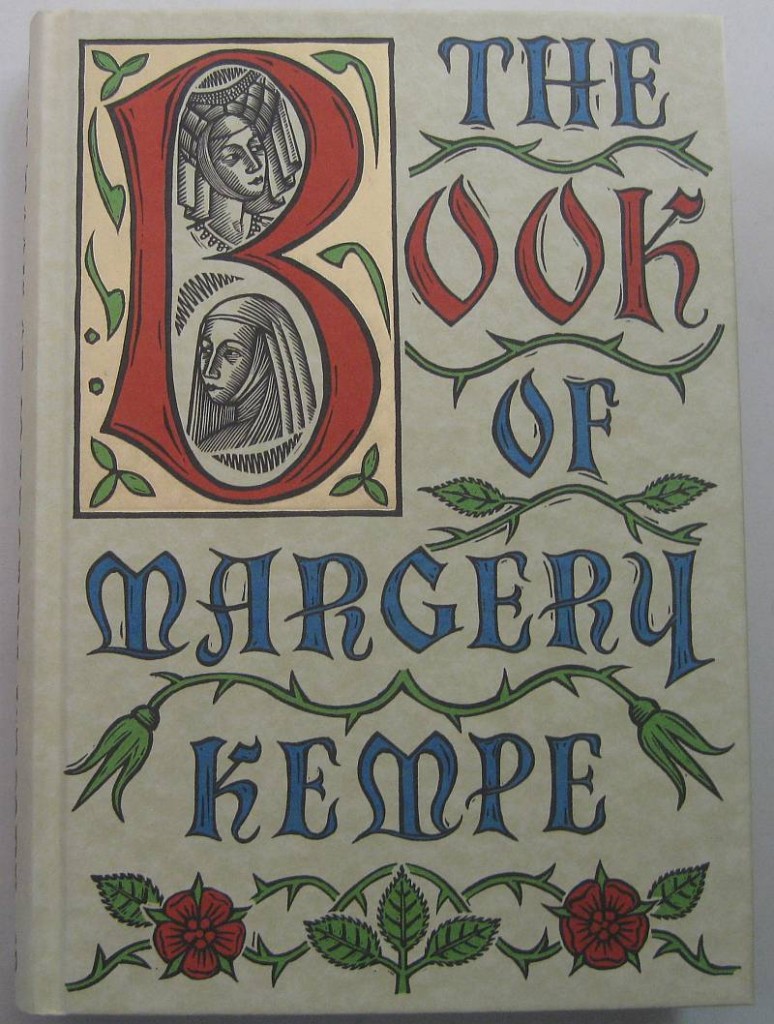
Medieval Monday: Margery Kempe Chapter 1

In The Book of Margery Kempe, the first chapter, "The Birth of Her First Child and Her First Vision," functions as the exposition and inciting incident of the tale. The chapter begins by setting the stage, letting readers know how about Kempe’s marriage at 20, her quick conception, and her illness while pregnant. She writes that she was plagued by devils and that she never fully confessed her sins to her priest, and while this troubled her, she was as afraid of “his sharp reproving” as of damnation (Kempe 426). The demons continue to appear to her, and her demeanor was sharply affected as she “slandered…she spoke many a reproving word…knew no virtue or goodness…desired all wickedness” exactly as the demons wanted (Kempe 426). Relief came only when Jesus appeared to her. His appeal to her is the inciting incident, the moment Margery’s struggle to pure faith begins.

This is also the point the first chapter ends. As I said, this chapter sets the reader up for what is to come next. We have been provided with the background information necessary to understand what dire straits Margery was in and we have seen the moment in time her transformation begins.

In my opinion, the most interesting point this episode relates is Margery’s fear of confession. Judgement is just as scary as damnation to Margery, and this fear keeps her from confessing some grievous past sin to her priest. She calls him to her, fully intending to confess, but he was “too hasty and began sharply to reprove her…so she would no more say for aught he might do” (Kempe 426).

Researching confession in the Middle Ages, I find that Kempe certainly had a right to be nervous about what her priest would say. According to Andrew Reeves, there were texts confessional priests used in order to assign punishment for sins which “were often extreme (to the point that the administrator of the penance would often remit it to a fine or lighter penalty) (374). For a townsperson like Kempe, large monetary penalties would certainly be worrisome. Combine that with the fact that “the penitentials placed little emphasis on the internal state of the penitent, whether he or she was actually contrite” (Reeves 374) and Margery is certainly not in a position to be inclined towards confession. She is clearly looking for contrition rather than penance, and it seems like she wasn’t going to get it through normal avenues.

Confession for Catholics is a recitation of specific sins to a priest. This recitation is required as the priest functions as the intermediary between God and the person. Obviously, here that function is not fulfilled. Later in The Book of Margery Kempe, the concept of a priest as go-between is again subverted when Christ appears directly to Margery; actually she speaks directly to him on multiple occassions. It is possible the book is challenging this particular doctrine; however, if the text is challenging religious practices, how do we justify that with the fact that a cleric wrote this? While the words are supposedly Margery Kempe’s, it was written by a priest-scribe and more than likely revised over the years. So why keep the challenges to the Church? How did this radical document survive when it challenges so much?

If you haven't read this book, I highly recommend doing so. I've only spoken about the first chapter, and believe me, what comes after is just as (if not more) interesting. I mean, Margery actually convinces her husband to have a chaste marriage; she goes into fits and hysterics; she speaks directly to Jesus, who I might add is an attractive man. It's a fascinating story - and one of the first autobiographies of the English language.

“The Book of Margery Kempe.” The Norton Anthology of English Literature. Gen. ed. Stephen Greenblatt. 9th ed. Vol. A. New York: Norton, 2012. Print.


Reeves, Andrew. “The Cure of Souls is the Art of Arts:” Preaching, Confession, and Catechesis in the Middle Ages.” Religion Compass 7.9 (2013): 372–384. Web. 8 June 2015.

13 July 2015

Medieval Monday: The York Crucifixion

The York “Crucifixion”, which you can read here, chronicles the conversation between four soldiers who are nailing Jesus to the Cross; Jesus himself speaks only twice. For the four soldiers, this is their job. Their conversation is not particularly political or emotional. When they realize that the bored holes for the nails are a bit too far apart, they simple make Jesus's body a bit longer so the holes line up. Gruesome.

They are simply fulfilling their duty; although they do appear to take a certain amount of pleasure in torturing Jesus. At the least, they do not care about the pain he is in; as the First Soldier says, “It is no force how fell he feel” (136). The Fourth Soldier even abuses Jesus: “And I shall fond him for to hit” (139). The soldiers go on:
1ST SOLDIER. These cords have evil increased his pains
Ere he were till the borings brought.
2Nd SOLDIER. Yea, asunder are both sinews and veins
On ilk a side, so have we sought. (York Crucifixion lines 145-148).
After this horrifying conversation, the four soldiers go back to the job at hand which they are upset to learn includes carrying the cross, with Jesus already nailed to it, up the hill, “on height that men might see” (156). They struggle to get the cross up the hill, but once they get him up there, they fall to drawing lots for Jesus's now-abandoned belongings.

I first wondered why the playwright chose to make the play so remarkably cringe-worthy. Research quickly gave me an answer. In the early fourteenth century, Franciscan theology “exhorted the consideration of the practical details of the Crucifixion and Christ's suffering as a means of understanding the immense gift which the sacrifice offered to mankind” and encouraged “the contemplation of the minute details of the Crucifixion as a meditation aid to understanding the nature of Christ's sacrifice and to appreciate the potential of Salvation it represented” (Faust 158). To paraphrase, they wanted you to look closely at the details of Christ's suffering so you would be grateful. I do wonder how effective this strategy is: Do you think the combination of horror and appreciation felt from contemplating Jesus's suffering causes a permanent change or just a temporary feeling?

What’s really interesting to me is that according to the Norton Anthology, “the subject of the play corresponded to the function of the guild (thus the Pinners, or nail-makers, performed the York Crucifixion, for example)” (Greenblatt 448). This means that the Pinners were presenting their profession in a less than inspiring role.

Then again, this complicity in the crucifixion may be the point of the play. By highlighting the work of the soldiers, by having them as the speakers, the audience relates to them more so than to Jesus. This choice by the playwright directly points out the ability of every human to commit great evils. As Stanley Milgram pointed out after his famous electric shock experiments:
“This is, perhaps, the most fundamental lesson of our study: ordinary people, simply doing their jobs, and without any particular hostility on their part, can become agents in a terrible destructive process. Moreover, even when the destructive effects of their work become patently clear, and they are asked to carry out actions incompatible with fundamental standards of morality, relatively few people have the resources to resist authority.” (qtd. in Faust 159)
Do you think this poem effectively places people in the positions of torturer? Does the audience really relate to the soldiers enough to make them feel complicit in the Crucifixion? Is it all spectacle for the purpose of entertainment?

Faust, Joan. “The Education of a Torturer”: The Psychological Impact of the York Crucifixion Pageant.” Journal of Popular Culture (2001): 155-168. Web. 4 June 2015.

Greenblatt, Stephen, gen. ed. The Norton Anthology of English Literature. 9th ed. Vol. A. New York: Norton, 2012. Print.

06 July 2015

Medieval Monday: The Role of Drinking in Beowulf

“Drunk and Pledged”: The Role of Alcohol in Beowulf 

Matt Groening calls alcohol “the cause of…and the solution to…all of life’s problems” (“Quotes”). The Middle Ages, it seems, would agree. Drinking was clearly an important part of life; after all the primary place of gathering was called the “mead”-hall. Most of the important events then (and now) were celebrated with alcohol. Within Beowulf, alcohol has two primary effects: to cultivate community and to boost confidence. Both of these fulfill the larger purpose of engendering courage in the warriors.

Drinking held ritual significance in the Middle Ages, functioning as a way to celebrate individual and communal victories as well as foster a strong sense of community. One particular ritual, symbel, well illustrates this point. During symbel, “a celebrant would drink ale or mead from a drinking horn” presented by the lady of the house (Black 75, Wills). This takes place in Beowulf at both Heorot and Hygelac’s hall. At Heorot, Queen Wealhtheow presides over the ritual:
“Adorned in her gold, she graciously saluted the men in the hall, then handed the cup first to Hrothgar, their homeland’s guardian, urging him to drink deep and enjoy it because he was dear to them. And he drank it down like the warlord he was, with festive cheer. (614-619) 
After serving Hrothgar, Queen Wealhtheow offers the cup to the warriors according to rank, culminating with Beowulf, one of the lowest ranks at this point as he has not yet proven himself:
So the Helming woman went on her rounds, queenly and dignified, decked out in rings, offering the goblet to all ranks, treating the household and the assembled troop, until it was Beowulf’s turn to take it from her hand. (620-624) 
As readers find out later in the poem, Freawaru, King Hrothgar and Queen Wealhtheow’s daughter, also performs this ritual: “Sometimes Hrothgar’s daughter distributed / ale to older ranks, in order on the benches” (2020-2021). In Hygelac’s hall, “Haereth’s daughter / moved about with the mead-jug in her hand, / taking care of the company, filling the cups / that warriors held out” (1980-1983). The continual reference to symbel reveals its importance to Anglo-Saxon culture, and as Black identifies, making drinking a ritual ensures the drinker becomes an active, integrated member of that culture (77).

Communal drinking equals social attachment, and not only does “sharing in ritual activity result in increased social bonding, [it also] emphasiz[es] the validity of the group” (Black 77). Reminiscent of the Catholic ritual of the Eucharist which includes the entire congregation drinking wine from a shared cup, this sort of ritualized drinking ceremony bound the warriors to each other and to the house the cup-bearer represented.

Even without the ritualized aspects, group drinking is a bonding activity. Beowulf describes Heorot hall as “a happy gathering. In my whole life / I have never seen mead enjoyed more / in any hall on earth” (2014-2016). Later when describing Heorot, Beowulf states that “Inside Heorot / there was nothing but friendship” (1016-1017) after the men “fell to with relish; [and] round upon round / of mead was passed” (1013-1014). While it could be argued that the friendship would exist without the alcohol, “alcohol serves as a bonding agent…lubricating social interaction and creating commonality” (Black 131). Through the ritualization of drinking and the shared enjoyment of drinking, beer in Beowulf certainly helps build a sense of community.

But that is not the only role beer plays in this epic poem. The effect of alcohol on confidence has been well documented anecdotally. A few cups in, one feels the beginning rush of confidence which, a few cups later, becomes arrogance. This is particularly evident in Beowulf with the character Unferth, who seems to become quite boastful while drinking. After Unferth insults Beowulf, Beowulf replies: “Well, friend Unferth, you have had your say / about Breca and me. But it was mostly beer / that was doing the talking” (530-531). Clearly, Beowulf believes that drinking has loosened Unferth’s tongue and provided him with the confidence needed to speak his mind, if a bit foolishly.

Unferth’s propensity to talk foolishly while drinking is mirrored by others in Beowulf. During Beowulf’s digression regarding Ingeld, Beowulf posits that “an old spearman will speak while they are drinking…[and] stir up trouble” (2041-2046). Here Beowulf is saying that under the influence of alcohol some of the warriors may gain the, possibly misplaced, confidence to say what should be kept silent. Again, the use of alcohol provides the “liquid courage” needed for a warrior to speak his mind without filters.

This “liquid courage” inspired more than insults and trash talk though. Drinking also inspired warriors to fight for their lord. Reading Beowulf reveals the link between drinking and oaths of loyalty. As Beowulf states, “I remember that time when mead was flowing, / how we pledged loyalty to our lord in the hall” (2633-2634). This connection is referenced earlier as well when it is stated that “the thanes…having drunk and pledged…do as I bid” (1230-1231). Swearing oaths of loyalty while drinking makes sense in a culture which not only ritualized drinking, but also made it a central part of life.

Combine these oaths of loyalty with an increase in confidence and a strongly instilled sense of community, and what results is a group of warriors feeling invincible and ready for action. In Heorot, the men drink in preparation for a night battling Grendel: “Time and again, when the goblets passed and seasoned fighters got flushed with beer they would pledge themselves to protect Heorot and wait for Grendel with their whetted swords. (484-487) These men, brave with alcohol would be dead by morning (491). This sort of stress certainly weighs on a person. Knowing what was coming, the men needed something not only to motivate them to fight, but also to keep them from fleeing in the first place. Their lives were hard, their fights dangerous, and alcohol may have made all of that a bit easier to face.

By increasing their confidence and binding them together as a community, alcohol served to embolden warriors, inspiring them to courageous acts. Now, centuries later, alcohol still fulfills many of the same purposes, although maybe on a lesser scale. Instead of mead-halls, we congregate in bars, but drinking still engenders a feeling of community. Instead of inducing the confidence and bravery to fight a monster, we get the courage to talk to someone new. We celebrate with alcohol and make our oaths under the influence, and alcohol is still “the cause of…and the solution to…all of life’s problems” (“Quotes”).

“Beowulf”. Trans. Seamus Heaney. The Norton Anthology of English Literature. Gen. ed. Stephen Greenblatt. 9th ed. Vol. A. New York: Norton, 2012. 36-108. Print.
Black, Rachel. Alcohol in Popular Culture: An Encyclopedia. Santa Barbara, CA: Greenwood, 2010. Web.
“Quotes About Alcohol.” Goodreads. Goodreads, Inc., 2015. Web. 21 May 2015.

Wills, John. “Symbel: The Heathen Drinking Ritual?”. OðrÅ“rir Vol. 2 (2012). Academia.edu. Web. 14 May 2015.

29 June 2015

Medieval Monday: Sir Gawain

Sir Gawain and the Green Knight begins by situating King Arthur in history. The poet places Arthur in a royal line including Aeneas, Romulus, Ticius, Langobard, and Felix Brutus, men who founded new lands, and some even have these lands named after them (Rome, Tuscany, Lombardy). Then the poet introduces Arthur, “honored above all” (26). All of this is to get the audience ready so they will “listen a little while to [his] tale” (30).

When the tale begins, readers are smacked down into a giant party. With a party spanning Christmas and New Year, it seems like the knights and ladies at Camelot were really living it up: “the feasting lasted a full fortnight and one day, / with more food and drink than a fellow could dream of” (45-46). Everyone was “luminous with joy” (49) which after the amount of drinking going on in Beowulf, I read as ‘ridiculously tipsy”.

The happily inebriated company sits down to eat, but as was the custom, the food could not be had until some form of entertainment commenced, whether a song or a fight. This is where we finally meet Gawain who is sitting next to Guinevere, indicating that he is a knight of good standing. Once the poet has described the seating arrangement and the food, my assigned section ends.

I did get a kick out of the rather detailed description of the dining hall. The poet very carefully describes where everyone is sitting, what food is being served, and in what order it is being served. I wonder why such detail was given. Wouldn’t the audience already know the customs? Why include such extensive descriptions?

More interesting, to me, is the idea that the king wouldn’t eat until someone either told a story or challenged a knight to a fight. The story I get, but the fight? The poet says: “till some chancer had challenged his chosen knight, / dared him, with a lance, to lay life on the line, / to stare death face-to-face and accept defeat / should fortune or fate smile more favorably on his foe” (96-99). I find it quite strange that they would chance injury or even death just for some pre-dinner entertainment. Then again, it is possible that the poet is exaggerating the danger. Considering how often knights dueled in one fashion or another, I can’t see the danger being so immediate or wouldn’t they have died out rather quickly? Does anyone have any insight into this?

Marije Pots calls this the "no adventure - no dinner" custom and claims that the danger is quite real. She also states, based on research, that the death of a knight is "a risk which King Arthur and his knights must have been aware of when the tradition was first introduced". For these knights, "whatever the consequence, the custom 'formed a traditional code of chivalrous practice' and the honour which could be gained from it overcame the fear of death or failure (Pots). Amazing to think that honor meant so much one would risk life and limb before dinner. Do we have any equivalent to this today?

This only covers the very first portion of this tale, which I highly recommend reading. Hopefully I'll get my act together and post on the rest of the story soon.

Pots, Marije. "The Function of Food and Dinner in Sir Gawain and the Green Knight." eThesis.net, 2011. Web. 28 May 2015.

“Sir Gawain and the Green Knight”. Trans. Simon Armitage. The Norton Anthology of English Literature. Gen. ed. Stephen Greenblatt. 9th ed. Vol. A. New York: Norton, 2012. 186-238. Print.

22 June 2015

Medieval Monday: Lanval's Sugar Momma

Written by the most awesome Marie de France in the 12th century, The Lay of Lanval takes us through the strange romance of an Arthurian Knight, Lanval, and a mysterious woman, presumably a faerie queen, on to his imprisonment for insulting Queen Guinevere, and to his eventual vindication. A much longer summary follows...

Lanval is not favored by Arthur and the men may “feign the appearance of love” (24) but apparently they “would not have been at all disturbed” (26) “if something unpleasant happened to him” (25). He is a rich man from a foreign household who, since Arthur is not giving him gifts, is in rather dire straits. That is, until he begins an affair with a beautiful rich woman who provides him with more than he needs so long as he tells no one of their affair. If he speaks of their love, she will desert him forever.

Unfortunately, Queen Guinevere takes a liking to Lanval and propositions him. He rejects her, and instead of taking it like a lady, Guinevere shockingly insults Lanval, insinuating that he is gay, a “base coward”, and a “lousy cripple”, who is so horrid that God may abandon Arthur because he associates with Lanval (280-286). Lanval loses it and tells Guinevere that he is in love with a woman whose servants are “better than [Guinevere] / in body, face, and beauty” (300-301). The queen, royally ticked off (pun intended) tells Arthur that Lanval tried to seduce her and when she rejected him he “insulted and offended her” (319).

Arthur has Lanval arrested for his offense against Guinevere. Knowing he broke his promise to his mistress and that, true to her word, she will no longer be with him, Lanval does not care about the charges against him: “they could have killed him, for all he cared” (358). Lanval denies the charges against him, saying that he did not proposition the queen and that, while he did say his love was more beautiful, he was speaking the truth in that matter. Arthur puts Lanval on trial, and the court begs Lanval to bring forth his lady love as if he can prove she is more beauteous than Guinevere, then he will have spoken the truth and be vindicated. He, of course, can't get in touch with his mistress since he broke the rules and told someone about her. Eventually she does show up, and as everyone can see she's like the cat's meow and hotter than hot, Lanval is set free. He rides off into the sunset with his love.

I find the relationship between Lanval and the mystery woman fascinating. This woman seems to be the one in control of the relationship. She approaches Lanval, she sets the terms of their relationship, she’s the one with the money. She is, in effect, Lanval’s sugar momma. Now the poem states that “she was completely at his command” (218), but I can’t quite figure out how that is so. While she does ‘make herself available’ to him sexually, I’m inclined to believe that their sexual relationship is not only to her liking, but her idea in the first place.

I’m trying to figure out if this woman, who is so in control, so sexual, is a hero or villain in this tale, and how she relates to the gender expectations of her time. If anyone knows or has any ideas, please share.

15 June 2015

Medieval Monday: Beowulf's Digression

So last week, we talked about Beowulf's insult, and this week I'm focusing on Beowulf’s Digression in lines 2009-2072 which focuses on a “what-if” scenario. Apparently, Hrothgar has promised his daughter, Freawaru, in marriage to Ingeld, King of the Heatho-Bards, a neighboring tribe with whom the Geats have been feuding. The previous King of the Heatho-Bards, Froda, was killed by the Danes (Freawaru’s people) as were many of his thanes. All hope “this woman will heal old wounds / and grievous feuds” (2027-2028). No pressure, right?

Beowulf doesn’t hold out much hope for this peace-making marriage, believing instead that “generally the spear / is prompt to retaliate when a prince is killed, / no matter how admirable the bride may be” (2029-2031). He envisions a scenario in which, after a few drinks, the Heatho-Bards resent the influx of Danes celebrating their kinswoman’s marriage. He posits that some will start noticing their ancestors’ armor in the hands of the visiting Danes: “your father’s sword, his favorite weapon / the one he wore when he went out in his war-mask / to face the Danes on that final day” (2047-2050). This observation will rile everyone up until eventually “one of the lady’s retainers lies / spattered in blood, split open” (2059-2060). Peace broken.

One thing I find interesting about this digression is the horrid, crazy situation in which poor Frearwaru may find herself. Many women were used as "peace-weavers" throughout history; girls married off in order to broker peace between the two tribes/nations. How jacked up is that? A single person, and one who basically has no power, responsible for ending hostility between tribes. In Beowulf's hypothetical, this does not end well for Freawaru and Ingeld as he cannot forget the massive deathtoll visited upon him by Freawaru's father.

Another thing I find interesting about this digression is its very existence. Why does the poet include this strange tangent in a poem centered on the heroics of Beowulf? The story has nothing to do with Beowulf whatsoever. The feud is between the Danes and the Heatho-Bards, not the Geats; Beowulf didn’t really know Freawaru; the outcome of the feud seems to have no effect on Beowulf or the Geats.

The relationship between this digression and the Finn song from Heorot is clear. Finn thought he had brokered peace, but the conquered Danes rose up and killed him, raiding his treasure and bringing it back to Denmark, as soon as they were able (1070-1161). So too, Ingeld may believe he is brokering peace by marrying Freawaru, but the Heatho-Bards will, according to Beowulf, not stand for it, and even Ingeld may find himself in a position to choose between vengeance and his bride. Vengeance, of course, will win.

Beowulf’s prediction about Ingeld is the result of the lesson he learned from the bard’s song regarding Finn. Perhaps that is the reason for the digression: to show Beowulf’s wisdom. He can take the lesson learned from one tale and apply it to a similar situation. Honestly though, I am very unsure as to why the Ingeld digression or the Finn digression are a part of this poem. Any ideas?


08 June 2015

Medieval Monday: Beowulf's Insult

I'm sure many of you have read Beowulf, or at least know the basics of the tale. If not, you can read the Seamus Heaney translation of Beowulf here. Put simply, a young buck named Beowulf comes to Heorot, King Hrothgar's hall, to rid the land of Grendel, a monster who has been decimating the population for over a decade. He kicks Grendel's ass, but that pisses off Grendel's mother who attacks the warriors in retribution. Beowulf, of course, has to go kill her then. After which - and yes, there's more if you can believe it - Beowulf returns home, eventually becomes King, and has to fight off a damn dragon in his old age which does not go well for the dragon or Beowulf.

For this post, I am only interested in discussing one particular part of the poem. Lines 399-606 in Beowulf cover two separate conversations. The first is the meeting of Beowulf, a warrior come to rid Heorot of Grendel, and Hrothgar, King of Heorot. Beowulf speaks first, telling how the stories of Grendel reached him, how he finally had to come help, and asking Hrothgar’s permission to take on this quest. Then, he boasts that since Grendel doesn’t use weapons to fight, he too will “renounce / sword and the shelter of the broad shield” (436-437) and fight Grendel in hand-to-hand combat. Because, of course, that's what a "real man" would do.

Hrothgar replies to Beowulf respectfully and with a short history lesson. Apparently Hrothgar once paid off a family Beowulf’s father had offended, “heal[ing] the feud by paying” (470). After, Beowulf’s father had “acknowledged [Hrothgar] with oaths of allegiance” (471). After establishing their one-degree of separation, Hrothgar admits that he is ashamed of needing others to stop Grendel. He says that despite all their boasting, his “seasoned fighters” (481) are no match for Grendel, and they all end up dead.

Pleasantries exchanged, the party begins, and then we have the second conversation which is between Unferth, one of Hrothgar’s warriors, and Beowulf. Unferth is not a fan of Beowulf; he is envious as “he could not brook or abide the fact / that anyone else alive under heaven / might enjoy greater regard than he did” (503-505). Unferth relates a story about Beowulf and one of his friends, Breca, engaging in a swimming-match. Unferth claims that “it was sheer vanity made [Beowulf] venture out” (509) and that Breca won. He also ominously states that regardless of Beowulf’s skill in fighting, “no one has ever / outlasted an entire night against Grendel” (527-528) and that Beowulf will surely fail.

Beowulf does not take kindly to this and he retells the Breca-swimming match tale much to his betterment. He also lays the smack down on Unferth saying “Now I cannot recall / any fight you entered, Unferth, / that bears comparison” (582-583) and Beowulf goes on to remind Unferth, and everyone else in the hall, that Unferth “killed [his] own kith and kin” ( 587) and as such, he “will suffer damnation in the depths of hell” (589). Just to top things off, Beowulf also points out that if Unferth were as great a warrior as he claims to be, then Grendel would “never have got away with / such unchecked atrocity” (592-593).

Beowulf then, much to my surprise, extends the insult to all of the Danes, claiming that Grendel knows:
“he can trample down you DanesTo his heart’s content, humiliate and murderWithout fear of reprisal. But he will find me different.I will show him how Geats shape to killIn the heat of battle. (599-603)
I find this particular quote very interesting as Beowulf is truly insulting all of the Danes, including King Hrothgar. I get the boasting: ‘I’m the biggest, baddest, strongest warrior of all, and I will rid this land of the evil that befalls it’. All of that makes sense. It even makes sense that Beowulf would insult Unferth; after all, the warrior had just questioned Beowulf’s prowess. But for Beowulf to go this far with the insult is a bit crazy to me. What purpose is served by belittling all of them? How do none of the Danes in the hall have a response to this?


Why, do you think, Beowulf’s insult is made in the first place? And, why do you think it passes unremarked upon by the Danes?

01 June 2015

Medieval Monday: The Wanderer

Brief Overview
Preserved in the Exeter Book, “The Wanderer” is one of the oldest poems we have access to; while the Exeter book dates from the 10th century, much of its content is clearly from an earlier time in the Anglo-Saxon period. An elegiac lament, the poem is a melancholy recitation of grief liberally peppered with nostalgia. I read the Alfred David translation in The Norton Anthology of English Literature, but you can access many translations online (other than David's of course) such as Jeffrey Hopkins translation.

First section of The Wanderer as it appears in the Exeter Book

The speaker in the poem, identified as “the wanderer” by the poet, is “wax[ing] dark” (59) about the loss of his lord and fellow warriors. His lament reaches a larger scale in the second half of the poem when he moves from the personal to the universal, mourning the loss of lords and warriors past. It is as if the wanderer is grieving the loss of his culture itself: “all over middle-earth / walls are standing wind-swept and wasted / downed by frost, and dwellings covered with snow” (75-77). It is possible the poem was written as the Anglo-Saxons were moving from paganism to Christianity, and the speaker is reflecting on this cultural shift.

Despite the rather depressing nature of the poem, the wanderer does spend a lot of time defining what it means to be a wise man in a way that does not detract from the melancholy but contains within it a bit of ‘kernel of truth’ type insight that pushes depressing into moving. Then, as now, it seems stories that bring you down are forgiven if they also instruct. The wanderer’s list of requirements for wise men primarily includes remonstrations to be moderate in all things.

The wanderer’s story doesn’t end with the personal and the universal; it also includes the celestial. Overall, the wanderer seems to be arguing that the world is a rather “wretched” (106) place, but we will be better off in heaven “where a fortress stands for us all” (115). This idea that turning to God will lessen our woes bookends the bulk of the poem, and provides some evidence that the poem was created at the meeting of pagan and Christian culture. This is notably evident by the positioning of the more Christian elements which are only located at the very beginning and very end of the poem, suggesting they were add-ons to a complete work already in existence.

The Problem of Translation
In my post responding to prompt #2, I question whether the original poem was meant to be as emotionally wrought as the David translation we read in the anthology. I looked around a bit at other translations, and I noticed a definite difference in tone. For example, our translation reads: “All is wretchedness in the realm of earth” (106), but look at the following translations:
  1.  “All is sorrowful in this earthly realm” (Kline 106)
  2.  “All the kingdom of the earth is full of hardships” (Diamond 106)
  3.  “Irksome is all the realm of the earth” (Thorpe 106)
  4. “In the earth-realm all is crossed” (Alexander 106)
  5. “All is full of hardship in this rich earth” (MacDonald 106)
While clearly similar in content (although oddly not the same), these different translations are markedly different in tone. Saying the earth is “wretched” (David 106) is quite different from calling it “irksome” Thorpe 106). A place which is “full of hardship” (Diamond 106; McDonald 106) is not the same as “sorrowful” (Kline 106).

In the David translation earthly objects are “fleeting” (108-110) while in other translations, they are “transient” (Thorpe 108-110), “transitory” (McDonald 108-110; Diamond 108-110), and “lent” to us (Hopkins 108-110; Alexander 108-110). The earth becomes “empty” (David 110; Hopkins 110; Diamond 110; Alexander 110), “vain” (McDonald 110), “wasted” (Kline 110), “desolate” (Thorpe 110).

I’m sure it is no surprise to learn that synonyms are not exact matches. After all, revolutionary and freedom fighter are both synonyms of terrorist. The connotations assigned to a word are just as important as the denotation, and this issue must be doubly problematic when translating a language not spoken for hundreds of years.

So to my question: Considering the variance in translation, can we truly analyze or even understand the works as they were intended originally? And if not, how do we assign validity and importance to these poems?